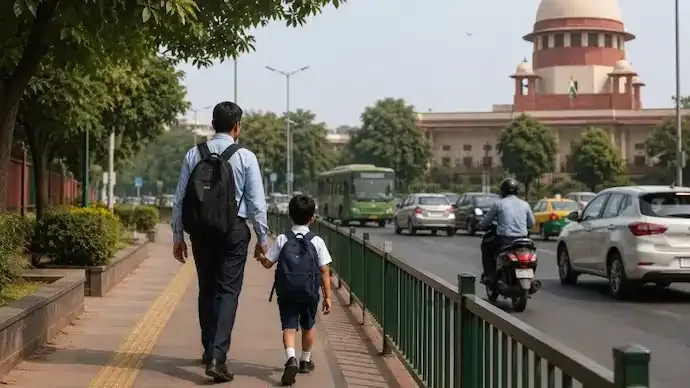
In a landmark judgment with far-reaching implications for urban planning and public infrastructure, the Supreme Court of India has declared that the right to walk on safe and properly demarcated footpaths is a fundamental right protected under Articles 19 and 21 of the Constitution.
The ruling establishes that public authorities have a legal and enforceable obligation to provide and maintain footpaths wherever roads exist, placing pedestrian rights at the center of urban development and transportation planning.
The decision is being hailed as one of the most significant judgments for pedestrian safety and public accessibility in recent years.
Supreme Court Recognises Walking as a Fundamental Right
The judgment was delivered by a Bench comprising Justice PS Narasimha and Justice AS Chandurkar.
The court held that the ability to walk safely on public roads is directly connected to constitutional rights, including personal liberty, dignity, and freedom of movement. By recognizing access to footpaths as a fundamental right, the court has elevated pedestrian safety from a policy matter to a constitutional obligation.
The ruling means government agencies and civic bodies can be held accountable for failing to provide adequate pedestrian infrastructure.
Public Authorities Given Clear Responsibility
One of the most important aspects of the judgment is the clear directive issued to public authorities.
The court stated that wherever roads are constructed or maintained, authorities must ensure the availability of safe and properly demarcated footpaths. This responsibility extends to planning, construction, maintenance, and protection of pedestrian pathways from encroachment and misuse.
The ruling could significantly influence how future road projects are designed across cities, towns, and rural areas in India.
Court Criticises Vehicle-Centric Urban Planning
The Bench observed that urban development in India has historically prioritized motor vehicles over pedestrians.
According to the court, city planning has often focused on expanding road networks for cars, buses, and other vehicles while neglecting the basic needs of people who walk. As a result, pedestrians have frequently been forced to share road space with traffic, increasing the risk of accidents and injuries.
The judgment acknowledges that pedestrians are among the most vulnerable road users and deserve greater protection.
Major Boost for Pedestrian Safety
Road safety experts have long argued that the absence of proper footpaths contributes significantly to accidents involving pedestrians.
The Supreme Court's ruling is expected to strengthen efforts to create safer and more accessible urban environments. Better footpaths can improve mobility for children, senior citizens, persons with disabilities, and daily commuters who rely on walking as part of their routine transportation.
The decision also aligns with global efforts promoting sustainable and pedestrian-friendly cities.
Impact on Indian Cities and Infrastructure Projects
The judgment is likely to influence infrastructure policies across India. Municipal corporations, urban development authorities, public works departments, and state governments may now be required to review existing road designs and ensure compliance with pedestrian safety standards.
Experts believe the ruling could lead to increased investment in footpath construction, accessibility improvements, safer crossings, and pedestrian-focused urban planning initiatives.
For millions of Indians who walk daily for work, education, and essential activities, the verdict marks a significant recognition of their rights and safety.
A Landmark Step Towards Inclusive Mobility
The Supreme Court's decision reinforces the principle that roads are not exclusively meant for vehicles but must serve all users equally.
By declaring access to safe footpaths a fundamental right, the court has emphasized that mobility, dignity, and public safety are essential components of constitutional protections. The ruling is expected to shape future urban planning decisions and strengthen the rights of pedestrians across the country.
Prev Article
Uddhav Thackeray Rejects Congress Merger Rumours Amid Fresh Shiv Sena UBT Rebellion
Next Article
Heavy Security Deployed in Delhi Ahead of Cockroach Janta Party Protest at Jantar Mantar