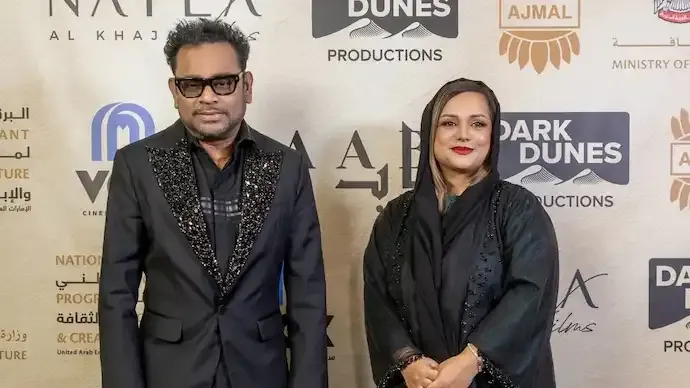
UAE’s first female filmmaker Nayla Al Khaja has come out strongly in support of legendary composer AR Rahman amid the controversy surrounding his recent remarks on alleged communal bias within the Indian film industry. Describing Rahman as a “national treasure,” Al Khaja urged people to respond with empathy and respect rather than outrage.
Rahman recently sparked debate after suggesting that he had experienced a decline in work opportunities due to shifting power dynamics in the film industry, while also hinting at possible communal undercurrents. His comments triggered mixed reactions from fans and members of the film fraternity, with some supporting his candour and others questioning his claims.
Nayla Al Khaja shares personal experience
Taking to Instagram, Nayla Al Khaja shared a deeply personal note based on her own interactions with the Oscar-winning composer. She emphasised that her words were not opinions formed from afar, but reflections drawn from lived moments.
She recalled witnessing Rahman patiently interacting with fans despite being surrounded by crowds. According to her, he repeatedly paused to smile, take photographs, and acknowledge people with quiet warmth, making each individual feel valued. She also spoke about observing the genuine affection between Rahman and his children, noting that such natural bonds reveal the true character of a person.
“As an Arab, I came to know Indian music through him,” Al Khaja wrote, adding that Rahman’s music transcends language and geography, conveying emotion without translation. She stressed that his contribution goes far beyond cinema, shaping cultural understanding and global appreciation of Indian music.
‘Legends become easy to project onto’
In her post, Al Khaja reflected on how iconic figures often become targets of projection and controversy. She suggested that being a legend makes one more vulnerable to misinterpretation and public scrutiny, while simultaneously making it harder to protect their legacy.
Calling Rahman a “national treasure,” she asserted that such figures deserve dignity and respect, not noise and distortion. She concluded her message by urging people to choose “grace over outrage” and “love above hate,” thanking Rahman for being a role model whose humility and kindness resonate worldwide.
Background of the controversy
The debate began after Rahman spoke in an interview about feeling sidelined in recent years. While he acknowledged that bias is rarely expressed openly, he hinted that changes in industry leadership and underlying communal factors may have contributed to fewer opportunities.
His remarks drew sharp reactions. Actor Kangana Ranaut criticised Rahman, accusing him of being driven by negativity, while singer Shaan offered a more neutral view, stating that phases of reduced work are common for artists and not always linked to religion.
Support pours in from across borders
Nayla Al Khaja’s defence stands out because it comes from outside India, highlighting Rahman’s global influence and the cross-cultural impact of his work. Her statement reframed the conversation from controversy to compassion, reminding audiences of Rahman’s decades-long contribution to music and culture.
As discussions around representation and bias continue within the entertainment industry, Al Khaja’s message has resonated with many who see Rahman not just as a composer, but as a cultural bridge whose work has united audiences across nations.
Prev Article
Mrunal Thakur Wraps Shooting for Adivi Sesh’s Dacoit, March 2026 Release Confirmed
Next Article
Hrithik Roshan’s Bollywood Biceps Go Viral, Fans Ask: Really 52?