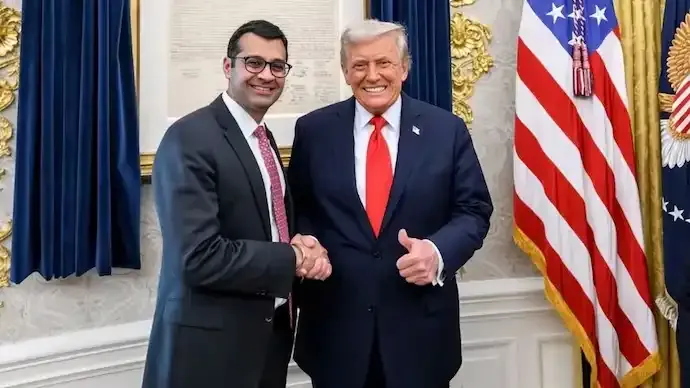
Indian-origin American official Ranjit ‘Ricky’ Gill has suddenly found himself at the centre of geopolitical debate after receiving a prestigious US government award for his alleged role in the India-Pakistan ceasefire following Operation Sindoor earlier this year. The recognition has sparked controversy in India, where authorities have repeatedly denied any third-party mediation in ending hostilities between the two nuclear-armed neighbours.
Gill, a senior official at the National Security Council (NSC) and a close adviser to Donald Trump, was recently conferred with the Distinguished Action Award. The honour was presented by Marco Rubio, though the Trump administration has not publicly detailed Gill’s specific contribution to the ceasefire process.
A Familiar Name, A Renewed Spotlight
Gill’s name is not new to American politics. Over a decade ago, as a 24-year-old Republican candidate contesting a California House seat, he was described by political observers as a possible “wunderkind”. While he narrowly lost that election, his career in policy and governance steadily advanced behind the scenes.
The latest award has catapulted the 37-year-old lawyer into public attention, especially in South Asia. Many analysts see the move as indirectly reinforcing President Trump’s long-standing claim that Washington played a role in facilitating the May 10 truce between India and Pakistan — a claim New Delhi has firmly rejected on multiple occasions.
India Pushes Back on Mediation Claims
India has consistently maintained that the cessation of hostilities followed direct communication between the Directors General of Military Operations (DGMOs) of India and Pakistan, without any foreign intervention. Prime Minister Narendra Modi has stated in Parliament that no external power asked India to halt Operation Sindoor.
Against this backdrop, Gill’s recognition has been viewed by several Indian strategic experts as unnecessary provocation. Former Foreign Secretary Kanwal Sibal termed the award “puzzling”, questioning why a mid-level NSC official would be credited when India had categorically denied US involvement.
Background and Career Trajectory
Born in New Jersey to Punjabi Sikh immigrant parents, both physicians, Gill entered public life early. At just 17, he was appointed by then-California Governor Arnold Schwarzenegger as the sole student member of the California State Board of Education.
Academically, Gill holds a bachelor’s degree from Princeton University’s Woodrow Wilson School of Public and International Affairs and a law degree from the University of California, Berkeley. During Trump’s first term, he served as director for Russia and European Energy Security at the NSC and was also involved in the controversial relocation of the US Embassy in Israel to Jerusalem.
Between his two stints in government, Gill worked as a policy adviser with TC Energy, the company behind the Keystone XL pipeline.
Why the Award Is Generating Buzz
In Trump’s second term, Gill oversees the sensitive South and Central Asia portfolio, including India, Pakistan and Afghanistan. He visited India in August amid trade and tariff tensions and discussions around the India-Middle East-Europe Economic Corridor (IMEC).
Now, the award linked to the India-Pakistan ceasefire has triggered intense debate on social media and among policy circles. Critics argue it risks reviving an already disputed narrative, while supporters see it as recognition of behind-the-scenes diplomatic engagement.
Whether Gill’s role was substantive or symbolic remains unclear. What is certain is that his sudden prominence has added a new layer of complexity to already delicate India-US-Pakistan dynamics.
Prev Article
Khaleda Zia Dies at 80: Bangladesh’s First Woman PM and Sheikh Hasina’s Historic Rival Passes Away
Next Article
“I’m Very Angry”: Trump Reacts to Putin’s Claim of Ukrainian Drone Attack on Residence