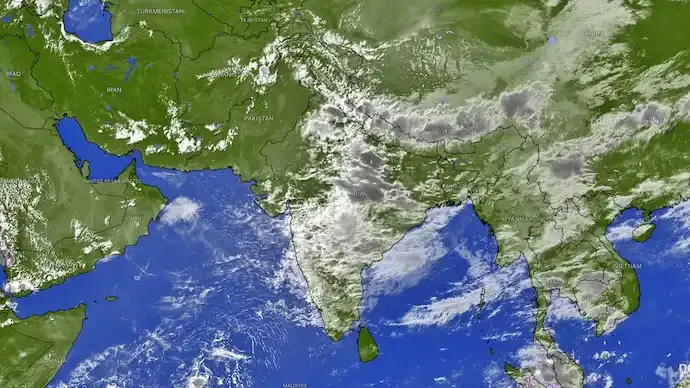
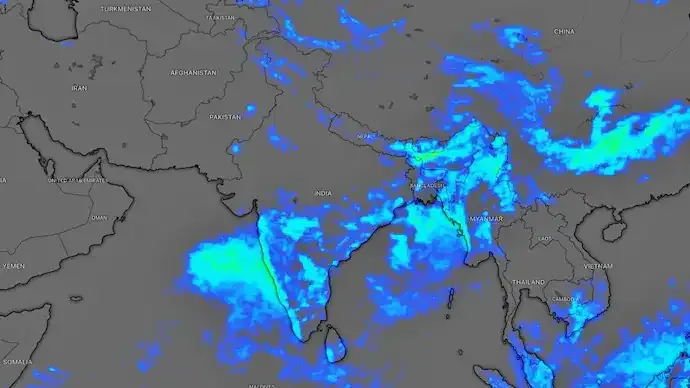
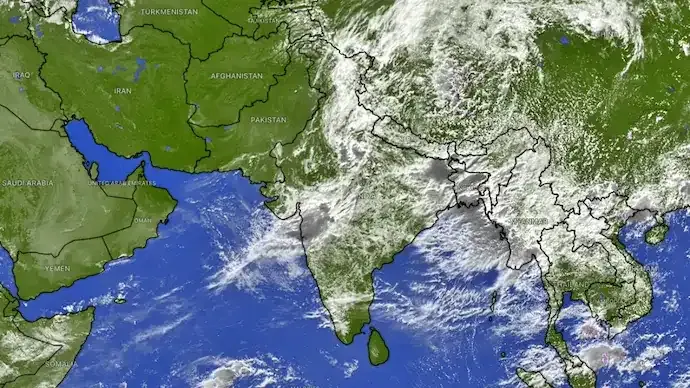
India's southwest monsoon is showing signs of weakening as satellite imagery reveals a noticeable decline in cloud cover over several regions of the country and the Bay of Bengal. The latest weather pattern has sparked renewed discussion over whether developing El Nino conditions could begin influencing India's rainfall during the remaining monsoon season.
While rainfall activity has not stopped entirely, meteorological indicators suggest that the intensity and spread of monsoon clouds have reduced compared to previous weeks.
Monsoon Activity Weakens Across Several Parts of India
Recent satellite observations indicate that dense monsoon cloud formations are gradually retreating from large parts of India. The reduction is visible not only over land but also across the Bay of Bengal, one of the primary moisture sources that fuels the southwest monsoon.
Although central India continues to witness active weather due to an existing low-pressure system, many northern and northwestern regions are beginning to experience fewer rain-bearing clouds.
Meteorologists say the current low-pressure system remains the dominant driver of rainfall across central India, but its influence is becoming more localized rather than widespread.
Bay of Bengal Cloud Cover Declines
A significant concern is the decreasing cloud activity over the Bay of Bengal. This region supplies moisture that helps generate monsoon depressions and rain systems moving inland.
A reduction in organized cloud formation over the bay could weaken the transportation of moisture toward the Indian subcontinent, limiting the development of new rainfall systems in the coming days.
If this trend continues, rainfall distribution may become increasingly uneven across different parts of the country.
Monsoon Trough Shifts Southward
Weather experts are also monitoring the southward movement of the monsoon trough, a development that typically changes the distribution of rainfall across India.
With the trough moving south, northern states such as Delhi-NCR, Haryana, Punjab and Uttar Pradesh are expected to witness largely dry conditions with only isolated showers.
Most rainfall over these regions is likely to remain localized and short in duration rather than widespread.
El Nino Could Influence Remaining Monsoon Season
The latest weather developments coincide with growing attention on evolving El Nino conditions over the Pacific Ocean.
El Nino is known for altering global atmospheric circulation and has historically been linked to weaker Indian summer monsoons in several years. However, its impact varies depending on the strength and timing of the event, meaning every season behaves differently.
At present, scientists are closely monitoring whether the recent reduction in cloud cover marks a temporary fluctuation or the beginning of a broader weakening phase influenced by El Nino.
Monsoon Has Not Ended Yet
Despite the declining cloud cover, weather experts emphasize that the southwest monsoon has not collapsed.
Active rainfall-producing systems continue to remain over central India, supporting moderate to heavy rainfall in several areas. However, the rapid reduction in clouds over other regions suggests that rainfall activity may become less widespread if current conditions persist.
For residents across northern India, the coming days are expected to bring warmer weather, higher humidity and occasional localized rainfall instead of prolonged wet spells.
Key Highlights
- Satellite imagery shows declining monsoon cloud cover across large parts of India.
- Cloud activity has also reduced significantly over the Bay of Bengal.
- Central India continues receiving rainfall due to an active low-pressure system.
- The monsoon trough is shifting southward, reducing rainfall over northern India.
- Delhi-NCR, Haryana, Punjab and Uttar Pradesh may witness mainly dry weather.
- Scientists are closely monitoring the possible return of El Nino conditions.
- El Nino could weaken rainfall distribution if its influence strengthens.
- The southwest monsoon remains active despite signs of weakening.
FAQs
1. Why is India's monsoon cloud cover decreasing?
Satellite observations indicate a reduction in cloud formation due to changing atmospheric conditions and shifting weather systems.
2. Has the southwest monsoon ended in India?
No. The monsoon is still active, particularly over central India where a low-pressure system continues to generate rainfall.
3. What is El Nino?
El Nino is a climate pattern involving warmer-than-normal Pacific Ocean temperatures that can influence weather worldwide, including India's monsoon.
4. How does El Nino affect the Indian monsoon?
El Nino often weakens monsoon circulation, leading to reduced or uneven rainfall, although its impact differs with each event.
5. Why is the Bay of Bengal important for the monsoon?
The Bay of Bengal supplies moisture that helps develop rain-bearing systems moving across India.
6. Which regions may receive less rainfall?
Northern states including Delhi-NCR, Haryana, Punjab and Uttar Pradesh are expected to see reduced rainfall with only isolated showers.
7. Is central India still receiving rainfall?
Yes. An active low-pressure system continues to support rainfall over central India.
8. What does the southward shift of the monsoon trough mean?
It shifts the primary rainfall zone southward, reducing widespread rain across northern India.
9. Could rainfall increase again later this season?
Yes. Future low-pressure systems and atmospheric changes could revive rainfall in some regions.
10. Should people be concerned about the current weather pattern?
The situation is being monitored closely. While rainfall has weakened in some areas, the monsoon remains active and weather conditions may still change.