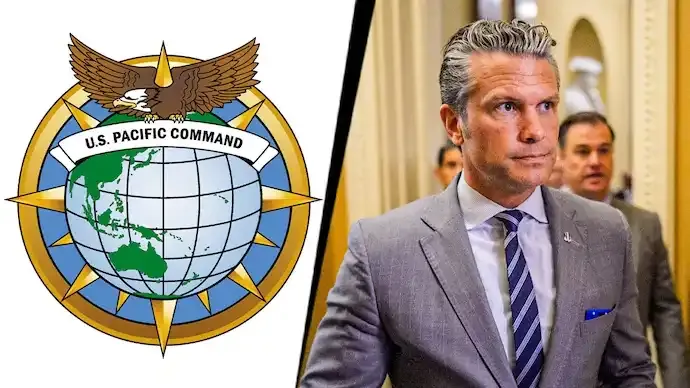
The decision by the administration of Donald Trump to restore the historic US Pacific Command (USPACOM) name has triggered fresh debate among defense and geopolitical experts about America's long-term strategy in the Indo-Pacific region.
The move reverses the 2018 decision that renamed the command as the US Indo-Pacific Command (INDOPACOM), a change that was widely viewed as a signal of Washington's growing strategic interest in the Indian Ocean Region (IOR) and its efforts to counter China's expanding influence.
Now, the restoration of the older name has raised questions about whether the United States is reassessing its regional priorities amid evolving global challenges.
Why the Name Change Matters
In geopolitics, names often reflect strategic priorities.
The shift from Pacific Command to Indo-Pacific Command in 2018 was not merely symbolic. It acknowledged the growing importance of the Indian Ocean in global trade, security and great-power competition.
The term "Indo-Pacific" emphasized the interconnected nature of the Pacific and Indian Oceans and highlighted the strategic role of countries such as India, Australia and Japan in maintaining regional stability.
For many analysts, the 2018 renaming represented a broader vision of regional security beyond East Asia.
Restoration of USPACOM Sparks Questions
The decision to restore the Pacific Command designation has generated speculation within strategic circles.
Some experts believe the move could indicate a renewed focus on the Pacific theater, particularly amid rising tensions in the South China Sea and concerns over China's military activities near Taiwan.
Others argue that the change is largely administrative and should not be interpreted as a major shift in military strategy.
However, given the importance attached to geopolitical messaging, the decision has inevitably attracted international attention.
Concerns About the Indian Ocean Region
The timing of the move has fueled concerns among some observers.
The Indian Ocean has become increasingly important in global geopolitics due to:
-
Major shipping routes
-
Energy supply chains
-
Strategic naval bases
-
Growing Chinese maritime presence
-
Regional security partnerships
Countries across the region have viewed the Indo-Pacific framework as a mechanism for balancing China's influence while strengthening cooperation among democratic powers.
Any perceived reduction in US focus on the region is therefore being closely scrutinized.
What It Means for India
India has been one of the key pillars of the Indo-Pacific strategy.
Through forums such as the Quadrilateral Security Dialogue (Quad), India has played an increasingly important role in regional security discussions.
The Indo-Pacific concept also elevated India's strategic importance in American foreign policy.
As a result, analysts in New Delhi are closely examining whether the command name change signals any broader adjustment in Washington's approach toward the Indian Ocean and regional partnerships.
Is the US Abandoning the Indo-Pacific?
Many defense experts caution against drawing conclusions solely from a name change.
The United States continues to maintain significant military assets, naval deployments and security partnerships throughout the Indo-Pacific region.
American strategic interests in the Indian Ocean remain substantial due to:
-
Maritime trade security
-
Counterterrorism operations
-
Energy supply routes
-
Competition with China
-
Defense cooperation with regional partners
Most analysts believe these interests are unlikely to disappear simply because of a command renaming.
China's Growing Influence Remains a Factor
Any discussion about US regional strategy inevitably involves China.
Beijing has expanded its economic, naval and diplomatic footprint across the Indo-Pacific over the past decade.
From the South China Sea to ports in the Indian Ocean, China's growing presence has been a central factor shaping American defense planning.
Many experts argue that competition with China will continue to drive US engagement in both the Pacific and Indian Ocean regions regardless of the command's official title.
Debate Over US Global Commitments
The decision also comes amid broader discussions about America's role in international affairs.
Recent foreign policy decisions have prompted debate over whether Washington is reducing its commitments in certain regions while concentrating resources elsewhere.
Supporters of the administration argue that strategic realignment is necessary to address emerging challenges.
Critics fear that perceived withdrawals could create opportunities for rival powers to expand their influence.
The command renaming has therefore become part of a larger conversation about America's global posture.
What Defense Analysts Are Saying
Many strategic experts view the restoration of the Pacific Command name as symbolic rather than transformational.
While the change may alter perceptions, there is currently little evidence that the United States intends to abandon the Indian Ocean Region or significantly reduce its engagement with key regional partners.
Military cooperation, joint exercises, intelligence sharing and strategic partnerships continue across the Indo-Pacific.
Analysts suggest that future policy decisions and resource allocations will provide a clearer indication of Washington's long-term intentions than the name itself.
The restoration of the US Pacific Command name has reignited debate over America's Indo-Pacific strategy and its commitment to the Indian Ocean Region. While the move has raised questions about shifting priorities, most experts believe the United States remains deeply invested in the region due to its strategic importance and growing competition with China.
Whether the change represents a symbolic adjustment or the beginning of a broader policy shift will likely become clearer through future defense and foreign policy decisions.