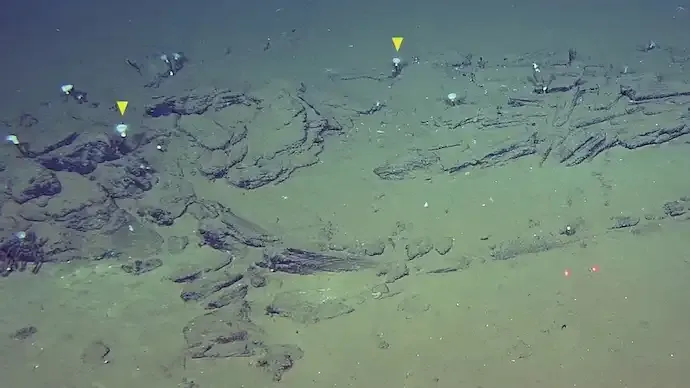
Scientists have discovered what is believed to be the world's deepest and largest whale graveyard in the southeastern Indian Ocean, uncovering a remarkable underwater site filled with ancient whale remains and thriving deep-sea ecosystems.
The groundbreaking discovery was made in the remote Diamantina Fracture Zone, a vast underwater region located in the southeastern Indian Ocean. Researchers say the site offers a rare glimpse into millions of years of whale history while revealing how whale carcasses continue to sustain life in some of the deepest parts of Earth's oceans.
The findings have been published in the prestigious scientific journal Nature.
What Scientists Found
The international research team identified numerous whale skeletons scattered across the deep ocean floor, including fossilized remains that date back millions of years.
Among the discoveries were:
-
Ancient whale bones
-
Fossilised whale remains
-
Active whale-fall sites
-
Deep-sea organisms feeding on whale carcasses
-
Evidence of long-term ecosystem development
Researchers believe the area has served as a natural resting place for whales over an extended geological period, creating what is effectively a massive underwater graveyard.
What Is a Whale Fall?
A whale fall occurs when a whale dies and its body sinks to the ocean floor.
Once on the seabed, the carcass becomes a crucial source of nutrients for deep-sea organisms.
These ecosystems can support life for decades and often attract a wide range of species, including:
-
Deep-sea worms
-
Crustaceans
-
Molluscs
-
Bacteria
-
Scavenging fish
Scientists describe whale falls as "islands of life" in the otherwise nutrient-poor depths of the ocean.
Deep-Sea Life Thriving Around the Remains
One of the most exciting aspects of the discovery is the presence of active whale-fall ecosystems.
Researchers observed thriving biological communities around recently deposited whale remains, demonstrating how these massive marine mammals continue to support life even after death.
The nutrient-rich carcasses create unique habitats that allow specialized organisms to survive in extreme deep-sea environments.
Scientists say these ecosystems provide valuable insights into biodiversity and adaptation in some of Earth's most challenging habitats.
Clues to Whale Evolution
Beyond the ecological importance of the site, the whale graveyard may also help scientists better understand whale evolution.
The fossilized remains represent different periods in whale history and could provide information about:
-
Ancient whale species
-
Migration patterns
-
Evolutionary changes
-
Population distribution
-
Marine environmental conditions
Researchers believe the site could become one of the most significant locations for studying the evolutionary history of whales.
Discovery Made by International Team
The research was conducted by scientists from:
-
The Chinese Academy of Sciences
-
The University of Pisa
-
Earth Sciences New Zealand
The collaboration combined expertise in marine biology, paleontology, geology, and deep-sea exploration.
Advanced underwater exploration technologies were used to map the area and study the remains located thousands of meters below the ocean's surface.
Why the Diamantina Fracture Zone Is Important
The Diamantina Fracture Zone is one of the least explored regions of the Indian Ocean.

Its extreme depth and remote location have limited scientific access for decades.
The newly discovered whale graveyard highlights the region's importance as a reservoir of both biological and geological information.
Scientists believe further exploration could reveal additional fossil deposits and previously unknown marine species.
A Window Into Earth's Deep Past
The discovery provides a rare opportunity to connect modern marine ecosystems with ancient ocean history.
By studying both fossilized and recent whale remains in the same location, researchers can examine how deep-sea environments have changed over millions of years.
The site effectively serves as a natural archive preserving evidence of:
-
Marine evolution
-
Climate changes
-
Ocean biodiversity
-
Deep-sea ecological processes
Deep Ocean Still Holds Many Mysteries
Despite advances in technology, large portions of the world's oceans remain unexplored.
Scientists estimate that only a small fraction of the deep seafloor has been thoroughly studied.
The discovery of the whale graveyard serves as a reminder that significant scientific discoveries continue to lie hidden beneath the ocean surface.
Researchers believe many more unknown ecosystems and fossil sites may still await discovery in the deep sea.
Landmark Discovery for Marine Science
The whale graveyard in the Indian Ocean is being hailed as one of the most significant marine discoveries of recent years.
By linking ancient whale remains with active deep-sea ecosystems, the site offers a unique opportunity to study both the past and present of marine life.
As scientists continue investigating the area, the discovery is expected to deepen our understanding of whale evolution, ocean biodiversity, and the extraordinary ecosystems that exist far below the reach of sunlight.
Prev Article
Anthropic Shuts Down Fable 5 and Mythos 5 Worldwide After US Government Restriction
Next Article
Microsoft Turns to Amazon to Support GitHub as AI Boom Triggers Global Computing Capacity Crunch