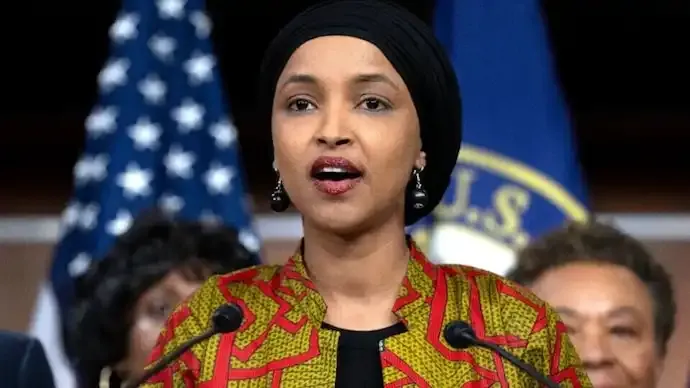
US Congresswoman Ilhan Omar has sparked fresh controversy after making critical remarks about India during a Muslim-American community event in the United States. Her comments, which included allegations regarding the condition of minorities in India, have drawn strong reactions from political observers, members of the Indian diaspora and commentators across social media.
The controversy has once again placed Omar at the center of debates involving India-US relations, minority rights and international political discourse.
What Did Ilhan Omar Say?
Speaking at an event organized by the Indian American Muslim Council, Omar made remarks criticizing India's social and political environment.
Her comments included allegations related to the treatment of minorities and broader concerns about democratic institutions, triggering immediate backlash from critics who accused her of presenting a distorted picture of India.
The remarks quickly gained attention online and became a topic of discussion among political groups in both India and the United States.
Why the Remarks Sparked Controversy
Critics argue that Omar's statements overlook India's democratic framework, constitutional protections and the participation of minority communities in public life.
Supporters of India pointed to the country's diverse social structure, representation of minorities in government, judiciary, business and public institutions, and the continued growth of minority populations over the decades.
Many commentators described the remarks as politically motivated and disconnected from ground realities.
The controversy has reignited discussions about how international political figures portray India's internal affairs.
Ilhan Omar's Past Positions on India
This is not the first time Omar's views on India have attracted attention.
The US lawmaker has previously commented on issues related to Kashmir, religious freedom and human rights in India. Her positions have often been criticized by Indian policymakers and members of the Indian diaspora who view them as one-sided.
Several of her earlier statements have also generated diplomatic and political reactions in both countries.
As a result, her latest remarks were quickly interpreted within the context of her broader record on India-related issues.
India's Diversity and Democratic Structure
India is home to one of the world's most diverse populations, with multiple religions, languages and ethnic communities living across the country.
Minority communities have historically held prominent positions in various sectors, including politics, science, education, defense, business and the judiciary.
Supporters of India's democratic model argue that the country's constitutional framework guarantees equal rights and protections to all citizens regardless of religion or background.
These factors have been cited by critics responding to Omar's comments.
Indian Diaspora Reacts
Members of the Indian diaspora in the United States expressed differing views following the controversy.
While some groups supported discussions around human rights and minority issues, others criticized what they described as unfair and exaggerated portrayals of India.
The debate highlighted the diversity of opinions within Indian-origin communities abroad regarding political developments in India.
Social media platforms saw intense exchanges between supporters and critics of Omar's remarks.
Impact on India-US Political Discourse
Although individual lawmakers do not determine foreign policy, comments from members of the US Congress often attract international attention.
Political analysts note that statements involving India frequently become part of broader discussions about democracy, human rights and international relations.
However, experts also point out that strategic ties between India and the United States continue to expand across defense, technology, trade and security cooperation.
As a result, such controversies rarely alter the overall trajectory of bilateral relations.
Broader Debate on International Commentary
The episode has also revived debate over the role of foreign politicians in commenting on domestic issues of other nations.
Supporters argue that elected representatives have the right to speak on global human rights concerns.
Critics contend that external commentary should be based on balanced assessments and a full understanding of local realities.
The differing perspectives continue to shape international political discussions involving major democracies.
Ilhan Omar's latest remarks about India have generated significant controversy and renewed debate over how the country is portrayed on international platforms. While critics argue that her comments misrepresent India's democratic and social realities, supporters maintain that global leaders should continue discussing human rights concerns.
The controversy underscores the continuing sensitivity surrounding discussions of India in international political forums and among diaspora communities worldwide.