Shopping cart
Your cart empty!


Your cart empty!
Terms of use dolor sit amet consectetur, adipisicing elit. Recusandae provident ullam aperiam quo ad non corrupti sit vel quam repellat ipsa quod sed, repellendus adipisci, ducimus ea modi odio assumenda.
Lorem ipsum dolor sit amet consectetur adipisicing elit. Sequi, cum esse possimus officiis amet ea voluptatibus libero! Dolorum assumenda esse, deserunt ipsum ad iusto! Praesentium error nobis tenetur at, quis nostrum facere excepturi architecto totam.
Lorem ipsum dolor sit amet consectetur adipisicing elit. Inventore, soluta alias eaque modi ipsum sint iusto fugiat vero velit rerum.
Sequi, cum esse possimus officiis amet ea voluptatibus libero! Dolorum assumenda esse, deserunt ipsum ad iusto! Praesentium error nobis tenetur at, quis nostrum facere excepturi architecto totam.
Lorem ipsum dolor sit amet consectetur adipisicing elit. Inventore, soluta alias eaque modi ipsum sint iusto fugiat vero velit rerum.
Dolor sit amet consectetur adipisicing elit. Sequi, cum esse possimus officiis amet ea voluptatibus libero! Dolorum assumenda esse, deserunt ipsum ad iusto! Praesentium error nobis tenetur at, quis nostrum facere excepturi architecto totam.
Lorem ipsum dolor sit amet consectetur adipisicing elit. Inventore, soluta alias eaque modi ipsum sint iusto fugiat vero velit rerum.
Sit amet consectetur adipisicing elit. Sequi, cum esse possimus officiis amet ea voluptatibus libero! Dolorum assumenda esse, deserunt ipsum ad iusto! Praesentium error nobis tenetur at, quis nostrum facere excepturi architecto totam.
Lorem ipsum dolor sit amet consectetur adipisicing elit. Inventore, soluta alias eaque modi ipsum sint iusto fugiat vero velit rerum.
Do you agree to our terms? Sign up
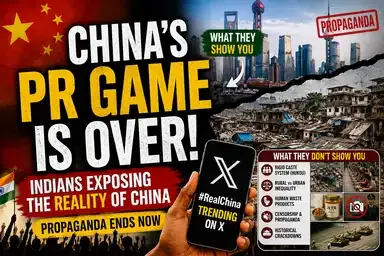
For years, social media has been flooded with videos showcasing China's futuristic cities, high-speed trains, massive infrastructure projects and technological achievements. From Shanghai's skyline to Beijing's smart-city initiatives, China has successfully built an image of being the world's ultimate development model.
But now, a new trend led by Indian users on X is attempting to challenge that narrative.

Over the past few days, hundreds of posts, memes, infographics and discussion threads have gone viral, claiming that the world only sees China's polished image while ignoring several uncomfortable realities hidden beneath the surface. The campaign has quickly become one of the most discussed geopolitical conversations among Indian social media users.
The viral posts argue that global audiences are constantly shown China's best-performing cities while rarely seeing the country's rural regions, economic disparities and social restrictions.

Many users have been sharing images and videos discussing:
Supporters of the trend claim that China's global image has been carefully curated through years of state-backed messaging and social media influence.

One of the most discussed topics in the viral campaign is China's Hukou system, a household registration framework that classifies citizens based on their place of birth and residency status.

Critics argue that the system creates barriers between rural and urban residents by affecting access to public services such as education, healthcare, housing benefits and employment opportunities. Some analysts and commentators have even compared the system to a birth-based social classification structure, although experts note it is different from India's caste system.

The issue has become central to the online debate as users question why international discussions often focus heavily on India's social problems while rarely discussing China's internal inequalities.

Another topic gaining traction is China's historical social hierarchy.
Several viral posts reference the traditional "Shi-Nong-Gong-Shang" structure, which historically categorized society into scholars, farmers, artisans and merchants. Historians note that while this was a social hierarchy, it was not identical to the caste system seen in South Asia.
The discussion has sparked widespread comparisons between historical social structures in different civilizations and how they continue to influence modern societies.
The trend is about more than China alone.
Many participants view it as a response to years of online content that highlighted India's poverty, sanitation challenges and caste issues while portraying China as a flawless success story.

Users argue that every country has strengths and weaknesses and that selective storytelling creates distorted perceptions.
According to supporters, the campaign aims to present a broader picture rather than relying solely on viral infrastructure videos.
The timing is significant.
As geopolitical competition between India and China continues across trade, technology and regional influence, social media has become a new battleground for public perception.
The rise of short-form content has amplified national image campaigns, making platforms like X increasingly important in shaping international narratives.
Many viral posts are attracting millions of views and generating debates far beyond India.
Not everyone agrees with the trend.
Critics argue that isolated images and selective examples cannot accurately represent a nation of more than 1.4 billion people.
Others point out that every major country faces regional inequalities and social challenges.
They caution that viral campaigns can sometimes replace nuanced discussion with political messaging and online nationalism.
Whether one agrees with the campaign or not, the trend highlights a growing reality: national reputations are increasingly being shaped on social media rather than through traditional media channels.
For years, China successfully projected an image centered on economic growth, infrastructure and technological advancement. Now, many Indian users believe it is time to spotlight the issues that receive far less international attention.
The result is a rapidly growing online movement that claims one thing above all else — the era of one-sided narratives is coming to an end.
5
Published: Jun 18, 2026

All India Story is your trusted source for comprehensive and up-to-the-minute news coverage across India. Bringing you the latest on politics, business, technology, entertainment, sports, and more, we are dedicated to keeping you informed with accurate, engaging, and insightful stories from every corner of the nation.