
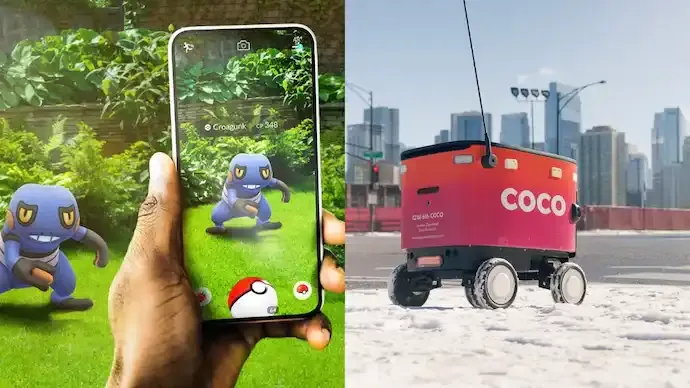
Millions of players who spent hours exploring their surroundings in Pokémon Go may not realise it, but their gameplay has contributed to building a powerful real-world AI system.
Game developer Niantic has used data collected from players to create a highly accurate AI navigation system, now being deployed to guide delivery robots in cities.
How Players Trained an AI Without Knowing
While playing Pokémon Go, users often scan their surroundings using their phone cameras to interact with virtual objects placed in real-world locations.
These scans helped Niantic build a detailed 3D map of the physical world, capturing:
-
Streets and pathways
-
Buildings and landmarks
-
Public spaces and navigation routes
Over time, with contributions from over 500 million players, this data became rich enough to train advanced AI systems.
Turning Game Data into Real-World Technology
Niantic has transformed this massive dataset into an AI-powered navigation system capable of understanding real-world environments with high accuracy.
The system can:
-
Identify obstacles and pathways
-
Navigate complex urban environments
-
Adapt to real-time surroundings
This goes beyond traditional GPS, which often lacks precision in dense urban areas.
Use in Delivery Robots
The same AI technology is now being used to guide autonomous delivery robots in selected cities.
These robots rely on the AI system to:
-
Move safely on sidewalks
-
Avoid obstacles
-
Reach destinations efficiently
This marks a major step in integrating gaming data into real-world applications.
Why This Is a Big Deal
The development highlights how everyday digital activities can contribute to large-scale technological advancements.
Key implications include:
-
Faster progress in autonomous navigation
-
Improved urban mapping systems
-
New use cases for augmented reality data
It also shows how crowdsourced data can be used to train AI systems at a global scale.
Blurring the Line Between Gaming and AI
Pokémon Go was initially designed as an entertainment experience, but it has now evolved into a data-driven platform supporting AI innovation.
Players, while catching virtual creatures, were effectively helping machines learn how to understand and navigate the real world.
Future of AI Navigation
As companies continue to collect and refine real-world data, AI navigation systems are expected to become even more advanced.
Technologies developed through such platforms could soon power:
-
Self-driving vehicles
-
Smart city infrastructure
-
Advanced robotics
Niantic’s approach demonstrates how combining gaming, augmented reality, and AI can create powerful real-world solutions.


