

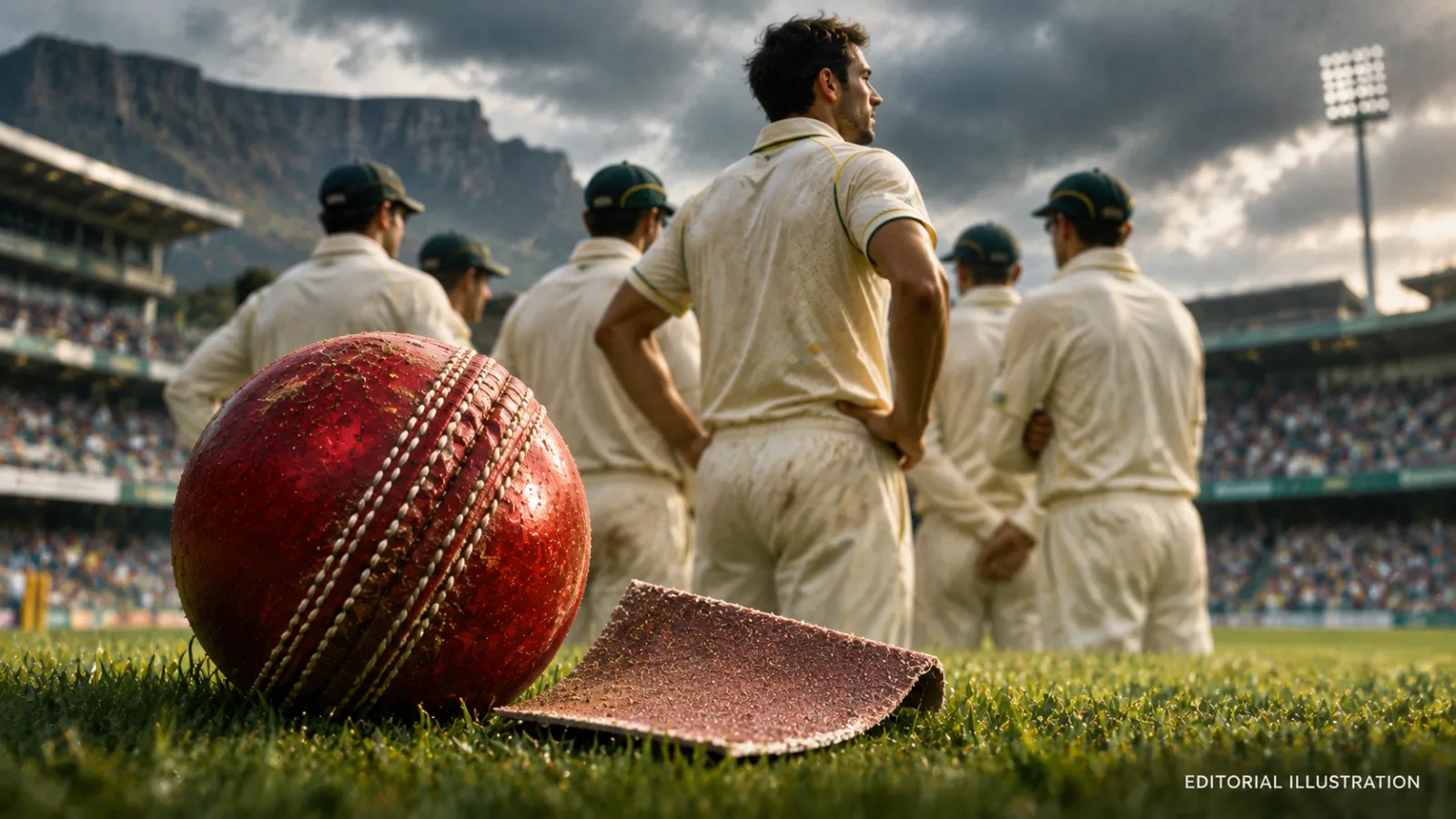

SYDNEY, November 10, 2026: Australian fast bowler Mitchell Starc has rejected suggestions that he knew about the use of sandpaper during the 2018 Cape Town Test, standing by his earlier account after former teammate Usman Khawaja made fresh allegations about the ball-tampering scandal.
Speaking to reporters in Sydney on Tuesday, Starc said he had no reason to change the position he outlined alongside Australia's other frontline bowlers in 2021.
His comments came as Khawaja's autobiography, Sabr, renewed questions about how much of the Australian dressing room knew about attempts to alter the condition of the ball during the South Africa tour.

The competing accounts have placed one of Australian cricket's most damaging controversies back in the headlines, eight years after three players were sanctioned.
Mitchell Starc Stands by His 2021 Sandpapergate Statement
Starc was questioned about Khawaja's allegations during a media event marking the launch of Australia's home cricket season.
He acknowledged that different players had offered different recollections of the 2018 events but maintained that his own account remained consistent.
"My opinion hasn't changed," Starc told reporters, referring to the statement issued by Australia's four specialist bowlers in 2021.
Starc, Pat Cummins, Josh Hazlewood and Nathan Lyon had jointly said they were unaware that a foreign substance had been taken onto the field to alter the cricket ball during the third Test against South Africa in Cape Town.
The bowlers said they first learned what had happened when images of Cameron Bancroft's actions appeared on the stadium's big screen.
On Tuesday, Starc reiterated that account while making clear he was speaking only for himself, rather than on behalf of the other bowlers.
His remarks directly challenge the suggestion that he knew sandpaper was being carried onto the field.
They do not, however, resolve every allegation contained in Khawaja's book, including claims about attempts to alter the ball before play began.
What Has Usman Khawaja Claimed in His Book Sabr?
Khawaja's autobiography has reopened debate about the events surrounding Australia's 2018 tour of South Africa.
In the book, the former Australian opener alleges that knowledge of ball tampering extended beyond the three players who were ultimately punished.
He also claims that sandpaper had been used during the second Test at St George's Park in Port Elizabeth, now known as Gqeberha, before the plan was exposed in Cape Town.
According to accounts of the book published by Australian media, Khawaja believes the responsibility for the scandal was not shared fairly across the team.
He has argued that captain Steve Smith, vice-captain David Warner and batter Cameron Bancroft became the principal targets of disciplinary action despite wider awareness of what was happening.
Those claims remain disputed.
Starc said the allegation concerning the second Test was new to him and that he had not previously known about any use of sandpaper at Port Elizabeth.
He also indicated that he had not read Khawaja's book.
David Warner Supports Khawaja's Version of Events
Khawaja has received public support from David Warner, one of the three players sanctioned in 2018.
Warner endorsed his former teammate's account and criticised Cricket Australia's original investigation.
His intervention has added weight to demands for a more complete explanation of the events, particularly because Warner was directly involved in the scandal.
However, other members of the 2018 squad have continued to dispute suggestions that knowledge of the tampering plan was widespread.
The disagreement means there is still no common public account of precisely who knew what, and when.
For Starc, the central point remains whether he knew that sandpaper was being taken onto the field during the Cape Town Test.
He maintains that he did not.
What Happened During Australia's 2018 Sandpapergate Scandal?
The controversy began during the third Test between Australia and South Africa at Newlands, Cape Town, in March 2018.
Television cameras captured Cameron Bancroft attempting to alter the condition of the ball using a piece of abrasive material.
The incident prompted an investigation by Cricket Australia and widespread criticism of the team's conduct.
The governing body subsequently imposed suspensions on three players.
Steve Smith and David Warner received 12-month playing bans, while Bancroft was suspended for nine months.
Smith and Warner also faced leadership restrictions.
The episode caused significant reputational damage to Australian cricket and raised broader questions about team culture, leadership and sporting ethics.
In 2021, the controversy resurfaced when comments by Bancroft led to speculation about whether Australia's bowlers had been aware of the tampering.
Starc, Cummins, Hazlewood and Lyon responded with a joint statement denying prior knowledge of the foreign substance being carried onto the field.
Khawaja's latest allegations have brought that same dispute back into public discussion.
Cricket Australia Rules Out Fresh Sandpapergate Investigation
Despite the renewed controversy, Cricket Australia has decided against reopening its investigation.
Chief executive Todd Greenberg said on Tuesday that the governing body had reviewed Khawaja's latest claims and spoken with members of the 2018 touring squad.
Greenberg acknowledged that several accounts contradicted one another, but said the organisation did not believe another inquiry would produce a useful outcome.
Cricket Australia remains satisfied with the findings of its original investigation, which resulted in sanctions against Smith, Warner and Bancroft.
The governing body has not announced any new disciplinary proceedings.
Its position has drawn attention because the allegations concern both the fairness of the original penalties and the accuracy of the accounts provided by those involved.
For now, Cricket Australia considers the matter closed.
Why Sandpapergate Continues to Divide Australian Cricket
Eight years after the Cape Town incident, the central disagreement is no longer whether ball tampering occurred. That was established during the original investigation.
The unresolved debate concerns the extent of knowledge within the Australian dressing room and whether responsibility was shared more widely than the official disciplinary findings recognised.
Khawaja's memoir and Warner's endorsement have challenged the accepted account.
Starc's response, meanwhile, underscores that not everyone involved remembers events in the same way.
With Cricket Australia ruling out another investigation, the competing versions are unlikely to be tested through a new formal disciplinary process.
The controversy remains a difficult chapter in Australian cricket's history, one that continues to generate questions even as the governing body seeks to move forward.








Conversation
Be kind and stay on topic. Comments are moderated; abuse, spam and personal attacks are removed. Report a problem