

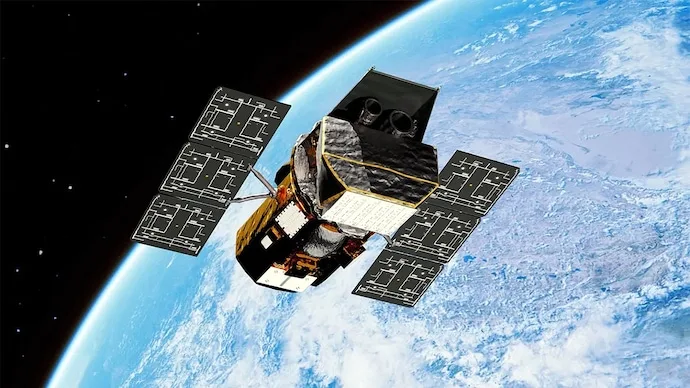

The NASA Swift telescope crash is believed to have taken place on Wednesday, November 4, after the Neil Gehrels Swift Observatory lost altitude rapidly due to increased atmospheric drag. NASA has not yet officially confirmed the spacecraft’s re-entry.
The 1,450-kg space observatory was expected to return to Earth around 2 pm IST, according to a prediction by the US Space Force. However, the estimated timing carried a possible variation of up to 11 hours.
Most of the spacecraft was expected to burn up while passing through Earth's atmosphere, although some components could potentially survive the descent and reach the ground.

Why Did NASA's Swift Observatory Lose Altitude?
Launched in November 2004, Swift was initially designed for a two-year mission to study gamma-ray bursts, among the most powerful explosions in the universe. However, it continued operating for almost 22 years, observing black holes, exploding stars, comets and other cosmic phenomena.
Its final descent was accelerated by increased solar activity. The resulting heating and expansion of Earth's upper atmosphere increased drag on satellites in low Earth orbit.
This atmospheric resistance gradually slowed Swift and pulled it into a lower orbit. The observatory did not have sufficient power to manoeuvre itself back to a higher altitude.
By October 20, the spacecraft had reached approximately 275 kilometres above Earth and could no longer compensate for the increasing drag.
How the Attempt to Rescue Swift Failed
NASA had attempted to save the observatory through a commercial spacecraft called Link, developed by Katalyst Space. The plan was to attach Link to Swift and push it into a higher orbit.
Link launched in July 2026 but experienced intermittent communication losses and difficulties controlling its orientation.
Following troubleshooting efforts, NASA and Katalyst abandoned the planned docking and orbit-boost operation in August.
NASA Astrophysics Division Director Shawn Domagal-Goldman described the rescue effort as a high-risk, high-reward mission. Although unsuccessful, it generated information that could support future satellite-servicing operations.
Was There a Risk to People on Earth?
NASA had estimated the probability of someone being harmed by falling debris at approximately one in 2,100, indicating a very low risk.
The agency is yet to confirm whether Swift's re-entry occurred as predicted or whether any spacecraft components survived the descent.
After nearly two decades of observations, the observatory's expected return marks the end of a significant chapter in space-based astronomy.
Read more: All India Story








Conversation
Be kind and stay on topic. Comments are moderated; abuse, spam and personal attacks are removed. Report a problem