
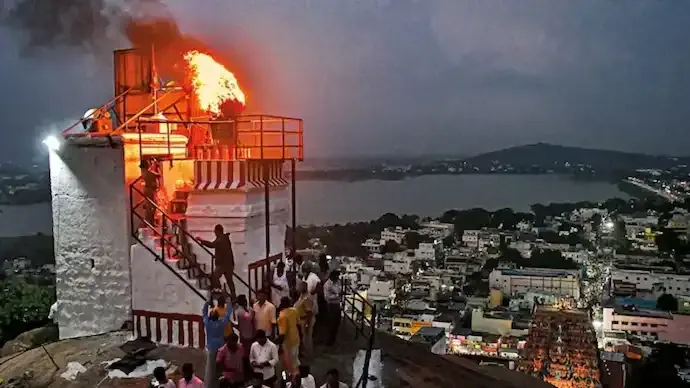
In a significant setback to the DMK-led Tamil Nadu government, the Madras High Court has upheld an order permitting the lighting of Karthigai Deepam at an ancient stone lamp pillar atop the Thiruparankundram hills in Madurai. The court strongly rejected objections raised on grounds of custom, law and order, and competing claims over the site, while making sharp observations on what it termed a politically motivated narrative.
A division bench of the Madurai bench of the High Court ruled that the traditional lamp could be lit near a dargah located on the hill, dismissing appeals filed by state authorities, police officials, the dargah management, and the Tamil Nadu Waqf Board. The judges held that there was no conclusive legal or religious prohibition preventing the lighting of the lamp at the site.
The dispute centred on whether Karthigai Deepam could be lit at an ancient stone pillar situated close to the Hazarath Sultan Sikkandar Badhusha Avuliya Dargah on the Thiruparankundram hill. The state and other appellants had argued that allowing the ritual could disturb public order, violate long-standing customs, and infringe upon competing religious claims.
Rejecting these arguments, the bench observed that earlier litigation had not conclusively settled the issue, and therefore the present order was not barred by the principle of res judicata. The judges noted that none of the appellants had produced credible or authoritative evidence to show that any agama shastra or established religious practice prohibited the lighting of Karthigai Deepam at the stone pillar.
In a stinging remark, the court said it was “ridiculous and hard to believe” that permitting representatives of the Arulmigu Subramania Swamy Temple to light a lamp on a single day in a year could lead to a law-and-order situation. The bench added that such a disturbance could arise only if it were “sponsored by the State itself,” and expressed hope that no government would stoop to that level to further a political agenda.
The appeals before the division bench arose from a December 1 order by a single judge, who had directed the temple management to light the Karthigai Deepam at the hilltop pillar. When the order was not implemented on the festival day, the single judge had subsequently permitted devotees to light the lamp themselves. That too did not materialise, leading to contempt proceedings, which are still pending.
During the hearings, the state government contended that the petition was not a public interest litigation and that devotees had no enforceable legal right to demand the lighting of the lamp. Officials also argued that the High Court’s writ jurisdiction could not be used to alter a long-standing custom. The Hindu Religious and Charitable Endowments Department maintained that the decision rested with the devasthanam, while the dargah claimed that the minority community faced difficulties in enjoying land granted to it decades ago.
The division bench rejected these submissions, stating that speculative fears and administrative inconvenience could not override religious practices in the absence of concrete evidence. It also expressed scepticism over claims that the stone pillar belonged exclusively to the dargah, noting that such assertions had complicated mediation efforts.
Reacting to the verdict, K Annamalai welcomed the ruling, stating that it was difficult to comprehend how a powerful state could claim that lighting a lamp on one day would disturb public peace. Quoting the court’s observations, he said the judgment served as a warning against invoking an “imaginary” law-and-order threat to pursue political objectives.
With the High Court clearing the way, the ruling marks an important judicial affirmation of religious practice, while also underscoring the court’s unwillingness to accept administrative or political objections unsupported by law or evidence.


