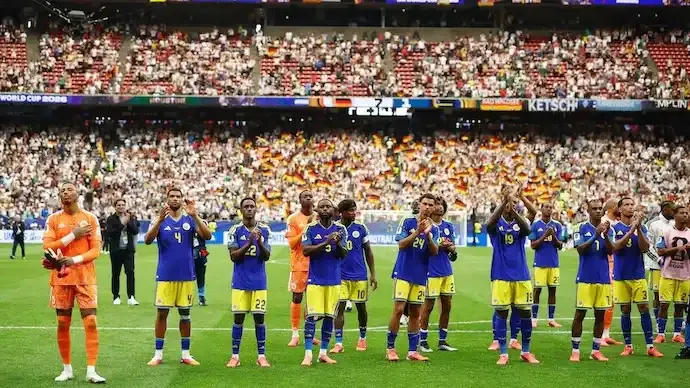
When Livano Comenencia found the back of the net against legendary German goalkeeper Manuel Neuer at the FIFA World Cup 2026, it was far more than just a goal.
For the Caribbean nation of Curaçao, it marked the first World Cup goal in its history. For football fans around the world, it became a reminder of one of the sport's most remarkable qualities: its ability to give small nations, territories, and communities a place on the global stage.
The moment sparked discussions far beyond the match itself, raising questions about identity, representation, and how football's map differs from traditional political geography.
A Historic Goal for a Small Nation
Curaçao, with a population of around 150,000 people, is one of the smallest participants ever to make a significant impact at the FIFA World Cup.
When Comenencia scored against football powerhouse Germany, the goal immediately became a landmark moment in the country's sporting history. For many supporters, it represented years of effort, investment, and belief in football's ability to unite people and elevate national pride.
While larger football nations often celebrate tournament victories, smaller countries frequently cherish individual moments that symbolize recognition on the world stage.
Football's Geography Is Different from Politics
One of football's unique characteristics is that FIFA's membership structure does not always mirror the political map of the world.
Territories and regions with distinct cultural identities often compete internationally even when they are not fully sovereign states. This has allowed communities across the globe to express their own sporting identities and traditions.
Examples can be found across continents, where football provides a platform for representation that may not exist in many other international institutions.
Why Small Nations Matter in World Football
The FIFA World Cup has traditionally been dominated by football giants such as Brazil, Argentina, France, and Germany.
Yet one of the tournament's greatest attractions remains the opportunity for smaller nations to compete against the world's elite. These stories often capture global attention because they represent determination, ambition, and the democratizing nature of sport.
For countries like Curaçao, merely qualifying or scoring at the World Cup can become a defining national achievement.
Croatia's Example Inspires Smaller Football Nations
The rise of Croatia is frequently cited as proof that population size does not determine football success.
Despite having a relatively small population, Croatia has consistently competed with football's traditional powers and established itself as one of the sport's most respected nations. Its success has inspired smaller countries and territories worldwide to believe they can achieve similar recognition.
Football remains one of the few global arenas where talent, organization, and passion can often outweigh demographic and economic limitations.
More Than Just a Goal
Comenencia's strike against Germany was important not only because it altered the scoreline but because it provided a moment of collective pride for an entire nation.
Sporting achievements often become symbols of identity, particularly for smaller communities seeking greater visibility on the international stage. A single goal can strengthen national confidence, inspire future generations, and create memories that endure long after the tournament ends.
For Curaçao, the historic moment was about recognition, belonging, and proving that even the smallest footballing nations can leave a lasting mark on the world's biggest sporting event.
Football's Greatest Strength
The story of Curaçao's first World Cup goal highlights one of football's enduring strengths: its ability to bring together countries, territories, and cultures of vastly different sizes and backgrounds on a common stage.
Whether it is a football giant lifting the trophy or a small nation scoring its first goal, the World Cup continues to provide moments that transcend sport and speak to identity, pride, and shared human aspiration.
Prev Article
FIFA World Cup 2026 Hydration Break Rule Sparks Debate: Player Safety or Commercial Opportunity?
Next Article
Turkey Crash Out of FIFA World Cup 2026 After 1-0 Defeat to 10-Man Paraguay