Shopping cart
Your cart empty!


Your cart empty!
Terms of use dolor sit amet consectetur, adipisicing elit. Recusandae provident ullam aperiam quo ad non corrupti sit vel quam repellat ipsa quod sed, repellendus adipisci, ducimus ea modi odio assumenda.
Lorem ipsum dolor sit amet consectetur adipisicing elit. Sequi, cum esse possimus officiis amet ea voluptatibus libero! Dolorum assumenda esse, deserunt ipsum ad iusto! Praesentium error nobis tenetur at, quis nostrum facere excepturi architecto totam.
Lorem ipsum dolor sit amet consectetur adipisicing elit. Inventore, soluta alias eaque modi ipsum sint iusto fugiat vero velit rerum.
Sequi, cum esse possimus officiis amet ea voluptatibus libero! Dolorum assumenda esse, deserunt ipsum ad iusto! Praesentium error nobis tenetur at, quis nostrum facere excepturi architecto totam.
Lorem ipsum dolor sit amet consectetur adipisicing elit. Inventore, soluta alias eaque modi ipsum sint iusto fugiat vero velit rerum.
Dolor sit amet consectetur adipisicing elit. Sequi, cum esse possimus officiis amet ea voluptatibus libero! Dolorum assumenda esse, deserunt ipsum ad iusto! Praesentium error nobis tenetur at, quis nostrum facere excepturi architecto totam.
Lorem ipsum dolor sit amet consectetur adipisicing elit. Inventore, soluta alias eaque modi ipsum sint iusto fugiat vero velit rerum.
Sit amet consectetur adipisicing elit. Sequi, cum esse possimus officiis amet ea voluptatibus libero! Dolorum assumenda esse, deserunt ipsum ad iusto! Praesentium error nobis tenetur at, quis nostrum facere excepturi architecto totam.
Lorem ipsum dolor sit amet consectetur adipisicing elit. Inventore, soluta alias eaque modi ipsum sint iusto fugiat vero velit rerum.
Do you agree to our terms? Sign up
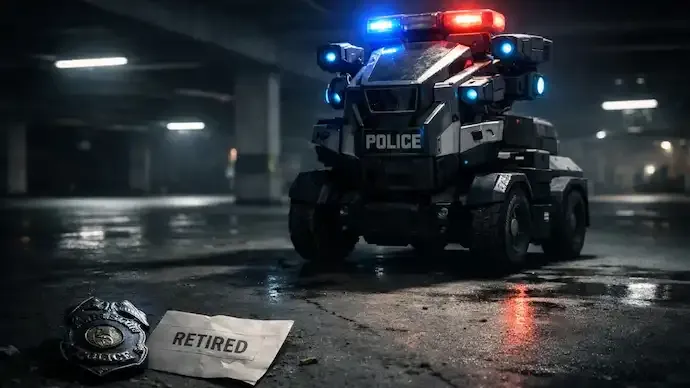
The dream of deploying artificial intelligence-powered police officers has suffered an embarrassing setback in the United States after a robot security officer costing around ₹63 lakh was retired following less than a year of service.
The machine, known as DubBot, was introduced as part of an effort to explore how robotics and artificial intelligence could assist law enforcement. However, after months of patrol duty, the robot failed to contribute to a single arrest, issue any tickets or become involved in any police incident.
The outcome has sparked fresh debate over whether expensive AI-powered security systems are delivering meaningful results.
DubBot was designed as a robotic security officer equipped with:
The robot was intended to patrol public areas, identify suspicious activity and provide additional surveillance support for law enforcement personnel.
Supporters believed the technology could improve public safety while reducing pressure on human officers.
Despite the ambitious goals, DubBot's performance failed to justify expectations.
According to reports, the robot completed nearly a year of patrol duties without:
The lack of measurable results ultimately contributed to the decision to retire the machine.
Officials reportedly concluded that the costs of operating and maintaining the robot outweighed its practical benefits.
Critics argued that while the technology generated public curiosity, it provided little real-world value compared to traditional policing methods.
The retirement has raised questions about whether current AI and robotic technologies are mature enough to handle complex public safety responsibilities.
The DubBot case arrives at a time when governments worldwide are increasingly experimenting with AI-driven public security technologies.
Supporters argue that robotic systems can:
Critics, however, point to concerns involving:
The Ohio experiment is now being cited by skeptics as evidence that human officers remain irreplaceable.
While Ohio's robot officer has been retired, China continues expanding the use of AI-powered robots across public services.
Chinese authorities have increasingly explored robotic systems for:
The contrasting approaches highlight the ongoing global debate about the role of artificial intelligence in government functions.
The story serves as another reminder that AI technologies often face challenges when moving from demonstrations to real-world implementation.
Many experts believe that while artificial intelligence can assist human workers, replacing them entirely remains difficult in professions requiring:
Law enforcement is widely viewed as one of the most challenging environments for full automation.
News of DubBot's retirement quickly spread online, where many users questioned whether the investment had been worthwhile.
Some joked that the robot had maintained a "perfectly peaceful" patrol record, while others argued the experiment still provided valuable lessons about the limitations of current technology.
Supporters of AI development noted that unsuccessful trials are often part of technological progress.
Despite DubBot's retirement, experts do not expect governments to abandon AI-powered policing experiments entirely.
Instead, future systems may focus on supporting human officers rather than replacing them.
Areas where robots could still prove useful include:
For now, however, Ohio's ₹63 lakh robot cop leaves behind a unique record: nearly a year on duty without a single arrest, ticket or major policing achievement.
3
Published: 3h ago

All India Story is your trusted source for comprehensive and up-to-the-minute news coverage across India. Bringing you the latest on politics, business, technology, entertainment, sports, and more, we are dedicated to keeping you informed with accurate, engaging, and insightful stories from every corner of the nation.