

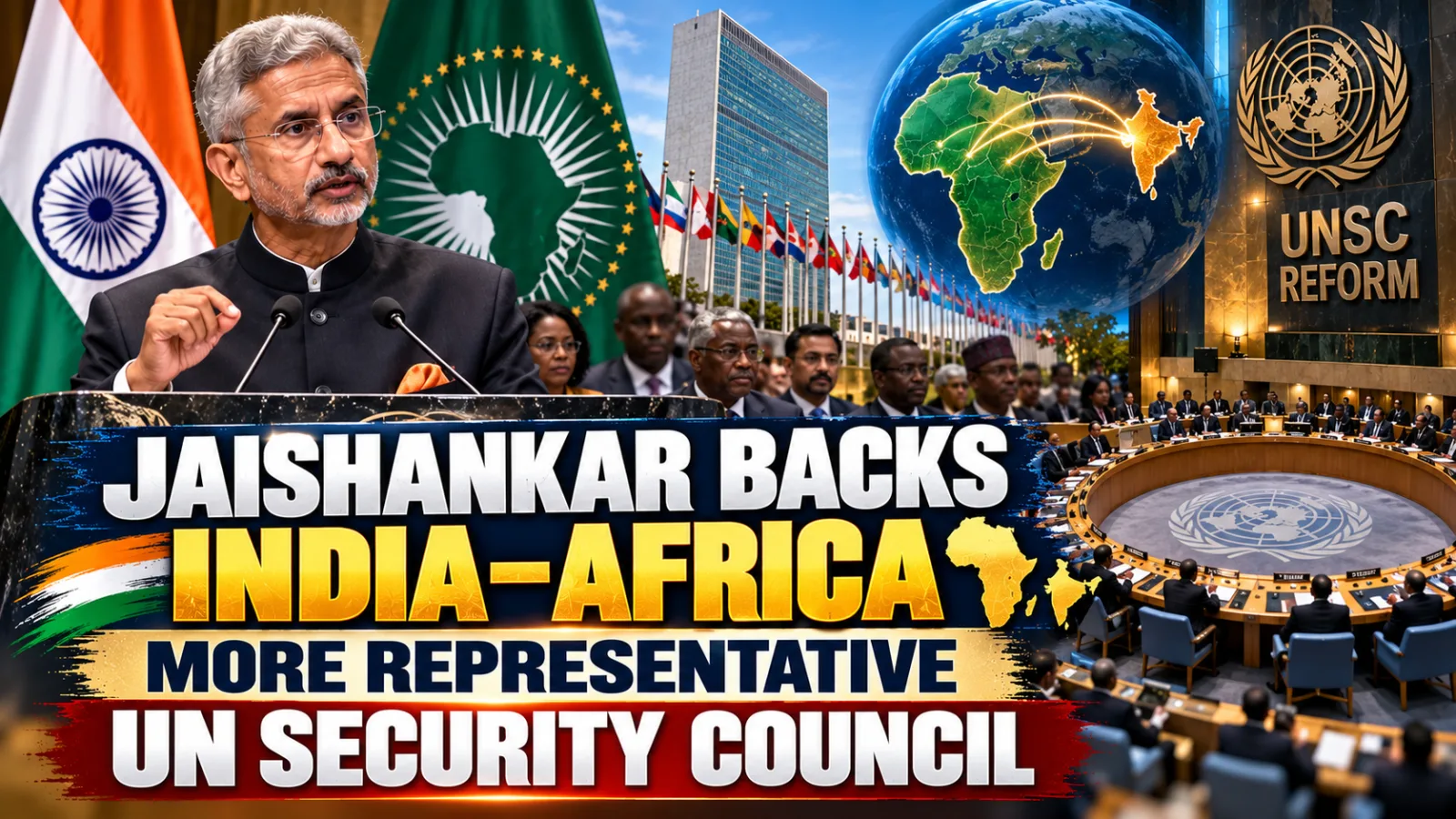

External Affairs Minister S Jaishankar has called for reform of the United Nations Security Council, arguing that India and Africa cannot remain underrepresented in global decision-making. Speaking in Addis Ababa, Ethiopia, on Friday, October 9, he said a more democratic and representative international order was essential for the interests of both regions and the wider Global South.
Addressing a gathering at the Adwa Victory Memorial Museum, Jaishankar criticised the existing structure of the Security Council, arguing that its effectiveness and representativeness were closely connected. He also called for Africa to receive fair representation in both categories of membership.
The 15-member Security Council consists of five permanent members — China, France, Russia, the United Kingdom and the United States — which hold veto powers. The remaining 10 members are elected for two-year terms and do not have veto rights.

Jaishankar Highlights India's Support for African Representation
Jaishankar referred to India's efforts during its 2023 G20 presidency to secure permanent membership for the African Union in the grouping. He said the existing global order did not adequately reflect the interests of India and Africa, while unnamed forces continued to delay reform.
His remarks came during the final leg of a three-nation African tour, which included visits to Côte d'Ivoire, Ghana and Ethiopia.
Jaishankar also drew a connection between Ethiopia's historic victory over Italian forces at the 1896 Battle of Adwa and India's freedom movement. He said both struggles reflected the importance of human dignity, political independence and the right of nations to make sovereign decisions.
The minister argued that the question of who gets to determine the future remains central to the shared concerns of India, Africa and the Global South.
India-Africa Economic Cooperation in Focus
Jaishankar said India and Africa shared historical connections spanning several millennia, with the Indian Ocean facilitating trade, migration and cultural exchange.
He called for this longstanding relationship to move beyond historical solidarity towards practical cooperation. India's ambition to become a developed nation by 2047 and Africa's Agenda 2063, he said, offered complementary development pathways.
Both sides prioritise industrialisation, infrastructure, connectivity, technology, human capital and sustainable growth. Jaishankar stressed that developing economies should have the opportunity to build domestic industries and access international markets.
According to figures cited in his remarks, India is Africa's fourth-largest trading partner, with bilateral trade approaching $100 billion. More than 220 Indian-supported development projects worth approximately $4.5 billion have been completed across the continent.
These projects cover electricity, water, agriculture, railways, healthcare, manufacturing and public infrastructure. Examples include metro rail development in Mauritius, hydropower projects in several African countries, drinking water pipelines in Tanzania and power transmission infrastructure in parts of West Africa.
Jaishankar also encouraged Indian businesses to explore investment opportunities in Africa, highlighting their potential contribution to employment, local value addition and economic development.
Food Security and Sustainable Partnerships
The minister called for stronger cooperation on food security, noting that conflicts in other regions can make grain and fertiliser supplies more difficult to access for Africa and the wider Global South.
He highlighted agricultural productivity, climate-resilient farming, value addition and food processing as areas requiring greater collaboration.
Jaishankar said future partnerships should build local capabilities rather than create dependencies. His remarks linked the demand for UN reform with a broader call for greater economic opportunity, stronger India-Africa cooperation and a more balanced international order.






Conversation
Be kind and stay on topic. Comments are moderated; abuse, spam and personal attacks are removed. Report a problem