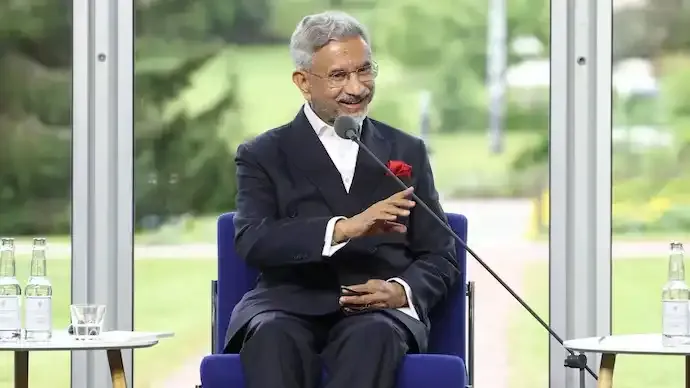
External Affairs Minister S. Jaishankar delivered a strong response to Western criticism of India's continued purchase of Russian oil, arguing that European nations have no moral authority to lecture New Delhi on its energy decisions.
Speaking at the Kultaranta Talks in Finland, Jaishankar defended India's position and highlighted what he described as double standards in international discourse regarding energy security, strategic interests, and geopolitical conflicts.
His remarks come amid ongoing debates between Western nations and several emerging economies over trade, energy supplies, and diplomatic engagement with Russia following the Ukraine conflict.
"European Weapons Have Been Used Against India"
During the discussion, Jaishankar pointedly remarked that weapons manufactured in Europe have been used against India, despite New Delhi never posing any threat to European countries.
The minister argued that countries criticizing India's energy purchases should also examine their own strategic decisions and historical policies.
According to Jaishankar, India's primary responsibility is to protect its national interests, ensure energy security, and support economic stability for its citizens.
His comments quickly gained international attention and sparked debate across diplomatic and political circles.
India's Stand on Russian Oil
Since the beginning of the Russia-Ukraine conflict, India has consistently maintained that its energy decisions are guided by national interests and economic considerations.
As one of the world's largest energy consumers, India imports a significant portion of its crude oil requirements from international markets.
Officials have repeatedly stated that affordable energy supplies are essential for:
-
Economic growth
-
Inflation management
-
Energy security
-
Industrial production
-
Consumer welfare
India has continued purchasing discounted Russian crude while maintaining diplomatic engagement with multiple global partners.
Jaishankar Highlights Global Energy Reality
The External Affairs Minister emphasized that energy security remains a critical concern for developing economies.
He noted that countries with large populations and growing economies cannot ignore affordable energy sources, especially during periods of global uncertainty and market volatility.
According to Indian policymakers, ensuring access to reliable and reasonably priced energy remains a national priority.
The government has consistently argued that energy purchases should not be viewed solely through a geopolitical lens.
Reference to US Position on Russian Oil
Jaishankar also pointed out that, during the early stages of the Ukraine conflict in 2022, the United States had encouraged India to continue purchasing Russian oil in order to help stabilize global energy markets.
The observation was used to highlight how international positions on energy trade have evolved over time.
Indian officials have frequently argued that energy policy decisions should be assessed within the broader context of global market realities and economic requirements.
India's Foreign Policy Focuses on Strategic Autonomy
India has maintained a policy of strategic autonomy in international affairs, seeking to balance relationships with major global powers while safeguarding national interests.
The country continues to engage with:
-
Russia
-
United States
-
European Union
-
Middle Eastern nations
-
Indo-Pacific partners
Foreign policy experts note that India's approach is driven by pragmatic considerations rather than alignment with any single geopolitical bloc.
This strategy has enabled New Delhi to maintain diplomatic flexibility amid increasingly complex global tensions.
Western Criticism and India's Response
Several Western governments and commentators have questioned countries that continue economic engagement with Russia.
However, India has repeatedly rejected suggestions that it should compromise its energy security to align with external political expectations.
Government officials have argued that developing nations face unique economic challenges and must prioritize affordable access to resources.
Jaishankar's latest remarks reinforce India's long-standing position that national interests will remain the guiding principle of its foreign and energy policies.
Growing Global Debate on Energy Security
The discussion surrounding Russian oil imports reflects a broader global debate about energy security, economic stability, and international diplomacy.
As geopolitical conflicts continue to influence energy markets, countries around the world are reassessing supply chains, trade relationships, and strategic priorities.
For India, ensuring reliable energy supplies remains central to sustaining economic growth and supporting the needs of over a billion people.
Jaishankar's comments in Finland underline New Delhi's message that energy decisions will continue to be guided by practical national interests rather than external pressure.
Prev Article
16 Protesters Killed in Rawalakot as Pakistan-Occupied Kashmir Unrest Intensifies
Next Article
Trump Claims US-Iran Peace Deal Near Completion, But Tehran Remains Cautious