
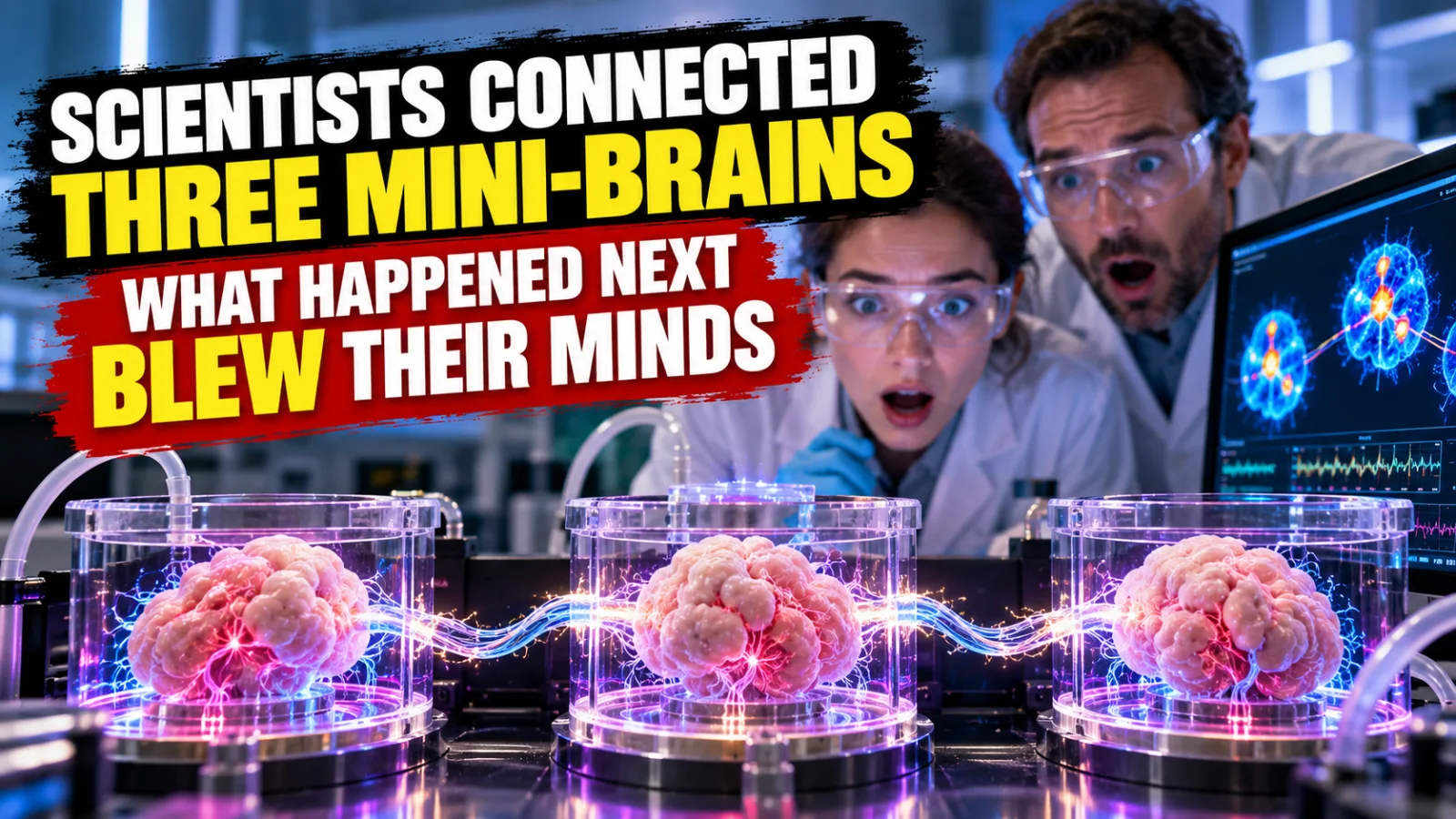
Scientists have discovered that connecting lab-grown human brain organoids can lead to changes in how the network processes information. In a study published in Communications Biology, researchers connected three brain organoids and repeatedly exposed them to signals to examine whether their responses would change over time.
Brain organoids are tiny clusters of human brain cells grown from stem cells. They can develop different types of neural cells and form connections, but they are far simpler than an actual human brain and do not reproduce its full structure or complexity.
Three organoids showed a striking change
Researchers compared networks containing one, two and three organoids. The tissue was repeatedly stimulated while scientists monitored its electrical activity.
After about two weeks, the three-organoid networks became significantly better at distinguishing where incoming signals originated. The same improvement was not observed in the single- and two-organoid systems.
Scientists also noticed that activity began moving through the three-organoid network in more organised patterns. The organoids responded differently depending on the incoming signal, while the overall response became faster.
One of the more interesting findings was that the organoids had initially been produced under similar conditions. Yet repeated exposure to signals appeared to encourage them to develop different functional roles within the connected network.
Experience appeared to shape function
The findings offer another example of neural plasticity — the ability of neural systems to change their connections and behaviour based on experience.
In simple terms, the study suggests that both connectivity and repeated input can influence how brain cells eventually function.
However, the experiment does not mean scientists created three miniature human brains capable of thinking or becoming conscious. The organoids remain simplified laboratory models of brain tissue.
Researchers from the University of Tokyo and collaborators said the work demonstrates how initially similar organoids can become functionally differentiated when repeatedly exposed to signals.
The next question is how far this ability to reorganise can extend. Studying increasingly complex organoid networks could eventually help researchers understand more about how real neural systems learn, adapt and divide tasks.






Conversation
Be kind and stay on topic. Comments are moderated; abuse, spam and personal attacks are removed. Report a problem