

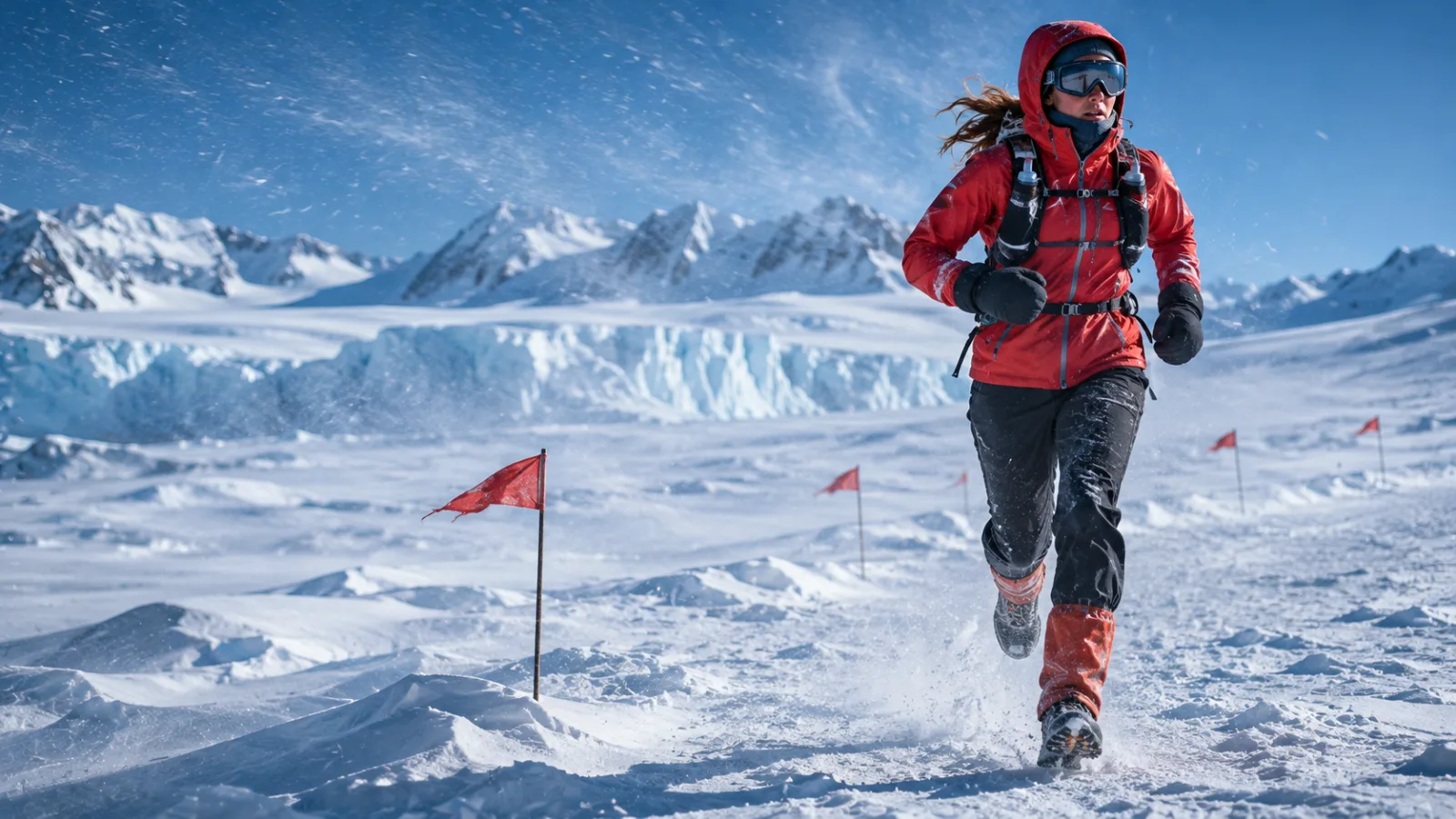

ANTARCTICA, November 12, 2026: Canadian ultrarunner Stephanie Case has become the first woman to complete a nonstop 100-mile race in Antarctica, overcoming severe winds and extreme cold to finish second overall at the 2026 Antarctic Ice Ultra.
Case completed the 160.9-kilometre distance in 17 hours, 31 minutes and 39 seconds on November 8, establishing the women's record for the distance on the frozen continent.
The race was held in the Schirmacher Oasis in Queen Maud Land, East Antarctica, where competitors faced conditions described as the coldest recorded by the event organisers.

China's Yusheng Ni won the race in 17 hours, 2 minutes and 24 seconds, finishing just 29 minutes and 15 seconds ahead of Case.
Only four of the eight competitors who started the 100-mile event reached the finish line, highlighting the difficulty of the conditions.
Stephanie Case Makes History at Antarctic Ice Ultra 2026
The Antarctic Ice Ultra is an endurance event held in one of the most challenging environments for competitive running.
Participants race across snow-covered terrain in freezing temperatures, where strong winds and prolonged exposure can make even routine movements difficult.
Case became the first woman to complete the event's 100-mile distance and established the inaugural women's record.
The organisers have also recognised her achievement in their published Antarctic ultrarunning records.
The key results were:
- Athlete: Stephanie Case
- Nationality: Canadian
- Competition: Antarctic Ice Ultra 2026
- Race date: November 8, 2026
- Distance: 100 miles, approximately 160.9 kilometres
- Finish time: 17 hours, 31 minutes, 39 seconds
- Overall position: Second
- Women's position: First
- Overall winner: Yusheng Ni of China
- Race finishers: Four of eight starters
Three women began the 100-mile race, but Case was the only female competitor to finish.
Her result also established a new benchmark for women attempting the same challenge in future editions.
How Stephanie Case Completed 100 Miles in Antarctica
The race took place in the Schirmacher Oasis, located in Queen Maud Land along the Princess Astrid Coast of East Antarctica.
The course consisted of repeated circuits measuring approximately 4.2 kilometres each.
Competitors completed 38 laps, followed by an additional section to cover the full 100-mile distance.
Unlike conventional ultramarathons that take runners through changing landscapes, the Antarctic event required competitors to return repeatedly to the same frozen route.
The repetitive course placed considerable demands on concentration, pacing and physical endurance.
Runners also had to manage their clothing, nutrition and energy throughout the race.
Although the course was relatively compact, the Antarctic environment made the challenge substantially more demanding.
Temperatures Plunged to Minus 35 Degrees Celsius
Extreme weather presented one of the greatest difficulties during the race.
According to organisers and reports from BBC Sport, conditions reached the equivalent of minus 35 degrees Celsius, with powerful winds adding to the danger.
The event website describes the figure as a wind chill reading.
Organisers brought forward the race start to 1 am on Sunday because of the approaching severe weather.
Case told BBC Sport that spending more than 17 hours in those conditions required careful management of body temperature and energy.
The body must expend energy simply to remain warm, making prolonged physical activity particularly demanding.
Runners also face a difficult balance between moving quickly enough to maintain performance and avoiding excessive perspiration.
Sweat can become dangerous when moisture cools rapidly in freezing conditions.
For Case, managing this balance was central to completing the event.
Why Sweating Was a Major Concern During the Race
Running in Antarctica presents challenges that differ considerably from those encountered in warmer environments.
During a normal ultramarathon, athletes frequently focus on preventing overheating and dehydration.
In extreme cold, maintaining sufficient body heat becomes another critical concern.
Excessive perspiration can dampen clothing, reducing its ability to keep the body warm.
Case explained that runners needed to regulate their effort to avoid becoming too sweaty while continuing to make progress.
The situation was complicated by strong winds and the need to remain outside for many hours.
Even simple activities such as adjusting gloves, changing clothing or taking a bathroom break carried additional risks.
Removing protective gloves for a short period could expose hands to potentially dangerous temperatures.
Environmental rules also required participants to avoid leaving waste behind on the course.
These conditions meant that Case had to think carefully about each decision throughout the race.
China's Yusheng Ni Wins Race and Sets Men's Record
While Case established the women's record, Chinese ultrarunner Yusheng Ni delivered a record-breaking performance of his own.
Ni completed the 100-mile event in 17 hours, 2 minutes and 24 seconds.
His time improved significantly on his previous Antarctic 100-mile record of 22 hours, 40 minutes and 47 seconds, set in 2025.
The improvement was more than five and a half hours.
Case remained close to Ni during parts of the race and described their competition as an important factor in maintaining her pace.
At certain points, the runners were separated by only a short distance.
Ni eventually secured first place, while Case crossed the finish line less than half an hour later.
Their performances established new men's and women's records for the Antarctic 100-mile distance recognised by the organisers.
Who Is Stephanie Case?
Stephanie Case is a Canadian ultrarunner, international human rights lawyer and advocate for women's participation in sport.
Beyond competitive running, she has worked in humanitarian and human rights settings.
She is also the founder of Free to Run, an organisation that uses running and outdoor activities to support women and girls affected by conflict.
The initiative aims to create opportunities for women to develop confidence, leadership skills and greater freedom of movement.
Case has previously competed in demanding endurance races around the world.
Her experience combines long-distance running with work focused on human rights and gender equality.
The Antarctic achievement adds another significant milestone to her sporting career.
Stephanie Case Previously Won Ultramarathon While Breastfeeding Daughter
Case had already attracted international attention in May 2025 after winning the women's 100-kilometre Ultra-Trail Snowdonia race in Wales.
The victory came approximately six months after she gave birth to her daughter, Pepper.
During the competition, Case stopped at aid stations to breastfeed her baby before continuing the race.
She completed the event in 16 hours, 53 minutes and 22 seconds.
The performance received widespread praise, but some online criticism questioned whether she should have been competing while caring for a young child.
Case has since spoken about how the reaction affected her.
She rejected the suggestion that becoming a mother should mean abandoning personal interests or athletic ambitions.
Her return to competitive running also followed a period away from racing during her journey to motherhood.
Motherhood Motivated Stephanie Case's Antarctic Challenge
Case said part of her motivation for attempting the Antarctic 100-mile race came from wanting to challenge assumptions about women and motherhood.
Speaking to BBC Sport, she explained that pursuing activities that bring personal fulfilment can contribute positively to being a parent.
She also wanted to demonstrate to her daughter that women should not feel limited in what they can attempt.
The runner described her achievement through a simple message: "Motherhood isn't the finish line."
For Case, Antarctica provided an opportunity to communicate that belief through a particularly demanding physical challenge.
She wanted to show that parenthood and ambitious athletic goals could exist alongside one another.
Her achievement has consequently attracted attention beyond the ultrarunning community.
Only Four of Eight Runners Finished the Antarctic Race
The difficult conditions were reflected in the competition's completion rate.
Eight athletes started the 100-mile event, but only four reached the finish line.
The finishers included:
- Yusheng Ni, China: 17:02:24
- Stephanie Case, Canada: 17:31:39
- Nate Buchanan, United States: 22:45:28
- Lucas Hathaway, United States: 23:53:57
The result meant that only half of the starting field completed the entire distance.
Case was also the only woman to finish the event.
The organisers list her as the first female finisher in Antarctic 100-mile racing, making her performance significant in both the women's category and the overall competition.
What Is the Antarctic Ice Ultra?
The Antarctic Ice Ultra is an organised endurance running competition conducted in East Antarctica.
It offers athletes the opportunity to compete over several distances in polar conditions.
The event includes:
- 50-kilometre races.
- 50-mile races.
- 100-kilometre races.
- 100-mile races.
- A 24-hour endurance category.
- Team relay events.
The competition is designed to test endurance and preparation in an environment where weather and terrain can present serious challenges.
Participants must prepare appropriate cold-weather equipment and follow the event's safety and environmental requirements.
The race is distinct from conventional road marathons and most trail ultramarathons because of the extreme conditions under which it takes place.
What Stephanie Case's Record Means for Women's Ultrarunning
Case's performance represents an important milestone for women competing in extreme endurance events.
Her time of 17:31:39 has established a recognised women's record for the Antarctic 100-mile distance.
The achievement is notable not only because she was the first woman to finish, but also because she placed second in the overall standings.
She was separated from the men's winner by less than 30 minutes.
The result provides a competitive benchmark for future women entrants and demonstrates what is possible with experience, preparation and careful decision-making.
Case has also used the achievement to encourage women, particularly mothers, to continue pursuing their sporting ambitions.
For her, completing the Antarctic Ice Ultra was both a personal accomplishment and an opportunity to challenge expectations.
After more than 17 hours on the frozen continent, she left with a record that will become part of Antarctic ultrarunning history.
Editorial note: This report is based on the official Antarctic Ice Ultra race records, interviews with Stephanie Case published by BBC Sport and CBC News, and reporting by Anadolu Agency. All India Story did not attend the race or independently interview the athlete.









Conversation
Be kind and stay on topic. Comments are moderated; abuse, spam and personal attacks are removed. Report a problem