

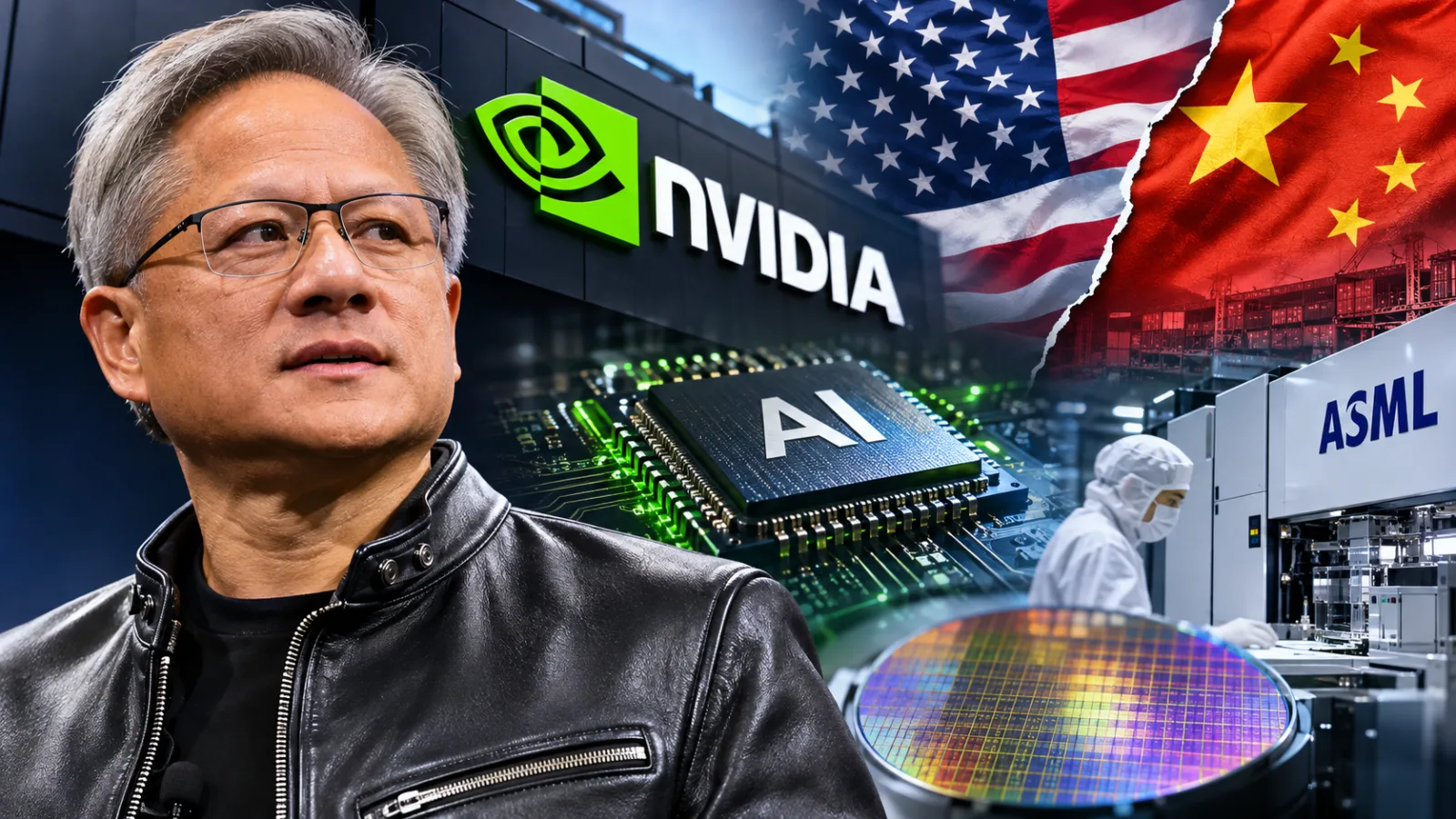

WASHINGTON, November 10, 2026: Nvidia CEO Jensen Huang is facing heightened scrutiny after acknowledging an extramarital affair, as the company's board investigates reports that he may have been targeted by a foreign intelligence operation.
The controversy has renewed attention on the US-China AI chip war, a struggle over the advanced processors, manufacturing equipment and computing infrastructure required to develop artificial intelligence.
While the allegations involving foreign intelligence remain under investigation, the broader competition between Washington and Beijing has already reshaped the global semiconductor industry.

Why Is Nvidia Investigating Jensen Huang?
On November 8, Nvidia announced that independent directors would oversee an investigation into reports concerning Huang and a possible foreign intelligence effort.
Huang separately acknowledged being unfaithful to his wife and apologised to his family and colleagues.
The New York Times previously reported that Huang had developed a relationship with Alice Huang, a former executive at Singapore-based technology company Megaspeed International. The report alleged that US intelligence authorities suspected her of passing information to Beijing.
Nvidia has emphasised that it currently has no reason to believe its confidential information or US national security was compromised. Huang has pledged to cooperate with the investigation and continue leading the company.
China's foreign ministry has rejected the espionage allegations, describing them as an attempt to discredit the country.
The investigation has attracted political attention because Nvidia supplies some of the world's most important AI processors and Huang has publicly supported allowing certain chip exports to China.
How Nvidia, TSMC and ASML Control Advanced AI Chip Production
Three companies occupy critical positions in the global semiconductor supply chain.
Nvidia, headquartered in the United States, develops graphics processing units, or GPUs, widely used for training and operating artificial intelligence systems.
Taiwan Semiconductor Manufacturing Company (TSMC) manufactures many of Nvidia's advanced processors. The Taiwanese company is among the leading global suppliers of high-performance semiconductor manufacturing services.
ASML, based in the Netherlands, produces extreme ultraviolet (EUV) lithography equipment used in the production of leading-edge chips.
EUV lithography enables manufacturers to create extremely small circuit patterns on silicon wafers. The machines are extraordinarily complex, and ASML remains the only commercial supplier of EUV lithography systems.
This division of responsibilities creates strategic dependencies. Designing a powerful AI processor is not enough. Companies also need access to advanced factories, manufacturing equipment and specialised technology.
For China, developing alternatives to these international suppliers has become an important industrial objective.
Why Has the United States Restricted AI Chip Exports to China?
Washington has progressively tightened semiconductor export regulations, citing concerns about military applications and national security.
In October 2022, the US Commerce Department introduced controls intended to restrict China's access to advanced computing chips and semiconductor manufacturing equipment.
Further measures in October 2023 expanded restrictions and addressed certain products designed to remain below earlier performance thresholds.
Nvidia responded to some restrictions by developing chips specifically for the Chinese market. However, changing regulations repeatedly complicated those sales.
The policy subsequently became more selective.
In January 2026, the US Bureau of Industry and Security introduced a framework allowing certain Nvidia H200 and comparable processors to be considered for export to approved Chinese customers.
The arrangement requires individual licence reviews and security conditions. It does not permit unrestricted shipments.
The central policy disagreement remains unresolved. Supporters of tighter controls argue that limiting advanced computing capabilities can protect national security. Critics contend that restrictions encourage Chinese technology companies to accelerate domestic semiconductor development.
The Dutch Chipmaking Machines at the Centre of the Dispute
The Netherlands has also imposed licensing requirements on exports of advanced semiconductor manufacturing equipment.
ASML has been unable to sell its EUV lithography systems to China under the existing restrictions.
In June 2026, Bloomberg reported that US officials had raised concerns about whether an advanced EUV machine might have reached China.
ASML rejected the suggestion and stated that it had not supplied EUV machines or equipment specifically designed for those systems to China.
The company has maintained that it complies with applicable export regulations.
Separately, Reuters reported in December 2025 that Chinese researchers had developed an experimental EUV lithography system with assistance from former ASML engineers.
However, producing EUV light is not equivalent to operating a commercially viable semiconductor fabrication process. The experimental project had not demonstrated the manufacturing capabilities of established EUV production systems.
How Dummy Servers Were Allegedly Used to Evade US Export Controls
An American criminal case has highlighted the difficulties involved in enforcing semiconductor trade restrictions.
On March 19, 2026, the US Department of Justice announced charges against three individuals accused of participating in a scheme to divert advanced AI servers to China.
Those charged included Yih-Shyan "Wally" Liaw, a co-founder of US server manufacturer Supermicro.
According to federal prosecutors, a business operating in Southeast Asia purchased approximately $2.5 billion worth of servers during 2024 and 2025.
Authorities alleged that some shipments were falsely presented as intended for the Southeast Asian purchaser before being redirected to customers in China.
Investigators also described an unusual method of concealing the alleged operation.
Prosecutors said thousands of non-functional replica servers were placed in warehouses to create the impression that genuine equipment remained in storage.
The indictment further alleged that individuals involved transferred identifying labels and serial-number stickers onto replica equipment before inspections.
These allegations demonstrate how advanced AI hardware could potentially be diverted through intermediaries even when direct exports are restricted.
Supermicro has stated that it was not named as a defendant and that it was cooperating with authorities.
The criminal allegations must not be treated as proven findings against the accused. The defendants are entitled to the presumption of innocence unless convicted.
China Is Accelerating Its Domestic AI Chip Industry
China's response to semiconductor restrictions has included greater investment in domestic chip design and manufacturing.
Huawei has developed its Ascend family of AI processors, while Semiconductor Manufacturing International Corporation (SMIC) remains a major Chinese chip manufacturer.
Domestic alternatives are receiving increased attention as Chinese technology companies face uncertainty over access to advanced American hardware.
However, building a competitive semiconductor ecosystem requires more than developing individual processors.
Companies must also improve manufacturing yields, memory integration, software compatibility, production capacity and access to advanced fabrication equipment.
These challenges explain why American processors continue to attract substantial interest in China.
According to an October 20 Reuters report, ByteDance, Alibaba and Tencent placed orders for more than three million Nvidia RTX PRO 5500 graphics cards.
The orders carried a combined list-price value exceeding $35 billion.
The RTX PRO 5500 is less powerful than Nvidia's most advanced data-centre processors but remains available to Chinese customers under the applicable export rules.
Reuters reported that Nvidia could not guarantee delivery of all the requested products because demand exceeded expected supply.
China's Rare Earth Controls Add Another Dimension
The semiconductor competition is not limited to processors and manufacturing machines.
China also holds an important position in the supply of critical minerals used across electronics, industrial equipment and advanced manufacturing.
Beijing introduced export controls affecting several strategic materials in 2023 and subsequently expanded restrictions on selected rare earth products.
On November 9, 2026, China extended the suspension of certain additional export restrictions until January 10, 2027.
The decision preserved part of the trade arrangements between Washington and Beijing ahead of anticipated discussions involving US President Donald Trump and Chinese President Xi Jinping.
However, some earlier restrictions remain in effect.
The competing controls demonstrate how both countries are using their positions in global supply chains as instruments of trade and technology policy.
What Happens Next in the US-China AI Chip War?
Nvidia's internal investigation comes at a sensitive moment for the company and the international semiconductor industry.
American lawmakers have sought additional information about the allegations involving Huang, including the implications for national security and sensitive technology.
Huang has been requested to attend a closed-door congressional briefing on November 18, according to Reuters.
Meanwhile, the US government continues to balance semiconductor export restrictions against the commercial interests of domestic technology companies.
China is pursuing technological independence while continuing to demand advanced computing products that can legally be imported.
The immediate question concerns the outcome of Nvidia's investigation. The longer-term issue is whether export controls can effectively limit access to advanced AI computing without accelerating the development of competing semiconductor ecosystems.
As governments, chipmakers and cloud providers adjust their strategies, control over AI hardware is likely to remain central to US-China technology relations.






Conversation
Be kind and stay on topic. Comments are moderated; abuse, spam and personal attacks are removed. Report a problem