



Wall Street's enthusiasm for artificial intelligence (AI) faced a significant reality check after Tesla and Alphabet reported quarterly earnings that underscored the mounting costs of the global AI race.
Following the earnings announcements, Tesla shares fell nearly 14%, while Alphabet, Google's parent company, declined around 7%, as investors shifted their focus from revenue growth to profitability, cash flow and the financial impact of massive AI investments.
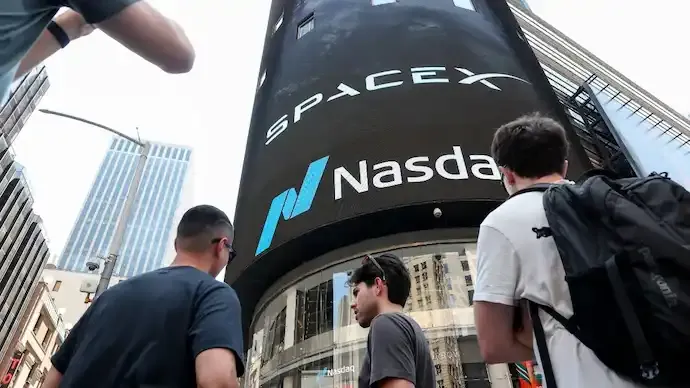
The broader US stock market also came under pressure, with the Nasdaq Composite falling 2.2%, the S&P 500 declining 1.2%, and the Dow Jones Industrial Average losing around 1%.

Alphabet Beats Revenue Expectations but AI Spending Raises Concerns
Alphabet reported another strong quarter in terms of revenue.
The technology giant posted:
- Revenue: $119.8 billion, above analyst expectations of $116.9 billion.
- Google Cloud revenue: $24.8 billion, representing 82% year-on-year growth.
Despite the impressive numbers, investors reacted negatively after the company increased its 2026 capital expenditure guidance.
Alphabet now expects to spend between $195 billion and $205 billion on capital investments in 2026, compared with its previous forecast of $180 billion to $190 billion.
During the second quarter alone, the company invested $44.9 billion in capital expenditure—almost double the amount spent during the same period last year.
Another concern for investors was Alphabet's negative free cash flow, reflecting the enormous cost of expanding AI infrastructure.
Tesla Reports First Cash Burn in Two Years
Tesla experienced an even steeper market reaction after reporting its first cash burn in two years.
Although the electric vehicle manufacturer exceeded revenue expectations, investors were concerned about weakening profitability and rapidly rising operating costs linked to future technologies.
Tesla reported:
- Revenue: $28.24 billion, up 25.5% year-on-year.
- Adjusted earnings per share: 33 cents, below analysts' expectations of 50 cents.
- Operating expenses: Up 47% year-on-year.
- Operating income: Down 57%.
- Operating margin: Declined from 4.1% to 1.4%.
The increased spending was driven by investments in:
- Artificial Intelligence (AI)
- Cybercab
- Optimus humanoid robot
- Tesla Semi
- Stock-based compensation
Despite weaker earnings, Tesla continued to post strong operational performance.
Vehicle deliveries reached a record 480,126 units, while energy storage deployments increased 41% and Full Self-Driving (FSD) subscriptions rose 56% compared with a year earlier.
Investors Shift Focus to Profitability
For much of the past two years, technology companies received strong market support for investing aggressively in artificial intelligence.
The latest earnings, however, suggest investor expectations are evolving.
Rather than rewarding companies solely for AI expansion, markets are increasingly evaluating:
- Cash flow
- Profit margins
- Operating efficiency
- Return on AI investments
- Earnings visibility
The reaction indicates that investors now expect technology companies to demonstrate when large AI investments will begin contributing meaningfully to profits.
Broader Market Sentiment
Market analysts noted that concerns over rising AI-related capital expenditure were compounded by other factors, including weakness in semiconductor stocks, higher oil prices and ongoing geopolitical uncertainty.
While many analysts continue to believe AI will remain a long-term growth driver, investors appear increasingly cautious about companies whose spending is rising faster than near-term earnings.
A New Phase in the AI Investment Cycle
The sharp declines in Tesla and Alphabet suggest Wall Street may be entering a new phase of the AI investment cycle.
Instead of rewarding companies simply for spending heavily on AI, investors are beginning to demand stronger evidence that those investments can generate sustainable revenue growth, improve profitability and create long-term shareholder value.
Key Highlights
- Tesla shares fell around 14% after reporting its first cash burn in two years.
- Alphabet declined approximately 7% despite reporting stronger-than-expected revenue.
- Alphabet increased its 2026 capital expenditure guidance to $195–205 billion.
- Tesla's operating margin narrowed sharply to 1.4%.
- The Nasdaq dropped 2.2% following the earnings reports.
- Investors are increasingly demanding stronger profitability and returns from AI investments.
Frequently Asked Questions (FAQs)
Why did Tesla shares fall?
Investors reacted to Tesla's first cash burn in two years, weaker-than-expected earnings, shrinking profit margins and rising spending on AI and future technologies.
Why did Alphabet's stock decline despite strong revenue?
Although Alphabet exceeded revenue expectations, investors were concerned by significantly higher capital expenditure plans and negative free cash flow driven by AI infrastructure investments.
What is capital expenditure?
Capital expenditure (CapEx) refers to money companies spend on long-term assets such as data centres, AI infrastructure, factories and equipment.
How much does Alphabet plan to spend on AI infrastructure?
The company raised its projected 2026 capital expenditure to between $195 billion and $205 billion.
Did Tesla report positive operational growth?
Yes. Tesla achieved record vehicle deliveries, higher energy storage deployments and continued growth in Full Self-Driving subscriptions despite weaker profitability.
What does this mean for AI stocks?
The latest market reaction suggests investors are becoming more selective, placing greater emphasis on profitability, cash flow and measurable returns rather than AI spending alone.






Conversation
Be kind and stay on topic. Comments are moderated; abuse, spam and personal attacks are removed. Report a problem