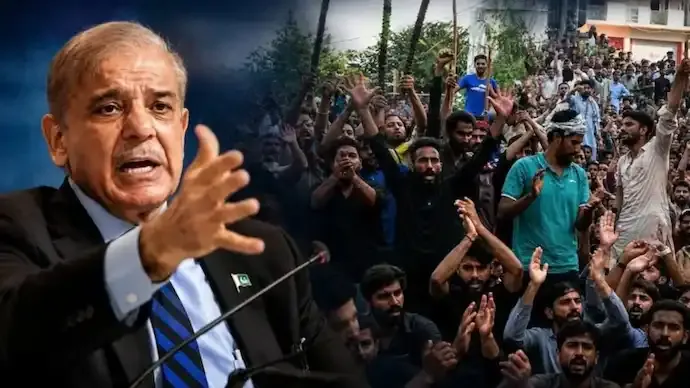
Pakistan-occupied Kashmir (POK), officially referred to by Pakistan as "Azad Jammu and Kashmir" (AJK), has long remained a subject of political debate and international attention. One question that frequently arises is why the region has its own President, Prime Minister, Legislative Assembly, and even a separate flag despite being administered by Pakistan.
At first glance, these institutions may appear to indicate a significant degree of self-governance. However, political analysts, constitutional experts, and activists have often questioned the extent of the region's autonomy, arguing that many important decisions remain heavily influenced by authorities in Islamabad.
The debate has gained renewed attention amid recent protests, political unrest, and allegations regarding governance and civil rights in the region.
POK Has a Separate Government Structure
Unlike Pakistan's provinces, Pakistan-occupied Kashmir has a distinct administrative setup that includes:
-
A President
-
A Prime Minister
-
A Legislative Assembly
-
A Separate Flag
-
Local Ministries and Administrative Departments
The region's capital is Muzaffarabad, where the local government operates.
Pakistan maintains that this structure reflects the special status of the territory and provides local representation for residents. However, critics argue that the arrangement creates an appearance of self-rule while significant powers remain concentrated elsewhere.
How Much Power Does the POK Government Actually Have?
While the Prime Minister and President of POK hold official positions, their authority is often viewed as limited when compared to Pakistan's federal leadership.
Key matters such as defense, foreign affairs, currency, national security, and strategic policy remain under Pakistan's control. Major decisions affecting the region are often linked to institutions based in Islamabad.
Analysts point out that the powers exercised by POK's leadership are significantly narrower than those held by leaders of fully sovereign governments.
This has led critics to argue that the region's political institutions function within a framework that allows only restricted autonomy.
Why Does POK Have a Separate Flag?
The separate flag is one of the most visible symbols of POK's distinct administrative identity.
Supporters of the arrangement argue that the flag represents the region's unique historical and political status. However, critics claim it is largely symbolic because the Pakistani national flag remains dominant in official functions and government affairs.
The existence of a separate flag, assembly, and executive offices has often been cited by Pakistan as evidence of local self-governance, while opponents argue that these symbols do not necessarily reflect genuine political independence.
Historical Background
The current administrative framework emerged following the first India-Pakistan conflict over Jammu and Kashmir in 1947-48. Since then, Pakistan has administered the territory while maintaining that its final status should be determined through broader political processes related to the Kashmir dispute.
Over the decades, various constitutional and administrative changes have shaped governance in the region, but debates over autonomy, representation, and decision-making authority have continued.
Political groups and activists in the region have periodically demanded greater powers, increased local control, and stronger democratic institutions.
Recent Protests and Growing Scrutiny
Recent demonstrations and political tensions have once again brought attention to governance issues in POK. Protesters have raised concerns regarding economic conditions, political representation, resource allocation, and administrative control.
The unrest has renewed discussions about whether existing institutions provide meaningful autonomy or merely serve as administrative structures operating within broader federal oversight.
These debates continue to shape political discourse both within the region and internationally.
Why the Issue Matters
The existence of a separate President, Prime Minister, Assembly, and flag often leads observers to assume that POK enjoys a level of autonomy similar to a self-governing territory.
However, critics argue that the real distribution of power tells a more complex story. While local institutions exist, questions persist regarding the extent of their authority and independence.
As political developments continue in the region, discussions surrounding governance, autonomy, and representation remain central to understanding the administrative structure of Pakistan-occupied Kashmir.
Prev Article
Afghan Taliban Says Pakistani Airstrikes Killed 13 People, Including 11 Children
Next Article
Bangladesh Jamaat Announces Border March Over Alleged Push-Ins, NCP Calls for Human Shield Along India Border