Shopping cart
Your cart empty!


Your cart empty!
Terms of use dolor sit amet consectetur, adipisicing elit. Recusandae provident ullam aperiam quo ad non corrupti sit vel quam repellat ipsa quod sed, repellendus adipisci, ducimus ea modi odio assumenda.
Lorem ipsum dolor sit amet consectetur adipisicing elit. Sequi, cum esse possimus officiis amet ea voluptatibus libero! Dolorum assumenda esse, deserunt ipsum ad iusto! Praesentium error nobis tenetur at, quis nostrum facere excepturi architecto totam.
Lorem ipsum dolor sit amet consectetur adipisicing elit. Inventore, soluta alias eaque modi ipsum sint iusto fugiat vero velit rerum.
Sequi, cum esse possimus officiis amet ea voluptatibus libero! Dolorum assumenda esse, deserunt ipsum ad iusto! Praesentium error nobis tenetur at, quis nostrum facere excepturi architecto totam.
Lorem ipsum dolor sit amet consectetur adipisicing elit. Inventore, soluta alias eaque modi ipsum sint iusto fugiat vero velit rerum.
Dolor sit amet consectetur adipisicing elit. Sequi, cum esse possimus officiis amet ea voluptatibus libero! Dolorum assumenda esse, deserunt ipsum ad iusto! Praesentium error nobis tenetur at, quis nostrum facere excepturi architecto totam.
Lorem ipsum dolor sit amet consectetur adipisicing elit. Inventore, soluta alias eaque modi ipsum sint iusto fugiat vero velit rerum.
Sit amet consectetur adipisicing elit. Sequi, cum esse possimus officiis amet ea voluptatibus libero! Dolorum assumenda esse, deserunt ipsum ad iusto! Praesentium error nobis tenetur at, quis nostrum facere excepturi architecto totam.
Lorem ipsum dolor sit amet consectetur adipisicing elit. Inventore, soluta alias eaque modi ipsum sint iusto fugiat vero velit rerum.
Do you agree to our terms? Sign up
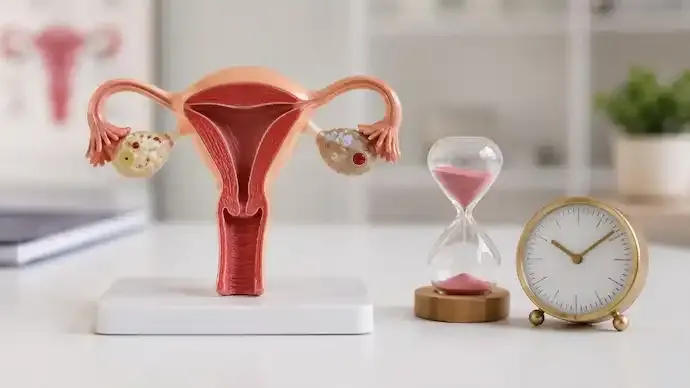
With girls reaching puberty at younger ages than in previous generations, many women wonder whether getting their first menstrual period (menarche) early could also mean experiencing menopause at a younger age.
Experts say that while research has identified an association between the two, an early first period alone does not determine when menopause will occur. Genetics, lifestyle and underlying health conditions continue to play a much larger role in reproductive ageing.
According to fertility specialists, studies suggest that women who experience their first period at a younger age may have a slightly higher likelihood of entering menopause earlier than others.
However, experts emphasise that this is an association rather than a direct cause-and-effect relationship.
Simply getting your first period at the age of 10 or 11 does not mean you are destined to experience early menopause.
One of the most common misconceptions is that women who begin menstruating earlier exhaust their egg reserve more quickly.
Experts say this is not how ovarian biology works.
Women are born with their lifetime supply of eggs, known as the ovarian reserve, which naturally declines with age. The age at which menstruation begins does not, by itself, accelerate this decline.
Instead, fertility specialists say the size and quality of the ovarian reserve are influenced by several factors, particularly genetics.
When fertility assessment is required, doctors generally rely on tests such as:
These provide a more reliable assessment of ovarian reserve than the age at which menstruation began.
Experts identify genetics as the strongest predictor of when menopause is likely to occur.
A woman's family history—particularly the age at which her mother reached menopause—often provides useful insight into her own reproductive timeline.
Other factors that may influence menopause include:
These conditions may affect ovarian function and reproductive health over time.
An early first period alone is generally not considered a medical concern.
However, doctors recommend seeking medical advice if early menstruation is accompanied by symptoms such as:
Such symptoms may indicate hormonal or reproductive health conditions that require further evaluation.
For most women, beginning menstruation early does not require any special fertility monitoring.
However, women with a family history of early menopause may benefit from discussing future family planning with a gynaecologist.
In some cases, doctors may recommend ovarian reserve assessments—such as AMH testing—in the late twenties or early thirties to better understand fertility potential.
Regardless of when menstruation begins, experts recommend adopting healthy lifestyle habits to support long-term reproductive health, including:
These measures can contribute to overall reproductive well-being throughout adulthood.
Not necessarily. Research suggests there may be an association, but an early first period does not directly determine when menopause will occur.
No. The age at which menstruation begins is not considered a reliable indicator of fertility or ovarian reserve.
Genetics is considered the strongest predictor, particularly the age at which a woman's mother experienced menopause.
Doctors commonly use Anti-Müllerian Hormone (AMH) testing and Antral Follicle Count (AFC) to evaluate ovarian reserve.
Women should consult a healthcare professional if early menstruation is accompanied by irregular periods, severe pain, heavy bleeding, hormonal symptoms or a family history of early menopause.
Yes. Smoking, obesity, thyroid disorders, certain medical treatments and reproductive health conditions may influence the timing of menopause.
4
Published: 2h ago

All India Story is your trusted source for comprehensive and up-to-the-minute news coverage across India. Bringing you the latest on politics, business, technology, entertainment, sports, and more, we are dedicated to keeping you informed with accurate, engaging, and insightful stories from every corner of the nation.