

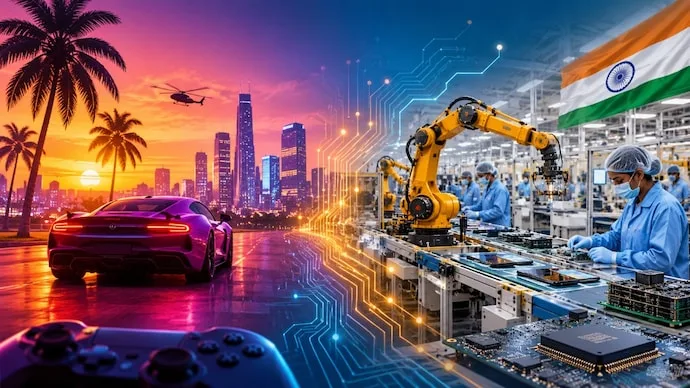

The India’s electronics manufacturing industry has undergone a major transformation in the years between the release of Grand Theft Auto V in 2013 and GTA VI. Electronics production has risen from around ₹1.9 lakh crore in 2014-15 to approximately ₹13.11 lakh crore in 2025-26, reflecting the country’s emergence as a significant manufacturing hub.
A social media post by Prakash Dadlani highlighted the shift, comparing growth in electronics and mobile phone production over the period.
Electronics production rises nearly eight-fold
According to a September 2026 Press Information Bureau factsheet, electronics production reached ₹13.11 lakh crore in 2025-26, up from ₹1.9 lakh crore in 2014-15. The sector recorded 15.8% annual growth in 2025-26.

Electronics exports also expanded, rising from around ₹38,000 crore in 2014-15 to approximately ₹3.3 lakh crore in 2024-25, according to MeitY.
Mobile phone manufacturing expands
Mobile phone production increased from around ₹18,000 crore in 2014-15 to ₹5.45 lakh crore in 2024-25, nearly 28 times higher. India’s manufacturing facilities grew from just two in 2014 to more than 300 operational units.
The country has also reduced its dependence on imported mobile phones. Government data cited in the supplied report said imports met around 75% of domestic demand in 2014-15, compared with 0.02% in 2024-25.
Mobile phone exports rose from ₹1,500 crore in 2014-15 to ₹2.59 lakh crore in 2025-26. India is now the world’s second-largest mobile phone manufacturer by volume.
Government schemes drive investment
The Make in India initiative, launched in 2014, aimed to attract investment and develop domestic manufacturing. Atmanirbhar Bharat, introduced in 2020, further emphasised self-reliance and stronger supply chains.
The Production Linked Incentive scheme for large-scale electronics manufacturing attracted ₹17,519 crore in investments by February 2026. Production under the scheme reached ₹11.01 lakh crore, while exports stood at ₹6.20 lakh crore.
The Electronics Components Manufacturing Scheme, notified in 2025, is intended to increase domestic production of components such as printed circuit boards, camera modules and other inputs. Its outlay was increased to ₹40,000 crore in the Union Budget 2026-27.
Local component manufacturing remains a challenge
Despite rapid growth, domestic value addition in electronics manufacturing remains around 18-20%, according to industry estimates cited by MeitY in April 2026. This means many high-value components are still imported, even when finished products are assembled in India.
India’s next challenge is to expand local manufacturing of semiconductors, displays, circuit boards and other critical components to deepen its role in global electronics supply chains.









Conversation
Be kind and stay on topic. Comments are moderated; abuse, spam and personal attacks are removed. Report a problem