
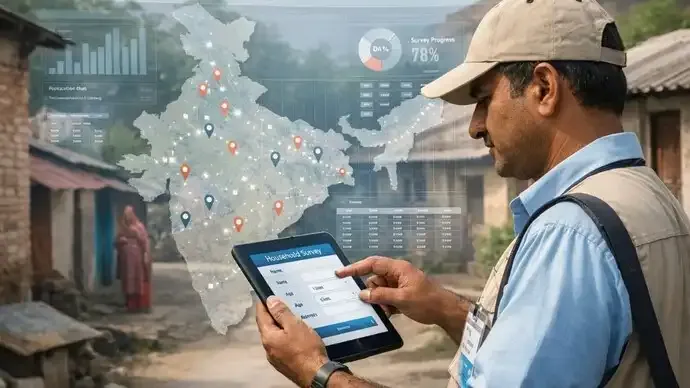
India has officially begun the first phase of Census 2027, marking a historic shift as the country adopts a digital-first approach for the first time. This massive exercise is set to become the world’s largest population census, combining technology, manpower, and data-driven processes.
The census starts with the House Listing and Housing Census phase, which commenced on April 1 across different states and Union Territories in a staggered manner.
First-Ever Digital Census with Self-Enumeration Option
A major highlight of this census is the introduction of digital tools, including mobile applications and self-enumeration features. Citizens now have the option to submit their data online, reducing dependency on manual processes and improving efficiency.
Enumerators will also use mobile devices to collect and upload data in real time. This digital transformation is expected to enhance accuracy, speed, and transparency in the overall process.
Massive Scale with Nationwide Coverage
Census 2027 is India’s 16th census overall and the eighth since Independence, making it one of the most extensive data collection exercises globally. It will cover every household across the country, involving lakhs of enumerators and supervisors.
The operation is being carried out in phases to ensure smooth execution, given the scale and diversity of India’s population. Authorities are focusing on streamlined coordination between central and state agencies.
Expanded Social and Economic Data Collection
Another key feature of this census is its broader social coverage. The data collection process is expected to include more detailed information on housing conditions, socio-economic indicators, and demographic changes.
This expanded dataset will play a crucial role in shaping government policies, welfare schemes, and development planning in the coming years. It will also provide insights into urbanisation, employment patterns, and population trends.
Key Details and Timelines Still Awaited
While the first phase has begun, several important aspects such as detailed timelines, full questionnaire structure, and final data release schedules are yet to be officially outlined.
Experts believe that the digital-first approach could significantly modernise India’s statistical systems, but its success will depend on execution, public participation, and technological reliability.
A Major Step Towards Data-Driven Governance
The launch of Census 2027 reflects India’s move towards technology-driven governance. By integrating digital tools into such a large-scale national exercise, the government aims to improve data quality and decision-making processes.
As the census progresses, it is expected to set new benchmarks in population data collection, both in terms of scale and innovation.






Conversation
Be kind and stay on topic. Comments are moderated; abuse, spam and personal attacks are removed. Report a problem