

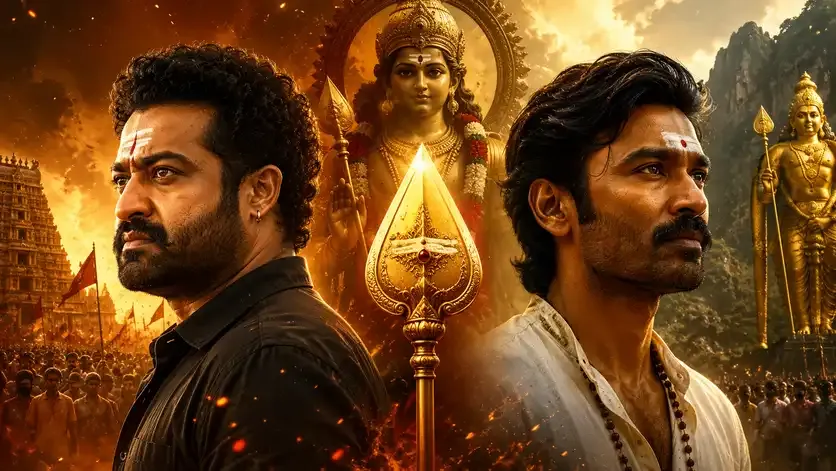

In the span of just a few days, two of South India's biggest stars—Jr NTR and Dhanush—announced ambitious films centered around Lord Murugan. While both projects draw inspiration from one of Tamil culture's most revered figures, they appear to offer strikingly different interpretations.
One presents Murugan as the widely worshipped Hindu deity revered across India. The other appears to reimagine him as an ancient Tamil warrior-king rooted in history and cultural identity.
Although neither film has officially revealed its complete storyline, the announcements alone have sparked widespread debate across social media, political circles and film communities.

Two Murugan Films, Two Different Visions
Jr NTR's upcoming film, directed by Trivikram Srinivas, is being positioned as a grand mythological spectacle celebrating Murugan's divine legacy.
In contrast, Dhanush and Vetri Maaran's Thamizh Murugan appears to explore Murugan through the lens of Tamil history, portraying him as a legendary king and protector rather than focusing solely on his religious identity.
The contrast has turned the two projects into one of Indian cinema's most discussed cultural conversations.
The Jr NTR-Trivikram Announcement That Triggered Debate
The controversy began after producer Naga Vamsi unveiled the first glimpse of Jr NTR and Trivikram's film on June 29.

The promotional tagline:
"Born in the North. Forged in the Heartland. Worshipped in the South."
quickly drew criticism in Tamil Nadu.
Many viewed the phrase as contradicting the long-held belief that Murugan, often referred to as Thamizh Kadavul (God of the Tamils), is deeply rooted in Tamil literature, Sangam traditions and regional culture.
The tagline prompted criticism from historians, political leaders and social media users, who argued that it overlooked Murugan's strong association with Tamil identity.
Dhanush's Thamizh Murugan Offers a Different Perspective
Just days later, Dhanush and filmmaker Vetri Maaran unveiled Thamizh Murugan.
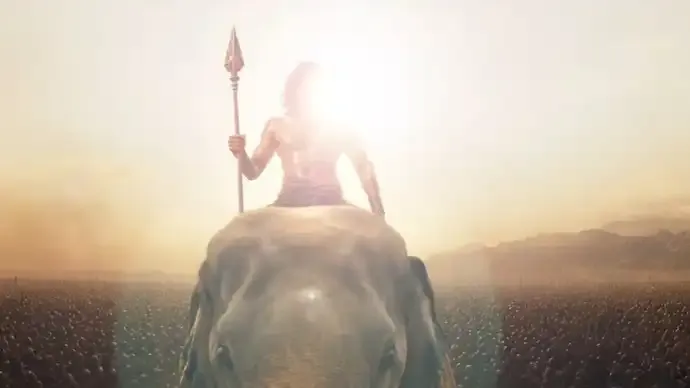
The announcement featured Dhanush seated atop an elephant, holding the iconic Vel (spear) and surrounded by warriors.
Instead of describing Murugan as a deity, the film introduced him as:
"The Eternal Protector, Warrior, King and Leader of the Thamizh people and lands."
The project is reportedly inspired by writer Arivumathi's book Thamizh Murugan, which explores the idea that Murugan's earliest identity may have been that of a historical Tamil leader before later becoming associated with Hindu mythology as Skanda or Kartikeya.
The filmmakers have not yet detailed how closely the film will follow this interpretation.
Why Vetri Maaran's Film Has Drawn Attention
Vetri Maaran is known for films that examine social justice, caste, politics and marginalized histories, including Asuran, Visaranai and Aadukalam.
Because of his filmmaking style, many believe Thamizh Murugan may explore Murugan through historical, cultural and political perspectives rather than as a traditional devotional epic.
However, the complete creative direction of the film will only become clear once official details are released.
Why Both Films Became Political Before Production
The discussion surrounding both projects extends beyond cinema.
Critics of the Jr NTR-Trivikram film argue that its promotional messaging appears to reinterpret Murugan's origins in a way that conflicts with Tamil cultural traditions.
Meanwhile, Thamizh Murugan has generated debate among some devotees because it appears to distinguish Murugan's historical and cultural identity from his religious significance.
As a result, the conversation has expanded into broader questions involving:
- Faith and mythology
- Tamil cultural identity
- Historical interpretation
- Regional traditions
- Representation in mainstream cinema
A Landmark Moment for South Indian Cinema
It is uncommon for two major stars to simultaneously develop large-scale films based on the same cultural figure.
What makes these announcements unique is that they seem to ask entirely different questions about Murugan.
One seeks to celebrate Murugan as a divine figure worshipped across India.
The other appears interested in examining Murugan's place in Tamil history and identity.
Whether audiences ultimately embrace one interpretation, both or neither, the debate has already ensured that these films will remain among the most closely watched projects in Indian cinema.
Key Highlights
- Jr NTR and Trivikram are developing a mythological film based on Lord Murugan.
- Dhanush and Vetri Maaran have announced Thamizh Murugan with a historical and cultural perspective.
- The promotional tagline of Jr NTR's film sparked criticism in Tamil Nadu.
- Thamizh Murugan reportedly draws inspiration from writer Arivumathi's work.
- The announcements have reignited discussions on faith, mythology, history and Tamil identity.
FAQs
Why are Jr NTR and Dhanush's Murugan films being compared?
Both films are based on Lord Murugan but appear to present different interpretations—one emphasizing his divine identity and the other exploring his historical and cultural significance.
Why did Jr NTR's film face criticism?
The promotional tagline describing Murugan as "Born in the North" drew criticism from those who believe Murugan's origins are deeply connected to Tamil culture and literature.
What is Thamizh Murugan about?
The film is reportedly inspired by writer Arivumathi's book, which examines Murugan's identity as a historical Tamil warrior and leader. The filmmakers have not yet revealed the complete storyline.
Has either film officially confirmed its storyline?
No. Both productions have only released initial announcements. Detailed plot information has not yet been officially disclosed.
Why is Lord Murugan significant in Tamil culture?
Murugan is widely revered as Thamizh Kadavul (God of the Tamils) and occupies a central place in Sangam literature, Tamil traditions and religious worship.





Conversation
Be kind and stay on topic. Comments are moderated; abuse, spam and personal attacks are removed. Report a problem