

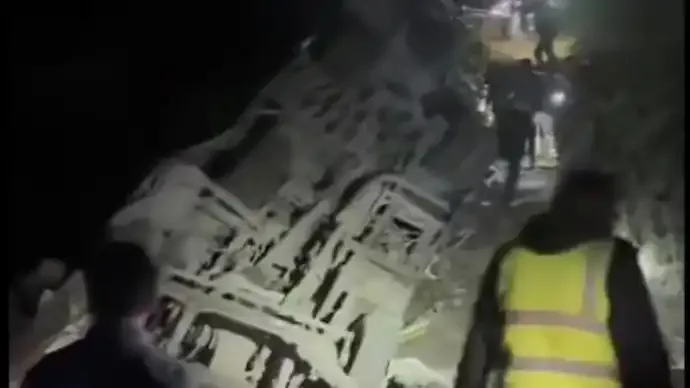

At least 18 people were killed and 26 injured after a passenger bus travelling from Pokhara to Kathmandu plunged into the Trishuli River in Nepal. The accident occurred in the early hours near the Bhaisepati area of Dhading district along the Prithvi Highway.
Authorities confirmed that the bus veered off the road and fell nearly 300 metres down a steep slope before crashing near the riverbank.
Victims Include Foreign Tourists
Officials said the deceased include 12 men and six women. Among those killed were two tourists from New Zealand — a man and a woman.

A total of 44 passengers were on board the bus at the time of the crash.
Injured Rescued and Hospitalised
Rescue teams evacuated 26 injured passengers and transported them to nearby hospitals for treatment. Several survivors sustained serious injuries and remain under medical care.
Some passengers were foreign nationals, though authorities are still verifying identities.
Challenging Night Rescue Operation
The rescue operation was carried out jointly by the Nepal Army, Armed Police Force and Nepal Police. Teams faced significant challenges due to darkness, steep terrain and limited rescue equipment.
Survivors were brought nearly one kilometre downstream by boat before being carried uphill to the road and transported by ambulance.
Officials said torchlights were used during the night rescue efforts, highlighting logistical difficulties at the remote site.
Investigation Underway
Authorities are investigating the cause of the accident. Initial reports suggest the bus lost control on the mountainous highway, a route known for sharp curves and steep drops.
Officials are assessing whether road conditions, vehicle failure or driver fatigue contributed to the crash.
Road Safety Concerns in Mountainous Terrain
Road accidents remain a major safety concern in Nepal’s hilly regions, where narrow highways, sharp turns and steep terrain pose significant risks.
The tragedy highlights the need for improved road safety measures and emergency response infrastructure in remote mountainous areas.
Rescue and recovery operations are ongoing as authorities continue efforts to identify victims and support survivors.





Conversation
Be kind and stay on topic. Comments are moderated; abuse, spam and personal attacks are removed. Report a problem