Shopping cart
Your cart empty!


Your cart empty!
Terms of use dolor sit amet consectetur, adipisicing elit. Recusandae provident ullam aperiam quo ad non corrupti sit vel quam repellat ipsa quod sed, repellendus adipisci, ducimus ea modi odio assumenda.
Lorem ipsum dolor sit amet consectetur adipisicing elit. Sequi, cum esse possimus officiis amet ea voluptatibus libero! Dolorum assumenda esse, deserunt ipsum ad iusto! Praesentium error nobis tenetur at, quis nostrum facere excepturi architecto totam.
Lorem ipsum dolor sit amet consectetur adipisicing elit. Inventore, soluta alias eaque modi ipsum sint iusto fugiat vero velit rerum.
Sequi, cum esse possimus officiis amet ea voluptatibus libero! Dolorum assumenda esse, deserunt ipsum ad iusto! Praesentium error nobis tenetur at, quis nostrum facere excepturi architecto totam.
Lorem ipsum dolor sit amet consectetur adipisicing elit. Inventore, soluta alias eaque modi ipsum sint iusto fugiat vero velit rerum.
Dolor sit amet consectetur adipisicing elit. Sequi, cum esse possimus officiis amet ea voluptatibus libero! Dolorum assumenda esse, deserunt ipsum ad iusto! Praesentium error nobis tenetur at, quis nostrum facere excepturi architecto totam.
Lorem ipsum dolor sit amet consectetur adipisicing elit. Inventore, soluta alias eaque modi ipsum sint iusto fugiat vero velit rerum.
Sit amet consectetur adipisicing elit. Sequi, cum esse possimus officiis amet ea voluptatibus libero! Dolorum assumenda esse, deserunt ipsum ad iusto! Praesentium error nobis tenetur at, quis nostrum facere excepturi architecto totam.
Lorem ipsum dolor sit amet consectetur adipisicing elit. Inventore, soluta alias eaque modi ipsum sint iusto fugiat vero velit rerum.
Do you agree to our terms? Sign up
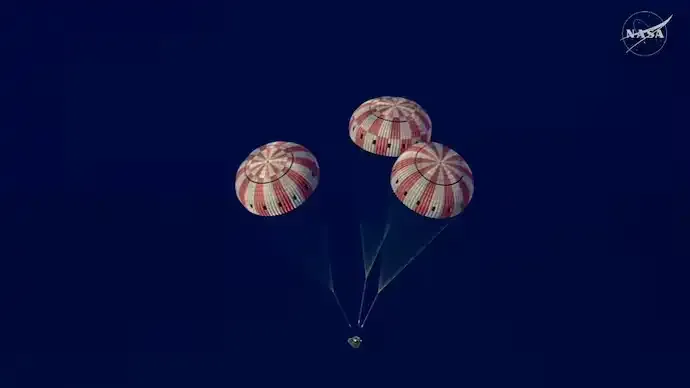
NASA’s Artemis II has successfully completed its journey, marking a major milestone in modern space exploration.
The spacecraft splashed down safely in the Pacific Ocean after carrying four astronauts on a historic mission around the Moon.
Artemis II is the first human mission to travel to the Moon’s vicinity since the Apollo program.
This makes it a defining moment in the return of human spaceflight beyond low Earth orbit.
The astronauts travelled approximately 4,06,778 km from Earth—farther than any human mission in history.

The mission demonstrated the capability for long-distance human space travel, paving the way for future lunar and Mars missions.
The return involved a high-speed re-entry through Earth’s atmosphere, followed by parachute deployment before splashdown.
The successful landing marked the safe return of all four astronauts.
The mission tested:
These are crucial for future long-duration missions.
Artemis II is part of NASA’s broader Artemis program, aimed at:
The mission signals a new era of international space collaboration and competition.
It also reaffirms the United States’ leadership in human space exploration.
Following Artemis II, future missions will aim to land astronauts on the Moon, including the first woman and next man.
The success of Artemis II marks the beginning of a new chapter in space exploration, with humanity once again reaching beyond Earth’s orbit.
84
Published: Apr 11, 2026

All India Story is your trusted source for comprehensive and up-to-the-minute news coverage across India. Bringing you the latest on politics, business, technology, entertainment, sports, and more, we are dedicated to keeping you informed with accurate, engaging, and insightful stories from every corner of the nation.