

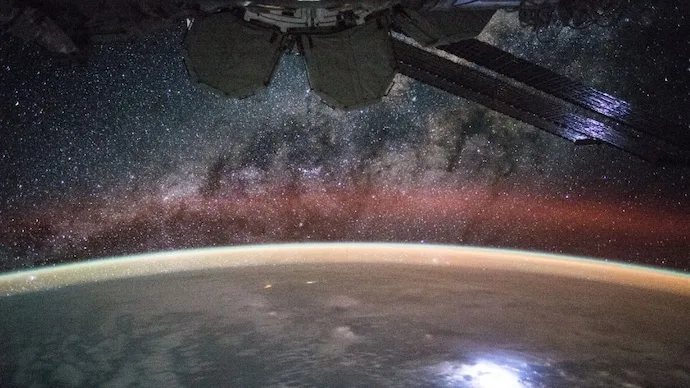

Shubhanshu Shukla airglow has once again drawn attention to one of Earth’s most subtle atmospheric phenomena. The Indian astronaut shared a video showing Earth’s curved horizon, city lights and a thin glowing band separating the planet from the darkness of space.
Airglow is a natural, extremely faint light produced by atoms and molecules in Earth’s upper atmosphere. Although it surrounds the planet continuously, it is generally too faint to be noticed easily from the ground.
Solar ultraviolet radiation provides much of the energy behind the phenomenon. During the day, sunlight energises or breaks apart atmospheric molecules. As these atoms and molecules undergo chemical reactions and return to lower-energy states, they release some of that energy as light.

On the night side, similar processes continue, producing what is commonly called “nightglow”.
Why Does Airglow Have Different Colours?
Airglow can appear in several colours depending on the atmospheric gases involved and the chemical reactions taking place.
Green light is strongly associated with atomic oxygen at altitudes of roughly 95–100 km. Sodium can produce yellow-orange light at around 85–90 km, while other atmospheric processes can generate red and other wavelengths.
The phenomenon becomes much easier to observe from orbit because astronauts have a clear view of Earth’s edge against the darkness of space.
Airglow vs Auroras: What’s the Difference?
Airglow and auroras may look similar, but they are created through different processes.
Auroras occur when energetic particles associated with the solar wind interact with gases in the upper atmosphere, particularly near the polar regions. Airglow, on the other hand, is a much fainter and more widespread phenomenon driven largely by solar radiation and atmospheric chemistry.
Airglow is also scientifically important. Changes in its colour and intensity can help scientists study the composition, temperature and movements of Earth’s upper atmosphere.
For Shubhanshu Shukla, the glowing line along Earth’s horizon offered a spectacular view. For scientists, it provides another window into the complex environment surrounding our planet.






Conversation
Be kind and stay on topic. Comments are moderated; abuse, spam and personal attacks are removed. Report a problem