

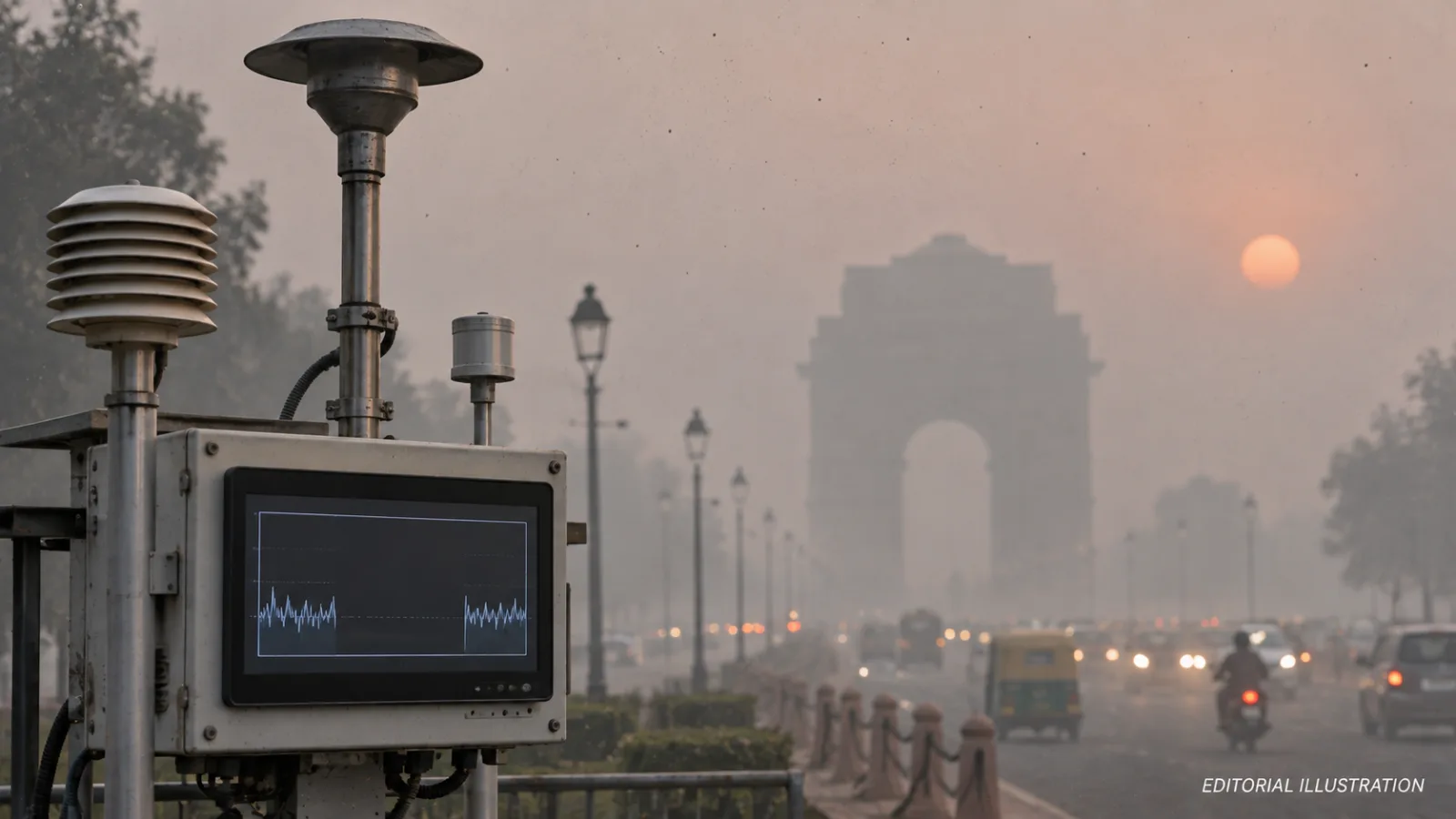

NEW DELHI, November 11, 2026: The Central Pollution Control Board (CPCB) has acknowledged that extreme particulate pollution readings above 1,000 micrograms per cubic metre are excluded from India's official Air Quality Index (AQI) calculations, following concerns over missing pollution data during Diwali night in Delhi.
In a clarification issued on November 10, the pollution regulator explained that its automated data validation system treats concentrations exceeding the prescribed measurement range as invalid for AQI calculations.
The explanation follows reports that dozens of Delhi's air quality monitoring stations stopped displaying PM2.5 readings during the hours when pollution levels were rising sharply.

Data released separately by the Delhi Pollution Control Committee (DPCC) revealed that PM2.5 concentrations had reached 3,744 micrograms per cubic metre at Mundka and exceeded 3,000 at two other locations.
The CPCB has said it is reviewing its methodology to address readings beyond the existing system's designed range.
Why Does CPCB Exclude PM2.5 Readings Above 1,000?
According to the pollution watchdog, India's National Air Quality Index was introduced in 2015 using instruments calibrated to measure particulate matter concentrations within a range of zero to 1,000 micrograms per cubic metre.
The automated validation process was designed around that measurement range.
When an hourly reading exceeds the limit, the system classifies it as outside the permitted range and excludes it from the calculation.
This means the value may not appear in the official data used to calculate the relevant pollutant's 24-hour average.
During ordinary conditions, the issue may have little effect because concentrations generally remain within the designed range.
However, extreme pollution episodes such as Diwali can produce readings far beyond that limit.
The CPCB acknowledged that these periods may create apparent gaps in the data displayed for individual monitoring stations.
The regulator said the methodology is under review as monitoring technology has advanced considerably since the AQI framework was introduced.
Delhi's PM2.5 Reached 3,744 During Diwali Night
The controversy intensified after previously unavailable readings from DPCC monitoring stations showed how severe pollution had become during the night of November 8 and the early hours of November 9.
The highest concentrations reported included:
- Mundka: 3,744 micrograms per cubic metre at 2 am on November 9.
- Jawaharlal Nehru University: 3,023 micrograms per cubic metre at 4 am.
- NSUT West Campus: 3,008 micrograms per cubic metre at 5 am.
- Mandir Marg: 2,908 micrograms per cubic metre at 3 am.
- Nehru Nagar: 2,808 micrograms per cubic metre at 3 am.
- Wazirpur: 2,721 micrograms per cubic metre at 1 am.
The figures were reported in an analysis of DPCC data published by Hindustan Times.
According to that analysis, 11 DPCC monitoring stations recorded PM2.5 concentrations exceeding 2,000 micrograms per cubic metre.
These are hourly pollution concentrations, not AQI scores.
India's national 24-hour PM2.5 standard is 60 micrograms per cubic metre. Although the recorded hourly peaks were many times higher, an individual hourly measurement cannot be treated as equivalent to a full-day average.
The readings nevertheless demonstrate the intensity of the short-term pollution episode experienced in several parts of Delhi.
Why Did 43 Delhi Air Quality Monitoring Stations Show Missing Data?
The missing readings became a major issue after news reports examined pollution records from Delhi's network of 59 monitoring stations.
An analysis by Hindustan Times found that 43 stations had at least one gap in PM2.5 reporting between 10 pm on November 8 and 6 am on November 9.
Several stations showed concentrations approaching 1,000 micrograms per cubic metre shortly before their particulate data disappeared from the published records.
For example, readings at certain locations climbed to approximately 980 or 990 before subsequent values became unavailable.
At the same time, several monitoring stations continued reporting gases such as carbon monoxide, nitrogen dioxide and ozone.
This is an important distinction.
A missing PM2.5 reading does not necessarily mean that the entire monitoring station lost power or stopped operating.
The CPCB's explanation indicates that some of the data gaps resulted from its automated system excluding particulate readings that exceeded the accepted measurement range.
However, the explanation does not independently establish that every missing reading was caused by the same issue.
Difference Between PM2.5 Concentration and AQI
One source of confusion is the difference between PM2.5 concentration and the Air Quality Index.
PM2.5 refers to fine particles measuring 2.5 micrometres or smaller in diameter.
These particles can enter deep into the lungs and are associated with respiratory and cardiovascular health risks.
Their concentration in the air is measured in micrograms per cubic metre.
The Air Quality Index, on the other hand, converts pollutant concentrations into a standardised number that communicates overall air quality conditions.
India's AQI uses six categories:
- 0 to 50: Good
- 51 to 100: Satisfactory
- 101 to 200: Moderate
- 201 to 300: Poor
- 301 to 400: Very Poor
- 401 to 500: Severe
The Indian AQI scale has a maximum reported value of 500.
That does not mean pollution concentrations cannot continue rising beyond the level associated with an AQI of 500.
For example, a PM2.5 concentration of 3,744 micrograms per cubic metre is a measured pollutant concentration, not an AQI of 3,744.
The distinction matters when interpreting air quality data and comparing reports from different monitoring services.
How Is India's Air Quality Index Calculated?
India's National Air Quality Index considers eight pollutants:
- PM2.5
- PM10
- Carbon monoxide
- Nitrogen dioxide
- Sulphur dioxide
- Ammonia
- Ozone
- Lead
For most pollutants, the system calculates a sub-index using the average concentration over the preceding 24 hours.
Carbon monoxide and ozone use an eight-hour averaging period.
The highest available pollutant sub-index determines the overall AQI at a monitoring location.
Under the CPCB methodology, a valid overall AQI generally requires sufficient readings for at least three pollutants, including either PM2.5 or PM10.
For pollutants assessed over 24 hours, at least 16 hours of valid data are generally required to calculate a sub-index.
This explains why the exclusion of extreme hourly values can become significant.
When readings from the most polluted hours are removed, the reported averages may not fully represent the concentrations experienced during that period.
CPCB Says AQI Reflects Exposure Over Time
In its clarification, the CPCB defended the use of longer averaging periods for calculating the National Air Quality Index.
The regulator said the system is intended to reflect prolonged exposure rather than individual short-lived spikes.
It referred to the National Ambient Air Quality Standards, which establish different averaging periods to assess pollution exposure.
The board also explained that the AQI cannot exceed 500 under the existing Indian scale.
Once the index reaches that level, additional pollution does not create a new health category.
According to the CPCB, private air quality platforms may display different figures because some place greater emphasis on immediate readings rather than the official rolling averages.
However, the distinction between an hourly pollution spike and a longer-term average does not eliminate the importance of recording the actual concentration.
Detailed hourly data remain useful for assessing pollution episodes, studying exposure and understanding whether control measures are effective.
Environmental Experts Question Missing Pollution Readings
Environmental researchers have raised concerns about the implications of excluding readings precisely when pollution concentrations are at their highest.
Sunil Dahiya, founder and lead analyst at Envirocatalysts, argued that complete pollution data are necessary to evaluate the effectiveness of measures intended to reduce emissions.
He said the information is relevant not only to government agencies but also to researchers, courts, journalists and members of the public.
Experts have questioned whether excluding extreme values could result in published averages that understate pollution conditions during severe episodes.
The concern is especially relevant during Diwali, when firecracker emissions can combine with unfavourable weather conditions and existing pollution to cause sharp increases in particulate concentrations.
Researchers have called for greater transparency in the publication of raw monitoring data and clearer explanations when readings are excluded.
The debate is not simply about whether the AQI scale should extend beyond 500.
It is also about whether the underlying measurements should remain accessible even when concentrations exceed the range used by the official calculation system.
CPCB Reviewing Air Pollution Monitoring Methodology
The CPCB has acknowledged that pollution monitoring technology has developed since the National Air Quality Index framework was established.
Modern instruments may be capable of measuring concentrations outside the range used by the existing validation process.
The regulator said internal discussions and consultations were underway to determine how such readings should be processed.
It has not announced a final revised methodology or a date for implementing changes.
The clarification comes at a time when Delhi's winter air pollution remains a major public health concern.
The latest episode has highlighted the need for monitoring systems that can capture both prolonged exposure and exceptionally high short-term concentrations.
For residents, the difference between a reported AQI score and actual pollution levels is more than a technical issue.
Accurate monitoring helps people understand the conditions they are breathing in, while reliable historical data allow authorities to assess whether pollution control measures are producing results.
The central question now is how the CPCB will update its reporting framework so that extreme pollution readings remain available and scientifically useful without compromising the consistency of the national AQI system.
Source attribution: This report is based on the CPCB's November 10 clarification, Delhi Pollution Control Committee data as analysed by Hindustan Times, and reporting by The Indian Express, Moneycontrol and The New Indian Express.


Conversation
Be kind and stay on topic. Comments are moderated; abuse, spam and personal attacks are removed. Report a problem