

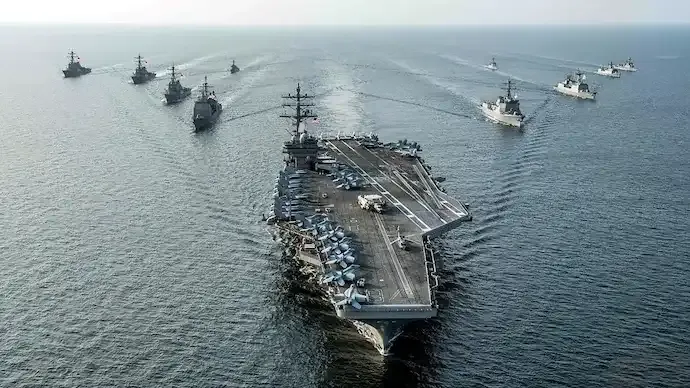

Aircraft carriers have become a central element in the ongoing conflict involving Iran, as the United States strengthens its military presence in the Middle East. These massive naval vessels are among the most powerful and expensive defence systems in the world and are often described as floating military bases capable of projecting power across vast distances.
The United States has already deployed major aircraft carriers to the region as tensions with Iran intensified. The USS Abraham Lincoln and the USS Gerald R. Ford were positioned in strategic waters such as the Arabian Sea and the Red Sea before the conflict escalated. Aircraft operating from these carriers have reportedly been involved in military strikes targeting Iranian positions since late February.
Reports indicate that the US is now considering deploying a third aircraft carrier, the USS George H.W. Bush, along with its carrier strike group to the Middle East. If deployed, it would significantly increase the American naval presence in the region and provide additional operational flexibility for military actions.

Aircraft carriers serve as mobile airbases that allow navies to conduct combat operations without relying on land-based infrastructure. These ships carry fighter jets, helicopters, surveillance aircraft, and advanced radar systems. Accompanied by a carrier strike group of destroyers, cruisers, submarines, and supply ships, they form a powerful naval force capable of conducting air strikes, intelligence missions, and maritime security operations.
Because of their advanced technology and massive operational capability, aircraft carriers are considered one of the most expensive military assets ever built. Their ability to project air power from the sea makes them a critical component of modern naval strategy.
Globally, only a limited number of countries operate aircraft carriers. Out of the 15 nations that possess these vessels, only eight countries have carriers capable of launching both helicopters and fixed-wing aircraft from their decks.
India is among these select countries. The Indian Navy operates aircraft carriers that play a crucial role in protecting maritime interests and maintaining strategic balance in the Indian Ocean region. Aircraft carriers allow India to project naval power, support humanitarian missions, and respond quickly to regional security challenges.

India’s carrier capabilities are seen as an important element of its broader defence strategy, particularly as maritime security becomes increasingly significant in global geopolitics. With expanding trade routes and growing strategic competition in the Indo-Pacific region, aircraft carriers provide India with greater operational reach and deterrence capability.

While the US continues to expand its military deployment in the Middle East amid the Iran conflict, India is closely monitoring developments in the region. The situation is particularly important for India due to its energy interests, trade routes, and the presence of a large Indian diaspora in West Asia.

Experts believe that aircraft carriers will continue to remain a central component of naval power in modern warfare. Their ability to rapidly deploy air power across oceans makes them a strategic asset for countries seeking to maintain influence and security across global maritime regions.

As geopolitical tensions evolve, the role of aircraft carriers in shaping military strategy and regional stability is expected to remain significant in the years ahead.





Conversation
Be kind and stay on topic. Comments are moderated; abuse, spam and personal attacks are removed. Report a problem