

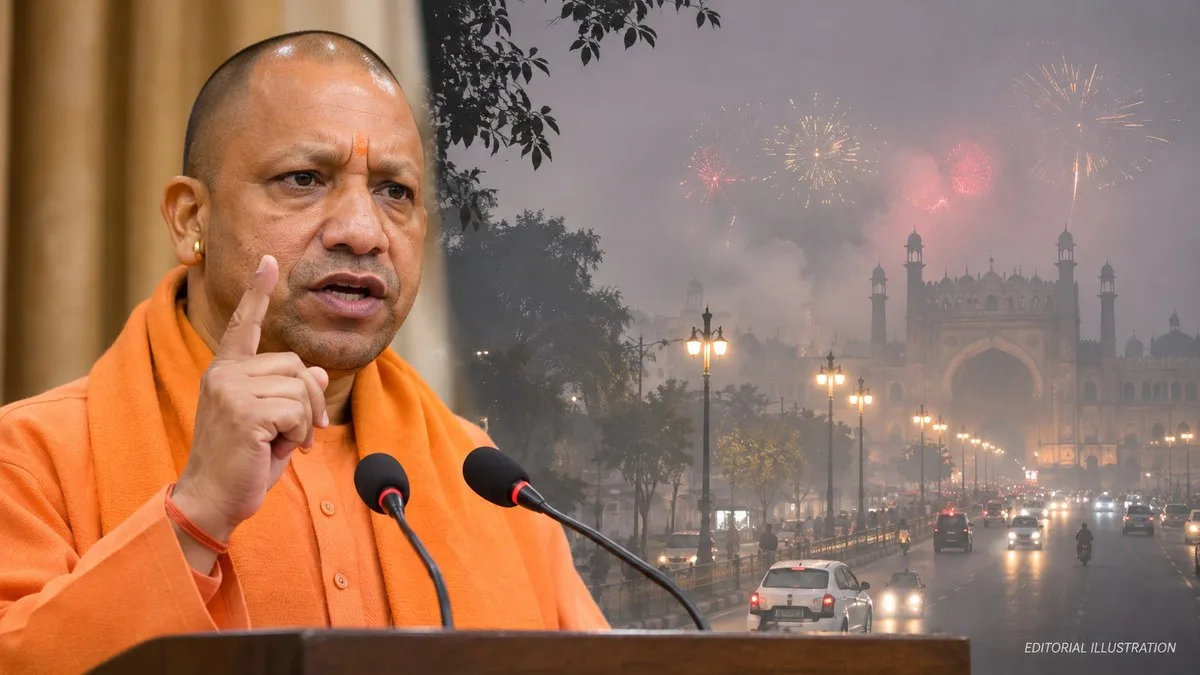

LUCKNOW, November 11, 2026: Uttar Pradesh Chief Minister Yogi Adityanath on Wednesday defended the bursting of firecrackers during Diwali, saying the resulting increase in air pollution would gradually subside. His remarks came amid concerns over deteriorating air quality in Lucknow and several other cities across the state following the festival.
Addressing a government programme in Lucknow, Adityanath questioned why people who criticised firecracker celebrations did not express similar concerns about corruption, which he said had polluted the system under previous governments.
The comments came after Lucknow's Air Quality Index (AQI) rose to 245 on November 9, a day after Diwali, before improving to 172 on Tuesday as winds helped disperse pollutants.

While the improvement provided some relief, pollution levels across parts of Uttar Pradesh remained a concern, particularly for people with respiratory illnesses.
What Did Yogi Adityanath Say About Diwali Firecrackers?
The Chief Minister made the remarks during a programme organised to distribute appointment letters to newly recruited junior assistants in the state revenue department.
Speaking about Diwali celebrations, Adityanath acknowledged that air pollution had increased but argued that the situation would improve.
"So what if it has increased? It will subside as well. Why are you worried?" he said, according to a report by news agency PTI.
He defended people who celebrated the festival with fireworks and said the state government had decided against imposing restrictions on firecracker use.
Adityanath also referred to his participation in Diwali celebrations in Ayodhya, where he attended the Deepotsav festivities.
His remarks suggested that he viewed the criticism of firecrackers as disproportionate to the temporary nature of the pollution increase.
However, the statement has brought attention to the distinction between pollution levels eventually falling and the potential health effects of exposure while concentrations remain elevated.
Yogi Adityanath Questions Critics Over Corruption
During the speech, Adityanath drew a comparison between environmental pollution and corruption in public life.
He questioned why those raising concerns about firecracker emissions had not, in his view, been equally vocal about corruption under previous administrations.
The Chief Minister argued that people should be allowed to celebrate festivals with enthusiasm without facing what he described as selective criticism.
He also criticised the previous political environment in Uttar Pradesh, claiming that communal tensions frequently accompanied major religious festivals before the Bharatiya Janata Party came to power in 2017.
Adityanath referred to festivals celebrated by different communities, including Holi, Diwali, Eid, Christmas, Guru Parv and Janmashtami.
His comments presented the government's position that public celebrations should take place without fear or unnecessary restrictions.
The claims about previous governments and selective criticism form part of his political argument and are separate from the independently recorded air pollution data.
Lucknow AQI Rose to 245 After Diwali
Air quality monitoring figures show that pollution increased in Lucknow during the days leading up to and immediately following Diwali.
According to Central Pollution Control Board data cited in reports by The Times of India and Hindustan Times, the city's AQI followed this pattern:
- November 5: AQI 188, Moderate
- November 6: AQI 193, Moderate
- November 7: AQI 207, Poor
- November 8, Diwali: AQI 233, Poor
- November 9: AQI 245, Poor
- November 10: AQI 172, Moderate
The figures show that Lucknow's air quality had already begun deteriorating before Diwali.
The AQI increased further during the festival and reached its highest reported daily level in this period on November 9.
By the following day, stronger winds helped disperse some of the accumulated pollutants, bringing the AQI down by 73 points.
The improvement supports the observation that pollution concentrations can decline as atmospheric conditions change.
However, an AQI of 172 still falls within the moderate category and does not indicate pollution-free air.
Thick Smoke Reduced Visibility in Lucknow on Diwali Night
The impact of the celebrations was particularly noticeable during the night of November 8.
According to Hindustan Times' reporting, thick smoke spread across several areas of Lucknow, with road visibility falling to approximately 200 metres around midnight.
The city experienced widespread firecracker use during the celebrations, adding particulate pollution to air that was already affected by traffic emissions, road dust and other sources.
Weather conditions also played a role.
Low wind speeds can prevent pollutants from dispersing quickly, allowing smoke and fine particles to accumulate closer to the ground.
As a result, pollution levels may remain elevated even after firecracker activity has ended.
Lucknow's six air quality monitoring stations recorded worsening conditions during the festival period, although pollution concentrations varied across locations.
The episode demonstrated how seasonal emissions and short-term activities can combine to produce poor air quality.
Air Pollution Worsens Across Noida, Ghaziabad and Other UP Cities
Lucknow was not the only city affected by pollution during Diwali.
According to CPCB figures cited by Hindustan Times, several urban centres in western Uttar Pradesh recorded poor or very poor air quality.
On November 8, the reported AQI values included:
- Ghaziabad: 344, Very Poor
- Noida: 318, Very Poor
- Greater Noida: 299, Poor
- Meerut: 295, Poor
The figures illustrate the wider pollution problem affecting the National Capital Region and neighbouring districts during the festive period.
Air quality conditions in these cities are influenced by multiple factors, including vehicle emissions, industrial activity, construction dust, seasonal weather and other sources of particulate matter.
Firecracker emissions can add to that existing pollution burden.
It would therefore be inaccurate to attribute every increase in AQI exclusively to fireworks without examining the relative contribution of different sources.
Nevertheless, the readings show that residents experienced elevated pollution levels during the celebrations.
What Does Poor or Very Poor AQI Mean for Health?
India's National Air Quality Index categorises pollution levels according to their potential health impact.
Under the CPCB classification:
- AQI 101 to 200, Moderate: May cause breathing discomfort among people with respiratory or heart conditions, children and older adults.
- AQI 201 to 300, Poor: May cause breathing discomfort to most people during prolonged exposure.
- AQI 301 to 400, Very Poor: May increase the risk of respiratory illness during prolonged exposure.
- AQI 401 to 500, Severe: May affect healthy individuals and seriously impact people with existing illnesses.
Fine particulate matter, especially PM2.5, is a major concern because these tiny particles can travel deep into the respiratory system.
Exposure can aggravate existing respiratory and cardiovascular conditions, particularly when pollution concentrations remain elevated.
Although weather changes may eventually reduce the concentration of pollutants in the air, they do not reverse exposure that has already occurred.
This makes both pollution prevention and timely public health information important during periods of unusually high emissions.
Why Does Air Quality Improve After Diwali?
The decline in Lucknow's AQI from 245 on November 9 to 172 on November 10 can partly be explained by changes in weather conditions.
Wind helps transport and disperse accumulated pollutants, reducing their concentration in a particular area.
When firecracker use decreases after the festival, one additional source of emissions also becomes less significant.
However, the speed of improvement depends on several factors, including wind direction, atmospheric stability, temperature and the continued release of pollutants from vehicles, industries and other sources.
A reduction in AQI does not necessarily mean that the underlying pollution problem has been resolved.
Lucknow's readings demonstrate this distinction. The air improved from poor to moderate, but the city did not return to the satisfactory category by November 10.
Diwali Celebrations and Air Pollution Remain a Policy Debate
The Chief Minister's remarks have brought renewed attention to the question of how governments should balance festival celebrations with environmental and public health concerns.
Supporters of unrestricted celebrations emphasise religious traditions, public participation and the importance of allowing communities to celebrate festivals freely.
Those concerned about air pollution point to the health consequences of concentrated emissions, especially in cities already experiencing poor air quality.
The two concerns do not necessarily require an all-or-nothing approach.
Public authorities can examine how pollution from different sources affects air quality while also considering measures that reduce harmful emissions during large celebrations.
Accurate monitoring, transparent reporting and practical public health guidance are important parts of that discussion.
Adityanath has maintained that the pollution increase following Diwali will subside, and Lucknow's November 10 readings show a measurable improvement.
The broader issue, however, remains how to reduce harmful exposure during periods when air pollution rises sharply.
With winter approaching and several Uttar Pradesh cities already recording poor air quality, the effectiveness of pollution control measures is likely to remain under scrutiny.
Source attribution: This article is based on Yogi Adityanath's November 11 public remarks as reported by PTI, The Indian Express and other news organisations, along with CPCB air quality figures and published reporting on pollution conditions in Lucknow.


Conversation
Be kind and stay on topic. Comments are moderated; abuse, spam and personal attacks are removed. Report a problem