
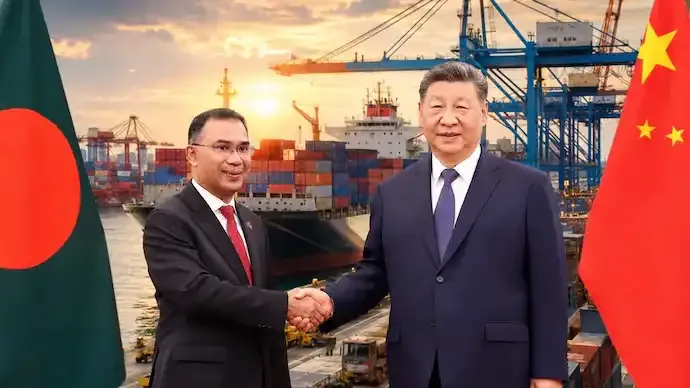
China has proposed a new multimodal economic corridor linking China with Bangladesh through Myanmar, marking a significant expansion of its regional connectivity ambitions beyond the China-Pakistan Economic Corridor (CPEC). The proposal emerged during Bangladeshi Prime Minister Tarique Rahman's recent visit to Beijing, where Chinese President Xi Jinping discussed deeper economic cooperation between the two countries.
If implemented, the proposed corridor would provide China with another strategic route to the Bay of Bengal, complementing its western access to the Arabian Sea through Pakistan under CPEC. While supporters view the initiative as an opportunity to boost trade and infrastructure development, analysts believe it could also carry important geopolitical and strategic implications for India and the broader Indo-Pacific region.
What Is the Proposed China-Bangladesh Economic Corridor?
According to reports, China has proposed developing a multimodal transport and trade corridor connecting southwestern China with Bangladesh through Myanmar.
The project is expected to integrate multiple modes of transportation, including:
- Highways.
- Rail connectivity.
- Port infrastructure.
- Logistics networks.
- Trade corridors.
The proposal forms part of Beijing's broader regional connectivity strategy under its infrastructure and trade initiatives.
Why Is China Pursuing Another Regional Corridor?
China has spent years investing heavily in international connectivity projects aimed at improving trade routes and supply chains.
Following the development of the China-Pakistan Economic Corridor (CPEC), which provides access to the Arabian Sea through Pakistan, the proposed Bangladesh route would potentially strengthen China's presence along the Bay of Bengal.
From Beijing's perspective, diversified transport corridors can:
- Improve regional trade.
- Expand market access.
- Strengthen logistics networks.
- Reduce dependence on single transport routes.
- Deepen economic partnerships across South Asia.
Bangladesh's Role in the Proposal
During bilateral discussions in Beijing, Bangladesh reportedly expressed interest in expanding economic cooperation with China.
As part of the discussions, Bangladesh agreed to work with a Chinese state-owned company to develop an economic zone near Mongla Port, one of the country's important maritime gateways.
Bangladeshi officials have indicated that improved connectivity could:
- Increase trade volumes.
- Modernise transport infrastructure.
- Expand port capacity.
- Improve access to regional markets.
- Attract foreign investment.
The corridor proposal remains at the discussion stage and no implementation timeline has been officially announced.
How Does It Compare With CPEC?
The China-Pakistan Economic Corridor (CPEC) is one of the flagship projects under China's Belt and Road Initiative (BRI).
Key differences include:
| Feature | CPEC | Proposed Bangladesh Corridor |
|---|---|---|
| Primary Route | China-Pakistan | China-Myanmar-Bangladesh |
| Maritime Access | Arabian Sea | Bay of Bengal |
| Main Objective | Trade, energy and connectivity | Trade, logistics and regional connectivity |
| Current Status | Operational across multiple sectors | Proposal stage |
Both initiatives reflect China's long-term focus on expanding regional infrastructure and trade links.
What Could It Mean for India?
The proposed corridor has attracted attention because of its geographical proximity to India's eastern border.
Strategic analysts suggest several possible implications:
Increased Regional Connectivity
The project could improve transportation and trade links across parts of South Asia.
Greater Chinese Economic Presence
Additional infrastructure investment may further expand China's economic influence in neighbouring countries.
Strategic Considerations
Enhanced Chinese connectivity near the Bay of Bengal could become an important factor in India's long-term strategic planning and maritime security assessments.
However, experts also caution that the proposal remains at an early stage, and its eventual scope, financing, and implementation remain uncertain.
Challenges Facing the Project
Despite its economic potential, the proposed corridor could face several obstacles.
Political and Security Issues
Parts of Myanmar continue to experience instability, which may complicate infrastructure development.
Financing Requirements
Large-scale transport corridors typically require substantial long-term investment.
Infrastructure Development
Extensive construction would be needed across multiple countries to establish integrated transport networks.
Regional Diplomacy
Successful implementation would depend on sustained cooperation among participating governments.
Bay of Bengal's Growing Strategic Importance
The Bay of Bengal has become increasingly significant in regional trade and maritime strategy.
Several countries are investing in:
- Port modernisation.
- Maritime infrastructure.
- Shipping connectivity.
- Industrial zones.
- Regional logistics.
The proposed corridor reflects the growing importance of the region in international commerce.
Broader Geopolitical Context
China's infrastructure diplomacy has become a defining feature of its foreign policy over the past decade.
Projects under the Belt and Road Initiative have expanded across Asia, Africa, Europe, and other regions, often combining economic cooperation with long-term strategic engagement.
India has consistently monitored regional infrastructure developments that could influence trade routes, connectivity, and strategic dynamics across South Asia and the Indian Ocean region.
Featured Snippet
China has proposed a new economic corridor linking Bangladesh through Myanmar, expanding its regional connectivity ambitions beyond the China-Pakistan Economic Corridor (CPEC). The proposal could improve regional trade and transport while carrying significant geopolitical implications for South Asia and the Bay of Bengal.
Key Highlights
- China has proposed a new economic corridor linking Bangladesh through Myanmar.
- The proposal emerged during talks between Xi Jinping and Bangladeshi Prime Minister Tarique Rahman.
- Bangladesh plans to develop an economic zone near Mongla Port with a Chinese state-owned company.
- The corridor would provide China another route toward the Bay of Bengal.
- The proposal follows China's investments under CPEC.
- Supporters highlight potential trade and infrastructure benefits.
- Analysts say the project could have strategic implications for India.
- The proposal remains at an early stage with no confirmed implementation timeline.
Conclusion
China's proposal for a Bangladesh-Myanmar economic corridor represents another step in its broader regional connectivity strategy. While the initiative promises improved trade, transport, and infrastructure for participating countries, it also carries wider geopolitical implications due to its location near India's eastern frontier and the strategically important Bay of Bengal. As discussions progress, regional governments and international observers will closely monitor how the proposal develops and what impact it may have on South Asian connectivity and regional strategic dynamics.
FAQs
1. What is the proposed China-Bangladesh economic corridor?
It is a proposed multimodal transport and trade corridor linking China with Bangladesh through Myanmar.
2. How is it different from CPEC?
Unlike CPEC, which connects China to Pakistan and the Arabian Sea, the new proposal focuses on Bangladesh and access to the Bay of Bengal.
3. Why is the project important?
It could improve regional connectivity, expand trade, and strengthen infrastructure cooperation among participating countries.
4. What role will Bangladesh play?
Bangladesh is expected to benefit through improved connectivity, infrastructure development, and expanded trade opportunities, including plans for an economic zone near Mongla Port.
5. What could the project mean for India?
Analysts believe the corridor may influence regional strategic dynamics because of its proximity to India's eastern border and the Bay of Bengal.
6. Is the project officially approved?
The proposal has been discussed, but no final implementation timeline has been announced.
7. What challenges could affect the project?
Security conditions in Myanmar, financing, infrastructure requirements, and regional diplomatic coordination could all influence its progress.
8. Why is the Bay of Bengal strategically important?
The region is a key maritime trade route and has become increasingly important for regional connectivity, commerce, and strategic cooperation.






Conversation
Be kind and stay on topic. Comments are moderated; abuse, spam and personal attacks are removed. Report a problem