
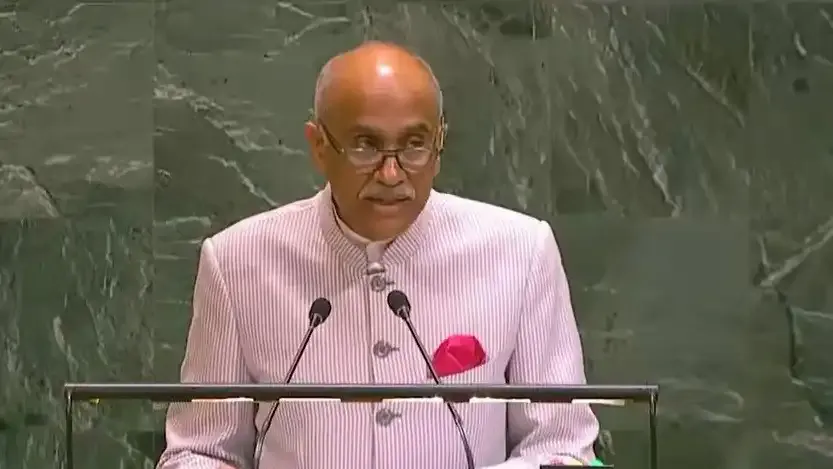
India has reiterated its firm stance against terrorism at the United Nations General Assembly (UNGA), urging the international community to adopt a united and uncompromising approach to combating global terror. Addressing the Assembly during the adoption of the Ninth Review of the United Nations Global Counter-Terrorism Strategy, India's Permanent Representative to the UN, Ambassador Harish Parvathaneni, stressed that terrorism can never be justified under any circumstances.
The Indian delegation called for stronger international cooperation, elimination of double standards in counter-terrorism efforts, tougher measures against terror financing, and faster progress on a long-pending global legal framework to combat terrorism.
India Reaffirms Zero-Tolerance Policy on Terrorism
Speaking before the General Assembly, Ambassador Harish Parvathaneni said terrorism must be condemned in all its forms and manifestations, regardless of the perpetrators or their motives.
India emphasized that there should be no distinction or selective approach when responding to acts of terrorism, warning that inconsistent international responses weaken global security.
According to the Indian representative, defeating terrorism requires collective international action against what was described as a "murderous ideology."
Call to End Double Standards
A major focus of India's statement was the need to eliminate double standards in the global fight against terrorism.
India argued that:
- Terrorism should never be justified for political or ideological reasons.
- Countries must avoid selective approaches when identifying terrorist threats.
- Perpetrators, planners, financiers, and sponsors must all be held accountable.
The statement reinforced India's longstanding position that every act of terrorism deserves equal condemnation.
Stronger Action Against Terror Financing
India also highlighted the continuing threat posed by terror financing.
The country called for:
- Enhanced monitoring of financial networks.
- Greater international cooperation to disrupt funding channels.
- Improved implementation of global financial safeguards.
- Stronger coordination among governments and international institutions.
Officials noted that cutting financial support remains one of the most effective ways to weaken terrorist organisations.
Concerns Over Emerging Technologies
India warned that terrorist groups are increasingly exploiting modern technologies to advance their activities.
The delegation stressed the need for international cooperation to address the misuse of:
- Digital communication platforms.
- Emerging technologies.
- Online radicalisation.
- Financial technologies.
- Cross-border digital networks.
India urged countries to remain vigilant as technological advancements create new security challenges.
Push for Comprehensive Convention on International Terrorism
India once again called for early adoption of the Comprehensive Convention on International Terrorism (CCIT), a proposed international legal framework that has remained under discussion at the United Nations for years.
The convention seeks to establish a universally accepted legal definition of terrorism while strengthening international cooperation in preventing, investigating, and prosecuting terrorist offences.
India has consistently advocated for finalising the convention as part of broader global counter-terrorism efforts.
Why the UN Strategy Matters
The United Nations Global Counter-Terrorism Strategy serves as the primary international framework guiding cooperation against terrorism.
The strategy focuses on:
- Preventing violent extremism.
- Strengthening international cooperation.
- Protecting human rights while combating terrorism.
- Enhancing national counter-terrorism capacities.
- Addressing conditions that enable terrorism to spread.
Regular reviews allow member states to assess emerging threats and update collective priorities.
India's Longstanding Position
India has consistently maintained that terrorism represents one of the greatest threats to international peace and security.
For decades, the country has advocated:
- Zero tolerance toward terrorism.
- Global legal cooperation.
- Strong action against state-sponsored terrorism.
- Accountability for terror financing.
- International coordination through multilateral institutions.
The latest statement at the UN reflects continuity in India's foreign policy on global security issues.
Global Counter-Terrorism Challenges
Despite extensive international cooperation, several challenges continue to affect counter-terrorism efforts, including:
- Cross-border terrorist networks.
- Online radicalisation.
- Terror financing.
- Emerging technologies.
- Lack of universally accepted legal definitions.
- Uneven implementation of international commitments.
India argued that addressing these issues requires coordinated global action rather than isolated national efforts.
Featured Snippet
India told the United Nations General Assembly that terrorism cannot be justified under any circumstances and called for stronger international cooperation to combat terror financing, eliminate double standards, address emerging technological threats, and advance the Comprehensive Convention on International Terrorism.
Key Highlights
- India called for unified global action against terrorism at the UN General Assembly.
- Ambassador Harish Parvathaneni said terrorism must be condemned in all forms.
- India urged countries to reject double standards in counter-terrorism efforts.
- The delegation called for stronger action against terror financing.
- Concerns were raised over terrorists' misuse of emerging technologies.
- India renewed its push for the Comprehensive Convention on International Terrorism.
- The statement came during the review of the UN Global Counter-Terrorism Strategy.
- India reiterated its longstanding zero-tolerance approach to terrorism.
Conclusion
India's address at the United Nations reinforced its consistent position that terrorism remains a global challenge requiring collective and uncompromising action. By emphasizing accountability, stronger financial oversight, technological safeguards, and progress on an international legal framework, India urged member states to adopt a more unified approach against evolving terrorist threats. The statement reflects New Delhi's continued focus on strengthening multilateral cooperation in the fight against terrorism.
FAQs
1. What did India say at the UN General Assembly?
India said there can be no justification for terrorism and called for stronger international cooperation to combat it.
2. Who represented India at the UN?
India's Permanent Representative to the United Nations, Ambassador Harish Parvathaneni, delivered the statement.
3. What is the UN Global Counter-Terrorism Strategy?
It is the United Nations' primary international framework for coordinating global counter-terrorism efforts.
4. What is the Comprehensive Convention on International Terrorism?
It is a proposed international treaty intended to create a comprehensive legal framework for combating terrorism.
5. Why did India mention double standards?
India argued that inconsistent approaches weaken the global fight against terrorism and called for equal treatment of all terrorist acts.
6. What concerns did India raise about technology?
India warned that terrorists increasingly misuse emerging technologies and digital platforms to support their activities.
7. Why is terror financing important?
Disrupting financial support networks is considered one of the most effective methods of weakening terrorist organisations.
8. What was India's overall message?
India urged all nations to work collectively, reject every form of terrorism, and strengthen international mechanisms to address evolving security threats.



Conversation
Be kind and stay on topic. Comments are moderated; abuse, spam and personal attacks are removed. Report a problem