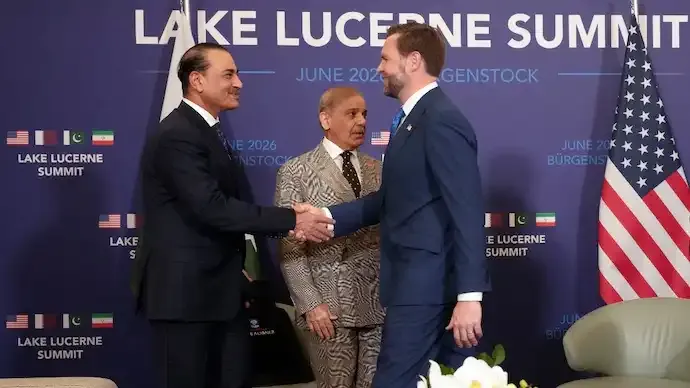
A recent diplomatic appearance by US Vice President JD Vance alongside Pakistani leaders has sparked fresh discussion about Washington's strategic approach to South Asia and the Middle East.
During discussions linked to ongoing US-Iran diplomatic engagement, Vance publicly praised Pakistan's leadership, including Prime Minister Shehbaz Sharif and Field Marshal Asim Munir, for their role in facilitating dialogue efforts.
The remarks have attracted attention because they come shortly after renewed efforts by Washington to strengthen ties with India, raising questions about how the United States is managing its relationships with both New Delhi and Islamabad.
Vance Highlights Pakistan's Role in Diplomacy
Speaking during diplomatic engagements connected to US-Iran discussions, JD Vance acknowledged Pakistan's contribution to facilitating communication between Washington and Tehran.
The Vice President commended both Shehbaz Sharif and Asim Munir, describing their involvement as helpful in supporting diplomatic channels at a time of heightened regional tensions.
Observers noted that Vance's comments were unusually direct and personal, particularly regarding Pakistan's military leadership.
Timing of the Remarks Attracts Attention
The significance of the comments lies not only in what was said but also in when they were made.
In recent months, the United States has continued efforts to deepen strategic cooperation with India across areas such as defense, technology, trade, and regional security. Against that backdrop, public praise for Pakistan's military establishment has prompted renewed debate among geopolitical analysts.
Many observers view the remarks as part of Washington's broader effort to maintain relationships with multiple regional stakeholders simultaneously.
US Balancing Multiple Strategic Interests
The United States has long sought to balance its relationships across South Asia and the Middle East.
India remains one of Washington's most important strategic partners, particularly in the Indo-Pacific region. At the same time, Pakistan continues to hold geopolitical relevance due to its geographic location, security role, and influence in regional diplomatic matters.
Analysts believe the Biden administration's successor government and current US leadership continue to engage both countries according to differing strategic priorities.
Pakistan's Role in Regional Diplomacy
Pakistan has historically served as a channel for diplomatic engagement in several regional conflicts and negotiations.
Its relationships with countries across South Asia, Central Asia, the Gulf region, and the broader Islamic world often place Islamabad in a position to facilitate dialogue during periods of tension.
The recent US-Iran diplomatic efforts have once again highlighted Pakistan's ability to engage with multiple stakeholders across the region.
India-US Partnership Remains Strong
Despite the attention generated by Vance's remarks, experts note that India-US relations continue to operate on a much broader strategic foundation.
Defense cooperation, technology partnerships, critical supply chains, semiconductor initiatives, trade relations, and Indo-Pacific security cooperation remain key pillars of the relationship between New Delhi and Washington.
Most analysts do not view the comments as signaling a shift away from the growing India-US partnership.
Strategic Messaging Under Scrutiny
Diplomatic language often carries significance beyond the immediate context in which it is delivered.
As a result, Vance's public appreciation of Asim Munir has been interpreted through multiple lenses, including regional security dynamics, Middle East diplomacy, and South Asian geopolitics.
Whether the remarks represent routine diplomatic courtesy or a broader strategic signal remains a subject of discussion among foreign policy observers.
What the Development Means
The episode illustrates the complexity of modern diplomacy, where major powers frequently engage multiple partners with differing interests at the same time.
As the United States navigates challenges involving Iran, regional stability, and Indo-Pacific security, maintaining communication channels with various actors remains a key part of its foreign policy approach.
For now, JD Vance's comments have added a new dimension to ongoing discussions about US engagement with Pakistan while reinforcing the delicate balancing act Washington continues to perform across the region.
Prev Article
Explosion at Qatar's Barzan Gas Facility Leaves 54 Injured, 18 Missing During Start-Up Operations
Next Article
US Strike on Suspected Drug-Smuggling Boat Kills Two in Eastern Pacific, Renewing Legal Debate