

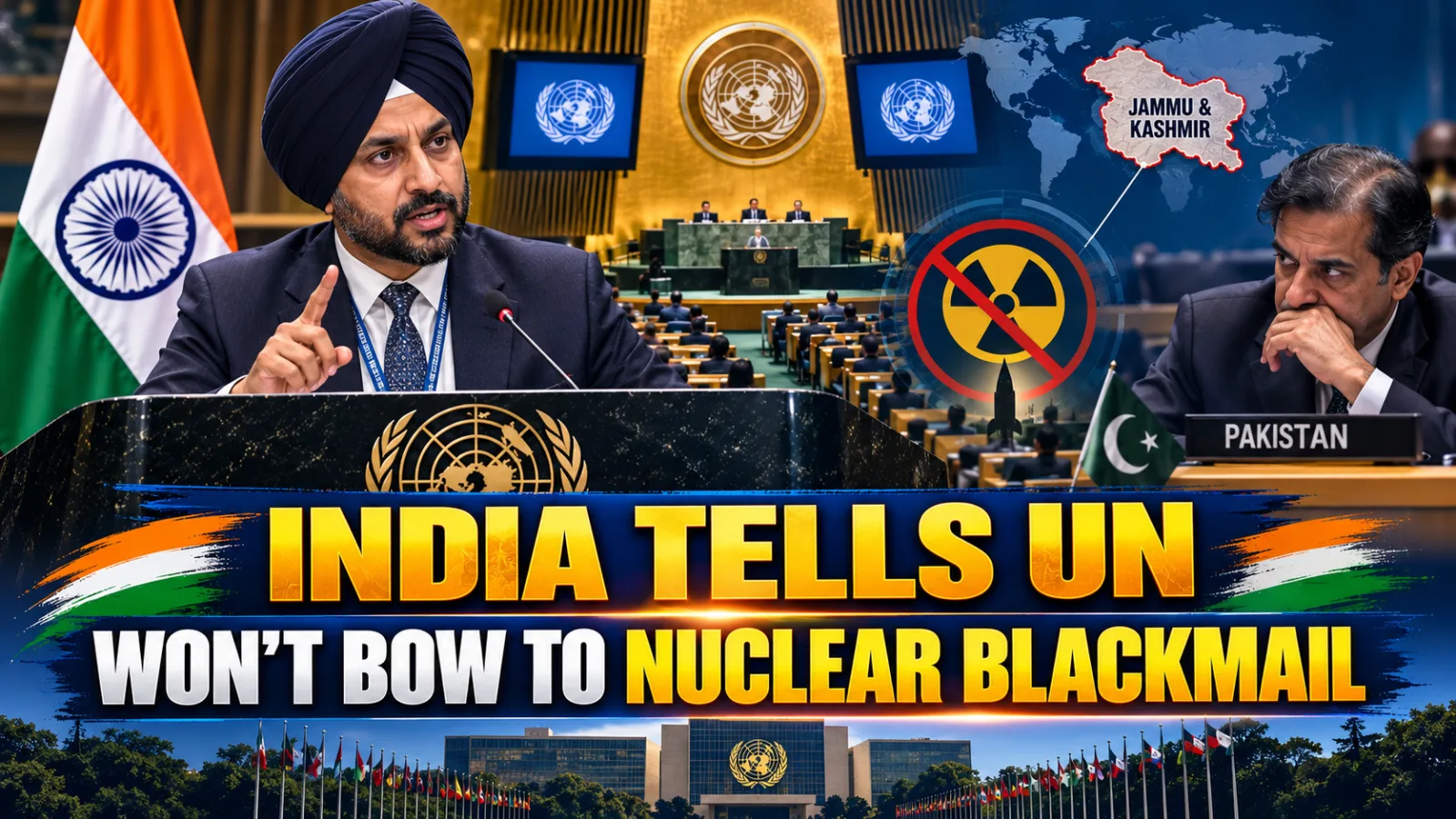

India has told the United Nations that it will not bow to what it described as Pakistan's nuclear blackmail, while warning that the use of nuclear threats to limit responses to terrorism could increase regional instability. New Delhi delivered its response through the Right of Reply at the UN General Assembly's First Committee on Friday, October 9, 2026.
Anmol Sher Singh Bedi, Senior Adviser for Disarmament at India's Permanent Mission to the Conference on Disarmament in Geneva, responded after Pakistan raised Jammu and Kashmir during discussions on disarmament and international security.
Bedi reiterated India's position that Jammu and Kashmir is an integral and inalienable part of the country. He said India's military capabilities were defensive and shaped by its security environment, adding that India did not seek conflict.

He also argued that nuclear weapons should not be treated as routine instruments of statecraft and that accountability for what India described as reckless actions was necessary to prevent recurring crises.
India Sets Out Its Position on Terrorism
During the statement, Bedi outlined three principles guiding India's response to terrorism: terrorist attacks against India would receive a fitting response, India would not bow to nuclear blackmail, and those who sponsor terrorism would not be treated differently from those who mastermind it.
He argued that states could not escape responsibility by acting through non-state actors. According to Bedi, India's right to self-defence remained intact.
He also described what he called a recurring pattern in regional crises involving provocation, denial of responsibility and subsequent appeals for restraint. These remarks formed part of India's criticism of Pakistan's approach to security and accountability.
India Cites Operation Sindoor After Pahalgam Attack
Bedi referred to the Pahalgam terror attack of April 22, 2025, in which 26 civilians were killed, most of them tourists. He said India's subsequent actions in May 2025, under Operation Sindoor, were measured, targeted and designed to avoid escalation.
India launched Operation Sindoor against what it described as terror infrastructure in Pakistan and Pakistan-occupied Kashmir following the attack. The Resistance Front, described in the report as a proxy of Pakistan-based Lashkar-e-Taiba, was identified in connection with the incident.
Bedi used the episode to reiterate India's position that responses to terrorism must take account of the responsibility of those involved in supporting or organising attacks.
Indus Waters Treaty Also Features in India's Statement
India also addressed the Indus Waters Treaty, arguing that the agreement depended on good faith and mutual cooperation. Bedi said a state could not undermine those foundations while expecting the benefits of the relationship to remain unaffected.
Following the Pahalgam attack, India announced that the treaty would be held in abeyance until Pakistan credibly and irrevocably ended its support for cross-border terrorism and other forms of terrorism.
India Raises Concerns Over Nuclear Proliferation
Bedi referred to the history of the AQ Khan nuclear proliferation network and its role in discussions that led to UN Security Council Resolution 1540, adopted in 2004 to address the proliferation of weapons of mass destruction.
He urged states and suppliers to exercise vigilance when considering nuclear cooperation and transfers of advanced military capabilities, arguing that safeguards were important for international security.
India's statement concluded by reaffirming its stated preference for peace while maintaining that it would respond to terrorism, reject nuclear coercion and hold states accountable for supporting non-state actors.




Conversation
Be kind and stay on topic. Comments are moderated; abuse, spam and personal attacks are removed. Report a problem