

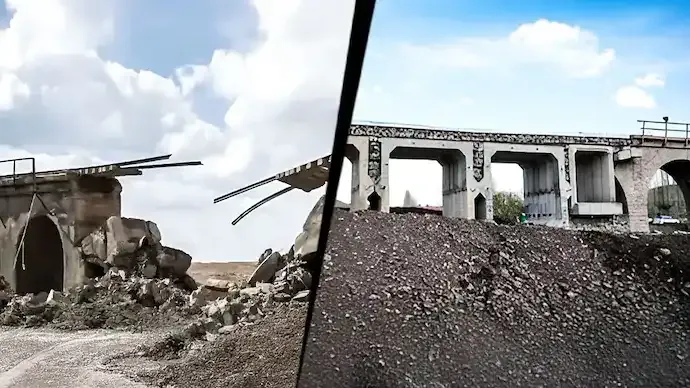

Amid escalating tensions in West Asia, Iran is showcasing a powerful message of resilience. Despite repeated strikes by United States and Israel targeting critical infrastructure, Tehran claims it is rebuilding damaged assets at a rapid pace.
The focus of recent attacks has expanded beyond military installations to include key civilian infrastructure such as railway bridges and transport networks. However, Iran’s swift reconstruction efforts are drawing global attention.
Strikes Target Transport and Communication Networks
The offensive strategy reportedly included attacks on:

- Railway bridges
- Railway tracks
- Transport corridors
- Communication infrastructure
Leaders including Donald Trump and Benjamin Netanyahu had earlier warned of efforts to weaken Iran’s infrastructure significantly.
These strikes were aimed at disrupting logistics, mobility, and internal connectivity, thereby limiting Iran’s operational capabilities.
Rapid Reconstruction Demonstrates Resilience
Despite the scale of destruction, Iran has claimed that several damaged railway links were restored within days. Images released through official channels show before-and-after visuals of infrastructure, indicating quick repair work.
This rapid rebuilding highlights:
- Strong engineering capabilities
- Efficient crisis response systems
- High coordination within infrastructure teams
Iran’s approach suggests a strategy where reconstruction is not just recovery, but a form of resistance.
Can Rebuilding Outpace Destruction?
The situation raises a critical question in modern conflict dynamics—can reconstruction happen faster than destruction?
Iran appears to be testing this idea by:
- Quickly restoring key transport routes
- Maintaining supply chain continuity
- Minimising long-term disruption
If sustained, this approach could reduce the effectiveness of infrastructure-targeted strikes and shift strategic calculations.
Global Implications of Iran’s Strategy
Iran’s rapid rebuilding capability could influence future conflict strategies across regions. It highlights how nations can invest in resilience to counter repeated attacks on infrastructure.
For global observers, this development signals:
- A shift in warfare beyond destruction to recovery speed
- The importance of infrastructure resilience
- The evolving role of engineering and logistics in conflict scenarios
What Lies Ahead
While the conflict continues, Iran’s reconstruction efforts are becoming a central narrative. Whether this strategy can be sustained over time remains uncertain, especially if attacks intensify.
However, the current developments indicate that resilience and rapid response could play a decisive role in shaping outcomes in modern conflicts.








Conversation
Be kind and stay on topic. Comments are moderated; abuse, spam and personal attacks are removed. Report a problem