

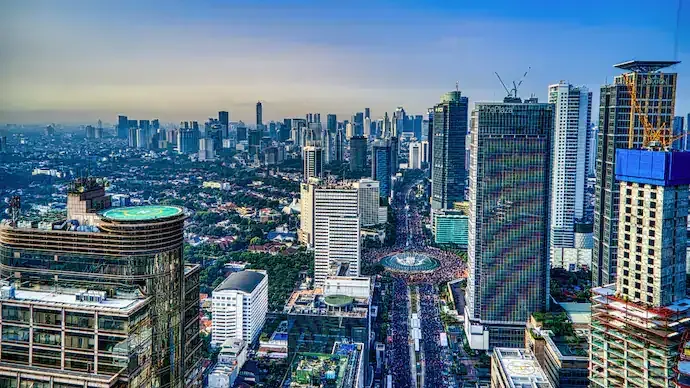

A major demographic shift has reshaped the global urban map. According to the UN’s World Urbanisation Prospects 2025, Greater Jakarta has officially surpassed Tokyo, Delhi and Shanghai to become the world’s most populous urban area, marking a historic first for Southeast Asia.
Spanning the massive Jabodetabek metropolitan corridor, Greater Jakarta now hosts around 42 million residents, making it not only the world’s largest urban cluster but also one of the fastest-growing regions in Asia.
This rapid ascent is the result of intense rural-to-urban migration, a booming industrial and services economy, and extensive infrastructure upgrades that have connected surrounding districts and unlocked new economic zones.

Jakarta Leads, Asia Dominates
The UN report highlights a broader transformation: the number of global megacities — urban areas with populations above 10 million — has surged from 8 in 1975 to 33 in 2025, illustrating a dramatic acceleration in urban expansion worldwide.
Asia remains the focal point of this transformation, now hosting nine of the world’s 10 largest cities.
Dhaka Becomes the World’s Second-Largest City
Hot on Jakarta’s heels is Dhaka, Bangladesh’s capital, reaching an estimated 40 million residents. Dhaka’s explosive growth is driven by high population density, expansion into neighbouring districts, and migration among its young workforce.
Tokyo, once the world’s largest metropolitan region for more than four decades, now has around 33 million residents, impacted heavily by Japan’s ageing population and declining birth rates.
Where India’s Cities Stand in 2025
India remains one of the fastest-urbanising nations, but none of its metros enter the latest global top three.
Delhi – 32 million
Still among the world’s largest megacities, Delhi continues its rapid growth despite serious concerns over pollution, water scarcity and unplanned sprawl.
Mumbai – 21 million
Growth has moderated due to land constraints, but Mumbai remains India’s economic and commercial capital.
Other Major Metros – 10–15 million
Cities like Bengaluru, Hyderabad, Chennai and Kolkata continue expanding rapidly, driven by tech hubs, migration, and the expansion of peri-urban regions.
UN Introduces New Urban Measurement Standards
The United Nations has revised its methodology for assessing global city populations to bring uniformity across countries.
A city is now defined as a contiguous high-density agglomeration of 1 km grid cells with:
-
At least 1,500 people per sq km, and
-
A minimum total population of 50,000
The UN also clarified that, except for rare exceptions, the new list focuses on individual cities, not merged conurbations — providing a clearer picture of true urban population sizes.
Asia’s Urban Future Is Here
With Jakarta, Dhaka and Tokyo leading the global chart, Asia’s demographic dominance is stronger than ever. The rise of these megacities signals a future shaped by emerging economies, young populations, and rapidly shifting urban landscapes.
Jakarta becoming the world’s most populous city marks not just a geographic milestone but a pivotal moment for global urbanisation — a signal for governments and planners to rethink how major cities grow, sustain and support millions of lives in the decades ahead.






Conversation
Be kind and stay on topic. Comments are moderated; abuse, spam and personal attacks are removed. Report a problem