

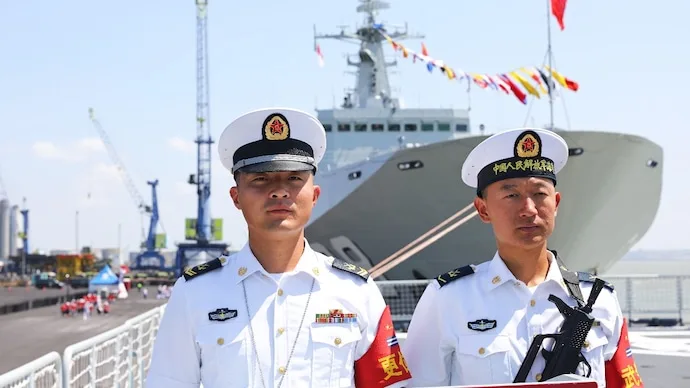

China's naval expansion is increasingly challenging the United States' long-standing maritime dominance, with around 100 Chinese naval vessels reportedly operating at sea every day across important Asian shipping and transportation routes.
According to a report cited in the source, China's battle force now exceeds 400 ships and submarines, making it approximately 35% larger than the US Navy by the number of vessels. The expansion reflects one of the most significant peacetime naval buildups in recent history.
China's growing shipbuilding capacity has played a major role in this development. The country is a global leader in commercial shipbuilding, and the same industrial infrastructure is being used to manufacture advanced military vessels, including destroyers, frigates and large amphibious ships.

Chinese naval activity extends across the South China Sea, waters around Taiwan, areas east of the Philippines and the southern coast of Japan. Its deployments have also reached the wider western Pacific, the Gulf of Aden and surrounding waters.
Chinese Warships Expand Operations Across the Indo-Pacific
Recent naval movements have highlighted the scale of China's expanding maritime presence.
A map shared by a Taiwanese official reportedly showed 53 Chinese vessels, including 34 naval warships, operating in the region. The aircraft carrier Liaoning and its escort vessels were positioned east of the Philippines.
Other Chinese naval groups were reportedly observed near Taiwan's eastern and southeastern coasts, while additional vessels operated close to southern Japan.
Japanese defence authorities also tracked three Chinese warships and a coast guard vessel passing through the Osumi Strait into the Pacific.
Beijing described the Liaoning carrier group's western Pacific activities as routine annual training intended to test long-range combat capabilities. It maintained that the exercises were not directed at any particular country.
China Demonstrates Ability to Sustain Long Naval Deployments
Beyond the number of vessels, China's ability to keep warships deployed for extended periods is another important factor.
A report by Chinese state media described the return of the 48th escort taskforce to Qingdao after 378 days at sea. The mission covered more than 150,000 nautical miles and protected 423 commercial vessels in the Gulf of Aden and nearby waters.
The taskforce included a destroyer, a frigate and a supply ship. Chinese military experts attributed the extended deployment capability to improved equipment reliability, better-trained personnel and stronger logistical support.
Facilities in Djibouti and a newer joint facility in Cambodia have also been cited as supporting China's overseas naval operations by providing opportunities for rest, repairs and supplies.
Xi Jinping's Vision for China's Naval Power
Chinese President Xi Jinping has repeatedly presented maritime strength as essential to national development and international influence.
In 2013, shortly after becoming president, Xi told the Communist Party's Politburo that the development of major powers had historically been closely connected to the ocean.
He also referred to the 15th-century voyages of Admiral Zheng He and argued that China's historical retreat from maritime activity had contributed to its decline.
The country's expanding naval capabilities reflect this emphasis on strengthening its position at sea.
Taiwan and South China Sea Tensions Add to US Concerns
China's growing naval reach comes amid increasing tensions involving Taiwan, Japan and the Philippines.
Beijing opposes Japanese support for Taiwan and remains involved in maritime disputes with Manila in the South China Sea. China has not ruled out using force to bring Taiwan under its control, although it continues to state a preference for peaceful reunification.
For Washington, the expansion presents both a military and industrial challenge.
Despite increased American shipbuilding expenditure, the US fleet has not grown significantly compared with its size in 2003, according to the report. Several American naval shipbuilding and modernisation programmes have also faced delays and difficulties.
China's combination of a large fleet, sustained deployments, carrier operations and extensive shipbuilding capacity is changing the strategic balance in the Indo-Pacific.
The challenge for the United States is no longer limited to counting warships. It increasingly involves matching China's ability to build, deploy and maintain naval forces across strategically important waters.
Read more: All India Story





Conversation
Be kind and stay on topic. Comments are moderated; abuse, spam and personal attacks are removed. Report a problem