
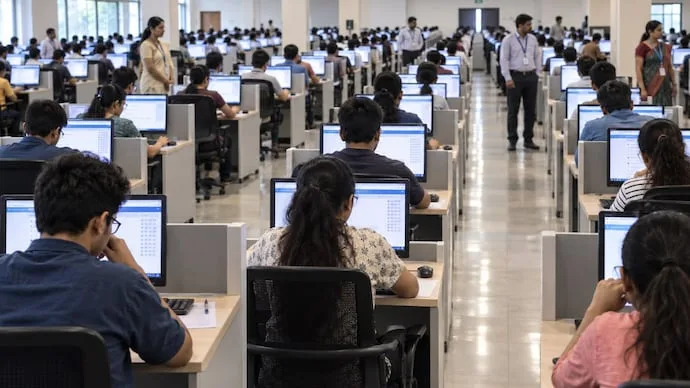
NTA exam reforms have emerged as a major recommendation in a new SBI Research report, which has proposed a separate law for the National Testing Agency, an independent governing board, a permanent professional workforce and a dedicated mechanism for candidate appeals. The proposals form part of a broader reform agenda covering examination security, accountability, higher education access, funding and vocational training.
SBI Research proposes separate NTA law
SBI Research has recommended replacing the NTA’s current status as a society registered under the Societies Registration Act with a statutory body established through an Act of Parliament.
The NTA was established in 2018 and, according to the report, had conducted more than 240 examinations involving over 5.4 crore candidates by July 2024. Given the scale of its operations, the report argues that the agency requires a clearer legal mandate defining its responsibilities, governance structure, examination operations and accountability.
The proposed NTA law would operate separately from the Public Examinations (Prevention of Unfair Means) Act, 2024, which focuses on preventing malpractice and unfair means in public examinations.
Independent board proposed for NTA
The report recommends an independent NTA Board comprising specialists from areas such as assessment, technology, examination security, logistics and accessibility.
The board would oversee examination readiness and vendors involved in conducting tests. The Director General or CEO would continue managing the agency’s day-to-day operations while working under the board, creating a proposed distinction between institutional oversight and routine administration.
SBI Research has also recommended building a permanent professional workforce within the NTA, with expertise in assessment, technology, security, examination operations and candidate support.
The report argues that critical examination functions should increasingly remain under the agency’s direct control instead of depending heavily on outsourced services and infrastructure.
Independent appeals mechanism
Another key proposal is an independent Standards and Appeals Body. It would audit high-risk examination processes and handle final administrative appeals in serious cases.
The report also calls for stronger question-paper custody procedures, independent reviews and more effective grievance mechanisms for candidates.
SBI Research has suggested that India could study examination systems such as China’s Gaokao for lessons in large-scale logistics, security, planning and accountability.
Reforms extend beyond competitive exams
The report also proposes examining whether Article 21 of the Constitution could be amended to recognise a right to free and fair educational opportunity.
Beyond examinations, SBI Research has highlighted concerns over higher education funding and staffing. India had 64,756 universities, colleges and standalone institutions in FY24, while student enrolment crossed 4.5 crore.
The report noted that higher education’s share of total government expenditure has remained around 1 per cent and suggested increasing it to 1.5 per cent. It also highlighted teaching vacancies, with around 34 per cent of sanctioned teaching posts across centrally funded institutions reportedly vacant.
The research further calls for greater investment in research, stronger industry links and faster expansion of vocational training. According to the report, 30.7 per cent of Indians aged 15–29 had received or were receiving vocational training in 2025, compared with 7.1 per cent in 2018.
The proposed reforms therefore go beyond changing the structure of the NTA, linking examination management with wider questions around educational access, institutional accountability, staffing, skills and funding.




Conversation
Be kind and stay on topic. Comments are moderated; abuse, spam and personal attacks are removed. Report a problem