



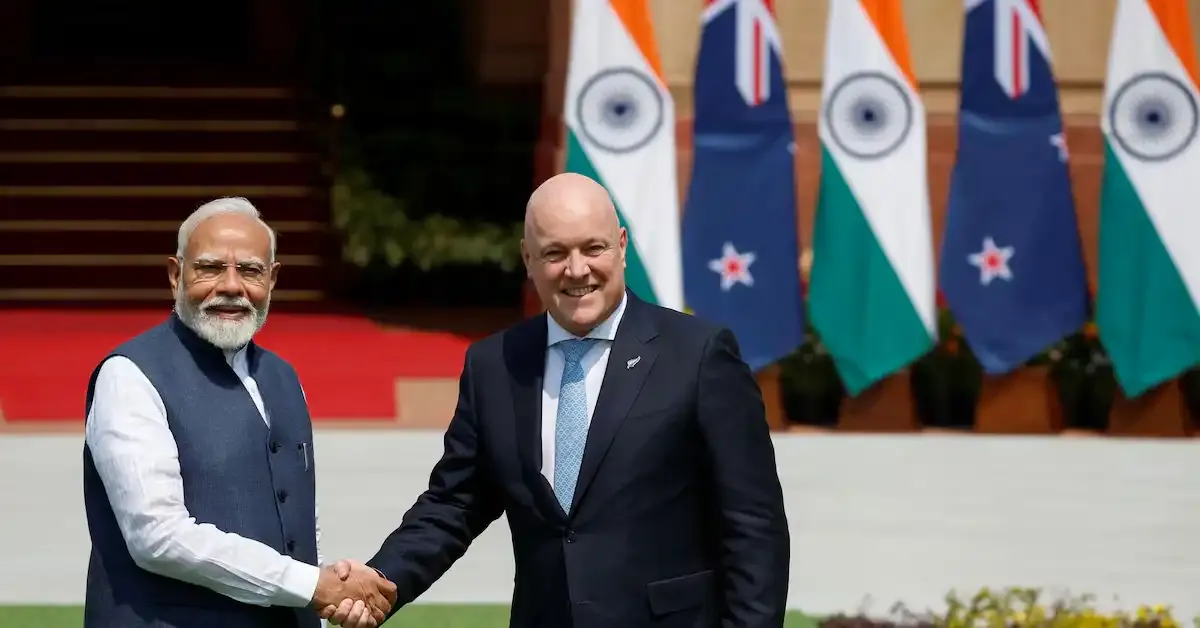
Prime Minister Narendra Modi and Japanese Prime Minister Sanae Takaichi jointly inaugurated Maruti Suzuki India's new manufacturing facility at Kharkhoda, Haryana, marking one of the largest investments in India's automobile sector. The inauguration coincided with the India-Japan Economic Forum, highlighting the growing strategic and economic partnership between the two countries.
The Kharkhoda facility, backed by a planned investment of ₹35,000 crore, is expected to significantly expand India's passenger vehicle manufacturing capacity while generating thousands of direct and indirect employment opportunities. The project also reflects Maruti Suzuki's long-term commitment to the 'Make in India, Make for the World' vision.
₹35,000 Crore Investment to Expand Manufacturing Capacity
The Kharkhoda manufacturing complex represents one of Maruti Suzuki's biggest industrial investments in India.

Key highlights include:
- Total planned investment of ₹35,000 crore.
- Spread across nearly 800 acres.
- Maruti Suzuki's fourth manufacturing facility in India.
- Designed to become one of the company's largest production hubs.
The project is expected to strengthen India's position as one of the world's leading automobile manufacturing destinations.
Maruti Suzuki's Fourth Manufacturing Facility
The Kharkhoda plant joins Maruti Suzuki's existing manufacturing operations in:
- Gurugram
- Manesar
- Gujarat
Currently, two production units are operational at the new facility with a combined annual production capacity of 5 lakh passenger vehicles.
The company plans to double capacity to 10 lakh vehicles annually in phases as demand grows.
A Smart Factory Powered by Industry 5.0
The Kharkhoda plant has been developed under Maruti Suzuki's 'Suzuki Smart Factory' concept, integrating advanced manufacturing technologies aimed at improving efficiency, quality and worker safety.
The facility features:
- AI-powered collaborative robots (Cobots).
- Industry 5.0 manufacturing systems.
- Smart automation technologies.
- Advanced production monitoring.
- Enhanced workplace safety systems.
These technologies are expected to improve manufacturing precision while supporting higher production volumes.
Sustainability at the Core
Environmental sustainability has been integrated into the design of the new manufacturing complex.
According to the company, the plant will operate with:
- 100% renewable electricity.
- 100% water recycling.
- Zero Liquid Discharge (ZLD) manufacturing.
- Planned 70 MW solar power plant.
- Proposed biogas facility during FY2026-27.
- In-plant railway siding to promote greener logistics.
The project aligns with India's broader sustainability and clean manufacturing goals.
Major Employment Generation
Once fully operational, the Kharkhoda manufacturing complex is expected to create more than 21,000 direct jobs.
Additional employment opportunities are likely across:
- Auto component manufacturing.
- Logistics.
- Supplier networks.
- Warehousing.
- Ancillary industries.
The integrated supplier park located within the campus is expected to strengthen the overall automotive manufacturing ecosystem.
India-Japan Economic Partnership Gets a Boost
The inauguration took place alongside the India-Japan Economic Forum, where more than 150 Japanese companies are participating.
The discussions cover cooperation in:
- Manufacturing.
- Semiconductors.
- Artificial Intelligence.
- Clean Energy.
- Mobility.
- Advanced Technologies.
Reports also suggest that around 120 cooperation initiatives worth nearly 2 trillion yen (approximately $12.5 billion) could be announced during the Japanese Prime Minister's visit, highlighting India's growing importance as a destination for Japanese investment.
Why the Kharkhoda Plant Matters
The facility is expected to play a major role in expanding India's automobile production capacity.
Its significance includes:
- Higher passenger vehicle production.
- Increased exports.
- Modern manufacturing technologies.
- Stronger domestic supply chains.
- Enhanced foreign investment.
- Support for India's manufacturing ambitions.
As India's largest passenger vehicle manufacturer, Maruti Suzuki continues to account for nearly half of the country's passenger vehicle sales.
Business Impact
Investment Impact
The ₹35,000 crore investment is among the largest recent commitments in India's automotive sector.
Industry Outlook
The expansion reinforces confidence in India's manufacturing ecosystem amid growing demand for passenger vehicles.
Investor Takeaways
- Expansion of production capacity.
- Strengthened India-Japan industrial cooperation.
- Long-term manufacturing growth.
- Increased employment generation.
- Greater focus on sustainable production.
Featured Snippet
Prime Minister Narendra Modi and Japanese Prime Minister Sanae Takaichi inaugurated Maruti Suzuki's ₹35,000 crore Kharkhoda manufacturing facility in Haryana. The plant, designed as a Suzuki Smart Factory, will eventually produce up to 10 lakh vehicles annually while creating over 21,000 direct jobs.
Key Highlights
- PM Modi and Japan PM Sanae Takaichi inaugurated Maruti Suzuki's Kharkhoda plant.
- The project involves a planned investment of ₹35,000 crore.
- It is Maruti Suzuki's fourth manufacturing facility in India.
- Production capacity will increase from 5 lakh to 10 lakh vehicles annually.
- The plant incorporates Industry 5.0 and AI-powered manufacturing.
- The facility will operate using 100% renewable electricity.
- More than 21,000 direct jobs are expected to be created.
- The inauguration coincided with the India-Japan Economic Forum.
Conclusion
The inauguration of Maruti Suzuki's Kharkhoda manufacturing facility marks a significant milestone for India's automotive industry and its economic partnership with Japan. Combining large-scale investment, advanced manufacturing technologies, sustainability initiatives and employment generation, the project reflects India's growing role as a global manufacturing hub. As production expands in the coming years, the facility is expected to contribute significantly to both domestic demand and export-oriented manufacturing.
FAQs
1. Where is Maruti Suzuki's new manufacturing plant located?
The new facility is located at Kharkhoda in Haryana.
2. How much has Maruti Suzuki invested in the project?
The company has earmarked a total investment of ₹35,000 crore.
3. What is the production capacity of the plant?
The facility currently has a capacity of 5 lakh vehicles annually, which will be expanded to 10 lakh vehicles in phases.
4. Why is the Kharkhoda plant significant?
It is Maruti Suzuki's fourth manufacturing facility in India and one of the company's largest investments.
5. How many jobs will the project create?
The fully developed facility is expected to generate over 21,000 direct jobs, along with significant indirect employment.
6. What technologies are being used at the plant?
The plant features Industry 5.0-enabled manufacturing, AI-powered collaborative robots and smart factory technologies.
7. What sustainability features does the plant include?
The facility will operate on 100% renewable electricity, recycle all water, function as a Zero Liquid Discharge unit and include solar and biogas projects.
8. Why is the inauguration important for India-Japan relations?
The project highlights growing economic cooperation between India and Japan, particularly in manufacturing, mobility, semiconductors and advanced technology.






Conversation
Be kind and stay on topic. Comments are moderated; abuse, spam and personal attacks are removed. Report a problem