

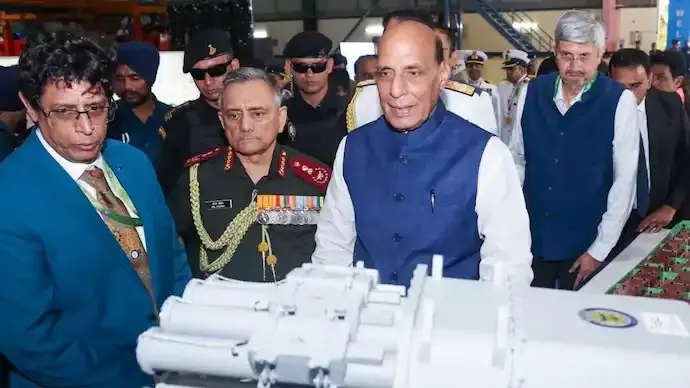

Defence Minister Rajnath Singh laid the foundation stone for a state-of-the-art naval testing facility in Visakhapatnam on April 3, 2026. The project marks a significant step towards strengthening India’s indigenous defence research and development capabilities, particularly in the naval sector.
The facility, known as the Large Cavitation Tunnel (LCT), will be developed at the Naval Science and Technological Laboratory (NSTL), a premier research center working under the Defence Research and Development Organisation (DRDO). This initiative aligns with India’s broader vision of achieving self-reliance in defence technologies.
What is the Large Cavitation Tunnel Facility?
The Large Cavitation Tunnel is a highly advanced testing infrastructure designed to study hydrodynamic behavior in naval systems. It will allow scientists and engineers to simulate underwater conditions and test the performance of naval equipment such as propellers, submarines, and torpedoes.

This technology is crucial for improving the efficiency, stealth, and durability of naval platforms. By enabling precise testing within India, the facility will significantly reduce the need to rely on foreign testing centers.
Focus on Indigenous Defence Development
During the foundation ceremony, Rajnath Singh emphasized the importance of indigenous innovation in strengthening national security. He highlighted that the new facility will empower India to design, develop, and test advanced naval systems using domestic resources.
The project is expected to enhance the capabilities of DRDO scientists and engineers, enabling faster development cycles and improved quality of defence equipment. It also supports the government’s push towards “Aatmanirbhar Bharat” in the defence sector.
Strategic Importance of Visakhapatnam
Visakhapatnam, often referred to as Vizag, plays a crucial role in India’s naval operations. It is home to key naval establishments and serves as a strategic hub for maritime security in the eastern region.
The addition of this advanced testing facility further strengthens the city’s position as a center for naval research and technological advancement. It is expected to contribute to both national defence preparedness and technological innovation.
Reducing Dependence on Foreign Infrastructure
One of the primary objectives of the project is to minimize India’s reliance on foreign testing facilities. Currently, certain advanced naval testing requirements often require international collaboration or access to overseas infrastructure.
With the development of the Large Cavitation Tunnel, India will gain greater control over its research processes, ensuring confidentiality, cost efficiency, and technological independence.
Strengthening India’s Defence Ecosystem
The establishment of this facility represents a broader effort to build a robust and self-sufficient defence ecosystem. It is expected to not only support military advancements but also encourage collaboration between research institutions, industry, and academia.
As India continues to modernize its armed forces, investments in such cutting-edge infrastructure will play a critical role in maintaining technological superiority and safeguarding national interests.









Conversation
Be kind and stay on topic. Comments are moderated; abuse, spam and personal attacks are removed. Report a problem