

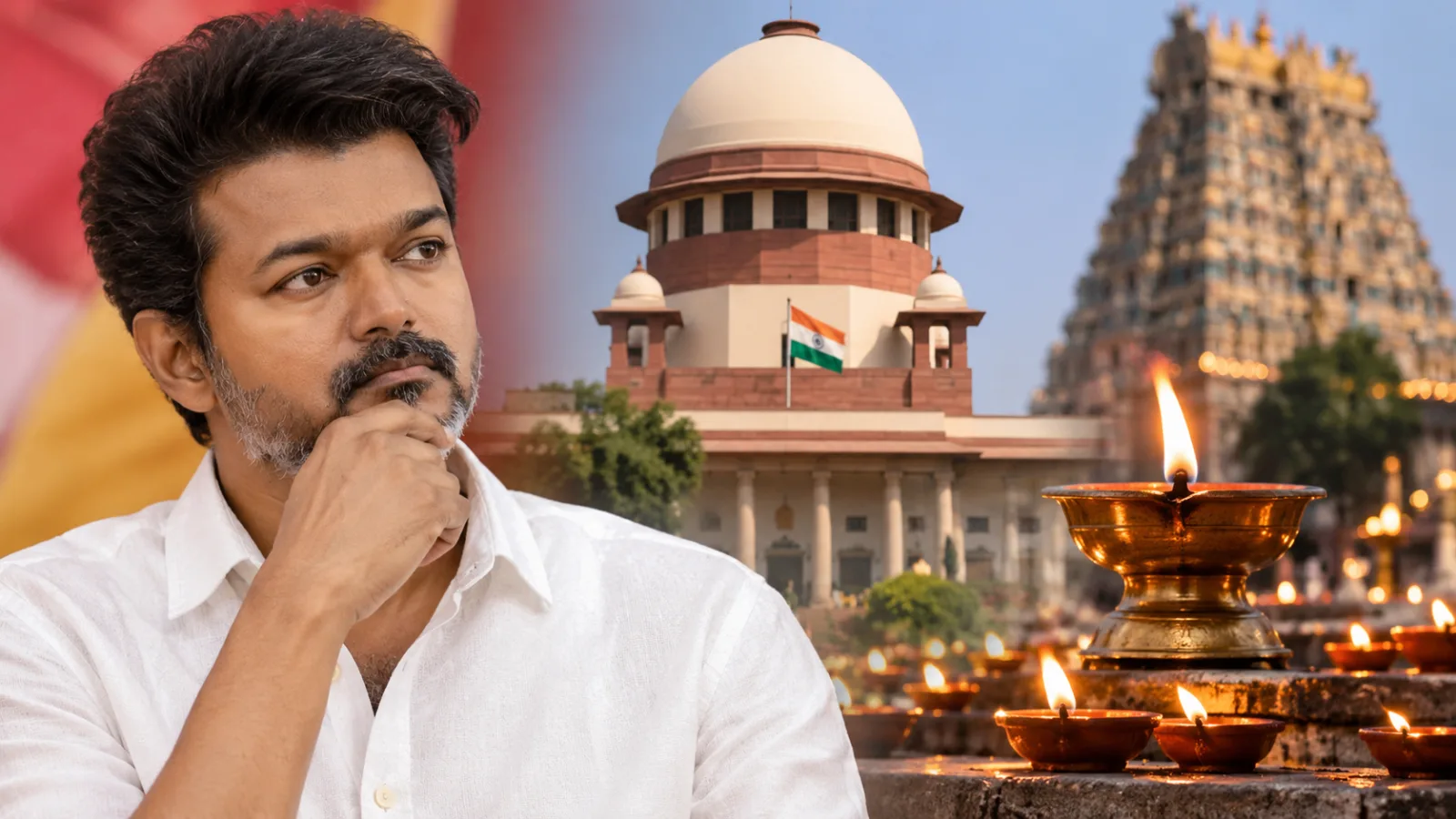

The Tamil Nadu government led by Chief Minister C Joseph Vijay has approached the Supreme Court seeking a review of its order permitting the Karthigai Deepam lamp-lighting ritual at a disputed stone pillar on Thiruparankundram Hill in Madurai. The government has raised concerns over religious tradition, communal harmony and the possible legal consequences of allowing the ceremony at the location.
The review petition comes days before the November 24 festival, despite the Supreme Court allowing the ritual as a one-time measure through its November 20 interim order. The court had also prescribed safeguards, including restricting access to authorised temple and government personnel and prohibiting public gatherings, processions and demonstrations.
However, the state government maintains that these restrictions do not address the larger religious and administrative questions surrounding the disputed location.

No Established Tradition of Lighting the Lamp at Deepathoon
One of the government's principal arguments is that there is no documented tradition of performing the Karthigai Deepam ritual at Deepathoon, the stone pillar located on Thiruparankundram Hill.
According to the Hindu Religious and Charitable Endowments (HR&CE) Department, the traditional location for lighting the lamp is Deepamandapam, near the Uchipillaiyar Temple. The department maintains that the ritual has historically been performed there and that no established evidence supports shifting it to the disputed pillar.
The government has also argued that decisions concerning temple rituals should be taken by the relevant temple authorities in accordance with established customs, Agamas and the opinion of temple administrators, known as Sthanikars.
Proximity to Dargah Raises Communal Harmony Concerns
Thiruparankundram Hill houses the Arulmigu Subramaniya Swamy Temple as well as the Hazrat Sultan Sikandar Badusha Auliya Dargah.
The disputed Deepathoon is situated close to the dargah, making the proposed change in the ritual location particularly sensitive.
The Vijay government has argued that conducting the ceremony at this spot could disturb the communal harmony maintained in the area. It believes that continuing the festival at its traditional location would avoid unnecessary tensions.
The state has also warned that the consequences of allowing the ritual at the disputed location could extend beyond the immediate festival.
Government Fears a Legal Precedent
Another major concern raised in the review petition is the possibility that permission granted for this year's ceremony could encourage similar claims in the future.
The government argues that the petitioners have not established a customary or legal right to light the lamp at Deepathoon through sufficient historical documentation.
Although the Supreme Court clarified that its permission was a one-time arrangement and would not establish ownership or a permanent customary right, the state believes that allowing the ritual could still have wider legal and administrative implications.
Why the Government Wants Temple Authorities to Decide
The HR&CE Department has invoked provisions of the Tamil Nadu Hindu Religious and Charitable Endowments Act, 1959.
Section 28(1) places responsibility for administering religious institutions on their trustees, while Section 63(e) empowers the Joint Commissioner to examine and decide questions concerning established usage in religious institutions.
The government argues that the dispute over the traditional location of the lamp should be examined through these statutory mechanisms rather than settled through an interim judicial direction.
Why Was the Supreme Court Order Challenged Despite Safeguards?
The state has also questioned the Supreme Court's decision to grant the requested relief at an interim stage, before the larger dispute has been conclusively decided.
According to the review petition, permitting the ritual at Deepathoon effectively grants the petitioners the relief they sought without first establishing a strong prima facie case.
The government has further argued that refusing permission at the disputed location would not deprive the petitioners of an existing right, as the festival could continue at Deepamandapam.
The review petition therefore goes beyond concerns about security arrangements on November 24. It raises questions about religious customs, temple administration and the legal implications of changing the location of an established ritual.
The Supreme Court's consideration of the review petition will be significant in determining whether its one-time permission remains in force ahead of the festival.






Conversation
Be kind and stay on topic. Comments are moderated; abuse, spam and personal attacks are removed. Report a problem