

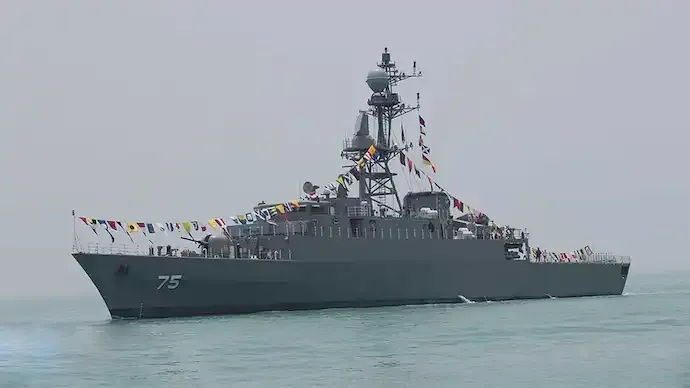

The sinking of the Iranian warship IRIS Dena in the Indian Ocean has sparked political debate in India, with opposition leaders questioning the government’s silence on the incident. The warship was torpedoed by a US submarine while returning from naval exercises in India, raising concerns about regional security and India’s diplomatic position.
However, defence experts say blaming India for the attack is misplaced and ignores important legal and strategic realities.
The incident occurred as the ongoing conflict involving the United States, Israel and Iran escalated rapidly. While the conflict has primarily been centred in the Middle East, the attack on the Iranian vessel brought the crisis much closer to India’s strategic neighbourhood in the Indian Ocean.

Iranian Warship Had Visited India Before the Attack
The IRIS Dena, a frigate from the Iranian Navy’s Southern Fleet, had arrived in Visakhapatnam on February 16 to participate in major international naval engagements hosted by the Indian Navy.
These included the International Fleet Review (IFR) and the MILAN-2026 multilateral naval exercise, which saw participation from around 74 countries. The exercises were designed to promote maritime cooperation and strengthen relations among global naval forces.
The Iranian ship was welcomed by India’s Eastern Naval Command and took part in joint maritime activities before the exercise concluded on February 25.

After completing the exercises, the vessel began its return journey toward Iran. Days later, it was attacked by a US submarine in the Indian Ocean near Sri Lanka.
The torpedo strike caused massive damage to the frigate and resulted in significant casualties among the crew.
Political Reactions in India
The attack has sparked criticism from opposition leaders who have questioned the Indian government’s response. Some political voices argued that India should have reacted more strongly because the Iranian ship had recently been a guest of the Indian Navy.
Several critics claimed that India’s silence could be interpreted as a weakening of its regional influence.

The government, however, has maintained a cautious diplomatic stance, avoiding direct confrontation while also rejecting claims that US forces used Indian facilities to carry out the attack.
Officials have described the approach as a balanced diplomatic response in a complex international conflict.
Why Experts Say India Is Not Responsible
Defence analysts and retired military officers have pointed out that India cannot be held responsible for what happened to the Iranian vessel after it left Indian territorial waters.
The attack took place in international waters near Sri Lanka’s exclusive economic zone, meaning that it occurred outside India’s jurisdiction.
According to experts, once a foreign naval vessel leaves a country’s territorial waters after participating in an event or exercise, that country is no longer responsible for its movements or security.
They also noted that the Iranian ship did not request any escort or protection from the Indian Navy while travelling through international waters.
Military experts explained that if the ship’s commander believed there was a serious threat due to the ongoing conflict, the vessel could have sought shelter at an Indian port or requested naval protection.
Without such a request, India had no operational obligation to intervene.
Strategic Concerns for India
Although India may not be responsible for the incident, the event still carries strategic implications.

The presence of foreign submarines operating in waters close to India’s maritime neighbourhood raises security concerns for policymakers in New Delhi.
The region is considered part of India’s broader Indian Ocean security framework, which aims to maintain stability and cooperation across the maritime domain.
The incident also highlights how the ongoing war involving Iran is expanding beyond the Middle East and into wider strategic waters.
LEMOA Agreement Debate
The development has also brought attention to the Logistics Exchange Memorandum of Agreement (LEMOA) between India and the United States.
Signed in 2016, the agreement allows both countries to use each other’s military facilities for logistics support such as refuelling and maintenance. However, such support is granted only after approval on a case-by-case basis.
Experts stress that the agreement does not automatically involve India in US military operations and does not obligate India to support military action against another country.
A Complex Geopolitical Situation
The sinking of the IRIS Dena highlights how quickly regional conflicts can spread beyond their original theatres.
While the incident has triggered political debate within India, defence experts emphasize that international maritime law and operational realities make it clear that India cannot be held responsible for the attack.
The focus for New Delhi now is likely to remain on maintaining regional stability while carefully balancing diplomatic relations with major global powers during an increasingly tense geopolitical moment.




Conversation
Be kind and stay on topic. Comments are moderated; abuse, spam and personal attacks are removed. Report a problem