
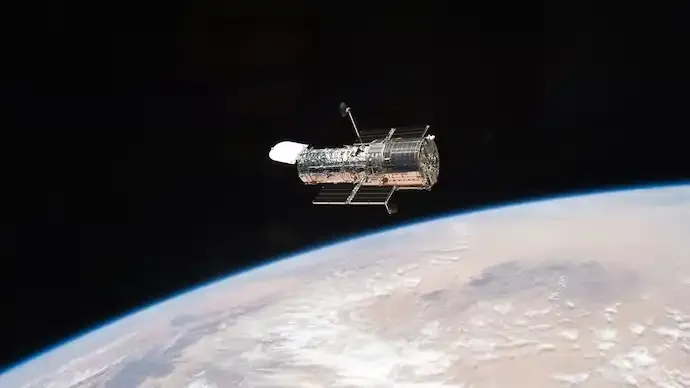
Astronomers have used artificial intelligence to analyse nearly 100 million image cutouts from NASA’s Hubble Space Telescope, leading to the discovery of more than 1,300 unusual and previously overlooked cosmic objects. The findings highlight how machine learning is reshaping astronomical research by uncovering rare phenomena buried deep within decades of observational data.
The study, published in the journal Astronomy & Astrophysics, demonstrates how AI can outperform traditional methods when handling massive datasets. In just two and a half days, the AI system identified over 800 undocumented objects from the Hubble Legacy Archive alone. Each image analysed covered a tiny section of the sky, measuring only 7 to 8 arcseconds, yet collectively they revealed an astonishing diversity of structures.
The research was led by David O’Ryan and Pablo Gómez from the European Space Agency (ESA). The team employed a neural network known as AnomalyMatch, specifically trained to recognise rare or unusual patterns in astronomical images. Unlike conventional algorithms that search for predefined objects, this system mimics aspects of human visual perception, allowing it to flag anomalies that do not neatly fit into existing categories.
What the AI Discovered
The AI identified a wide range of rare cosmic features, including:
-
Merging galaxies, with elongated streams of stars and gas pulled apart by gravitational forces
-
Gravitational lenses, where massive objects bend light into arcs, rings, and distorted shapes
-
Jellyfish galaxies, characterised by trailing gaseous tentacles formed through environmental stripping
-
Large star-forming clumps, far denser than typical stellar regions
-
Edge-on planet-forming disks, appearing like layered cosmic “hamburgers”
Several dozen objects completely defied classification, challenging current astrophysical catalogues and models.
Why AI Matters in Modern Astronomy
Manual inspection of telescope images has become increasingly impractical. Hubble alone has been collecting data since 1990, and newer missions such as ESA’s Euclid, NASA’s Nancy Grace Roman Space Telescope, and the Vera C. Rubin Observatory are expected to generate petabytes of data every year.
“Archival observations now span 35 years, creating a treasure trove where anomalies can easily hide,” O’Ryan explained. Traditional approaches, including citizen science projects, struggle to scale at this level. AI systems like AnomalyMatch provide a systematic and efficient way to triage vast datasets before human experts step in for verification.
After the AI flagged the unusual objects, astronomers manually reviewed them to confirm their authenticity, reinforcing confidence in machine-assisted discovery.
Scientific Impact
These newly identified objects could deepen understanding of:
-
Galaxy evolution and mergers
-
Dark matter distribution, inferred through gravitational lensing
-
Star formation processes
-
Environmental effects on galaxies
The findings also reaffirm Hubble’s enduring scientific value more than three decades after launch.
The Future of Space Discovery
As astronomical data continues to grow exponentially, the combination of human intuition and AI precision is expected to become the standard approach. Tools like AnomalyMatch signal a shift toward scalable discovery, ensuring that rare and unexpected phenomena are no longer lost in the noise.
In the era of big astronomy, artificial intelligence is no longer just a supporting tool—it is becoming essential to exploring the universe more deeply and efficiently than ever before.




Conversation
Be kind and stay on topic. Comments are moderated; abuse, spam and personal attacks are removed. Report a problem