
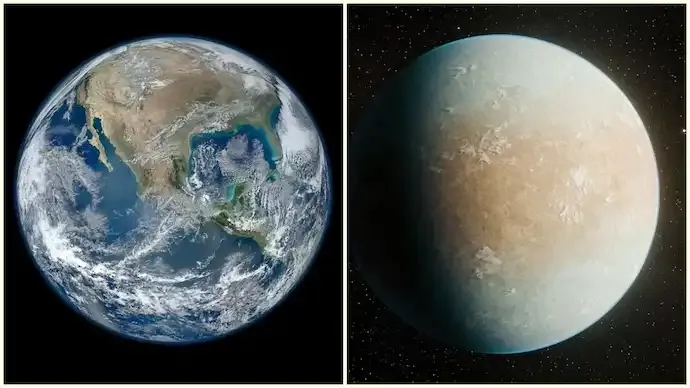
Astronomers have identified a fascinating exoplanet candidate that closely resembles Earth in both size and orbital period. Named HD 137010 b, the planet orbits a Sun-like star located about 146 light-years away, raising excitement about the possibility of finding an “Earth 2.0” beyond our Solar System.
The discovery was made by analysing archival data from NASA’s retired Kepler Space Telescope, specifically from its K2 mission. Researchers detected a single 10-hour transit, where the planet briefly passed in front of its host star, dimming its light. The findings were published in The Astrophysical Journal Letters by a team led by Alexander Venner of the Max Planck Institute for Astronomy.
What makes HD 137010 b particularly intriguing is its orbital period of roughly one Earth year, closely matching Earth’s own journey around the Sun. This places the planet near the outer edge of its star’s habitable zone, a region where liquid water could theoretically exist under suitable atmospheric conditions.
Why the Discovery Comes With a Catch
Despite its Earth-like orbit, HD 137010 b faces a major challenge: temperature.
Its host star, HD 137010, is a K-type dwarf, cooler and dimmer than our Sun. As a result, the planet receives less than one-third of the energy Earth gets, leading scientists to estimate surface temperatures around –68°C. This is even colder than Mars’ average temperature, suggesting the planet may be locked in a permanent deep freeze.
Could Life Still Be Possible?
There is a narrow window of hope. Climate models suggest that if HD 137010 b possesses a dense, carbon dioxide–rich atmosphere, it could trap enough heat to push conditions into the conservative or optimistic habitable zone. Scientists estimate:
-
Around 40% chance of falling within the conservative habitable zone
-
About 51% chance within a more optimistic scenario
Even so, there remains nearly a 50% probability that the planet lies completely outside any habitable range.
Why Confirmation Is Difficult
The planet has only been observed once, making confirmation challenging. With a year-long orbit, future transits are rare and easy to miss. While missions like NASA’s TESS or ESA’s CHEOPS could potentially detect additional transits, more advanced telescopes may be required for definitive confirmation.
Why This Discovery Still Matters
HD 137010 b highlights both the promise and difficulty of finding true Earth analogues. Earth-like planets with long orbital periods are notoriously hard to detect, and even a single confirmed transit is a major scientific achievement.
If future observations confirm its existence and atmospheric composition, HD 137010 b could significantly reshape how scientists define habitability beyond the Solar System—or serve as a reminder that Earth remains uniquely suited for life.





Conversation
Be kind and stay on topic. Comments are moderated; abuse, spam and personal attacks are removed. Report a problem