

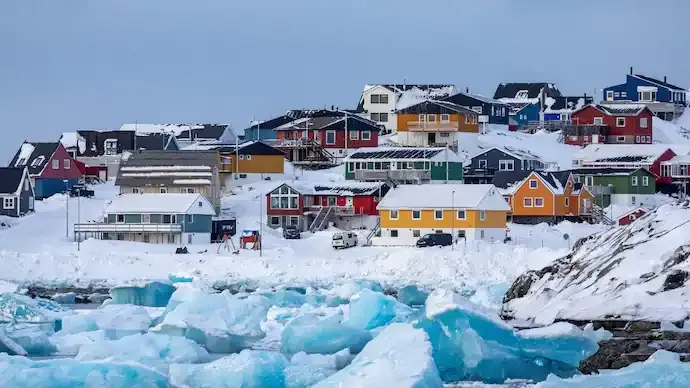

Renewed remarks from the United States about the possible acquisition of Greenland have once again sparked a global debate over whether a territory can truly be bought in the modern era—and if so, how a price tag could even be calculated. Despite Denmark’s firm stance that Greenland is not for sale, US President Donald Trump and his team have openly discussed what a hypothetical purchase might look like, reigniting a complex geopolitical and economic discussion.
Greenland is an autonomous territory within the Kingdom of Denmark, possessing its own parliament and a strong sense of national identity among its largely Inuit population. Any attempt to value it immediately runs into a fundamental problem: there is no established market or framework for buying and selling countries or self-governing territories.
Economists point out that historical precedents offer little guidance. In 1946, the United States offered Denmark $100 million for Greenland, an offer that was swiftly rejected. Adjusted for inflation, that amount would be roughly $1.6 billion today—still a figure widely regarded as meaningless in the context of the modern global economy. Earlier US purchases such as Louisiana in 1803 or Alaska in 1867 are even less relevant, as those transactions occurred under vastly different political, economic, and colonial conditions.

Another approach might be to value Greenland as if it were a company, based on income generation. However, this too proves inadequate. Greenland’s economy is small and heavily dependent on fishing, with its GDP estimated at around $3.6 billion in 2023. Moreover, Denmark currently subsidises roughly half of Greenland’s public budget, funding essential services such as healthcare, education, and infrastructure. Any buyer would effectively inherit not just assets, but long-term financial responsibilities.
Much of the international interest in Greenland centres on its vast mineral potential. Surveys indicate the presence of rare earth elements and other critical raw materials that are increasingly vital for modern technologies. Yet even here, valuation becomes speculative. The extraction of oil and natural gas is banned for environmental reasons, and mining projects face regulatory hurdles as well as opposition from local communities. These political and environmental constraints significantly complicate any attempt to assign commercial value to the island’s resources.
Crucially, mineral or energy investments do not involve the transfer of sovereignty. Greenland is home to Indigenous Inuit communities who assert cultural, historical, and land rights that cannot be monetised. Experts in Arctic geopolitics argue that once issues of identity, self-determination, and sovereignty are introduced, the idea of pricing a territory becomes fundamentally flawed.
Despite these obstacles, the US continues to describe Greenland as strategically vital, citing its location in the Arctic and existing American military presence. Senior US officials have indicated that all options remain on the table, including diplomatic pressure, as Washington seeks to counter growing Russian and Chinese influence in the region.
Analysts suggest that Trump’s rhetoric may be less about an actual purchase and more about leverage. By floating an extreme scenario, the US could be attempting to reshape negotiations over military access, economic cooperation, or Arctic security arrangements with Denmark and Greenland’s leadership.
For now, the debate underscores a deeper reality: in the 21st century, territories are no longer commodities. Even as a theoretical exercise, placing a price tag on Greenland exposes the limits of economic logic when confronted with sovereignty, identity, and geopolitics.







Conversation
Be kind and stay on topic. Comments are moderated; abuse, spam and personal attacks are removed. Report a problem