

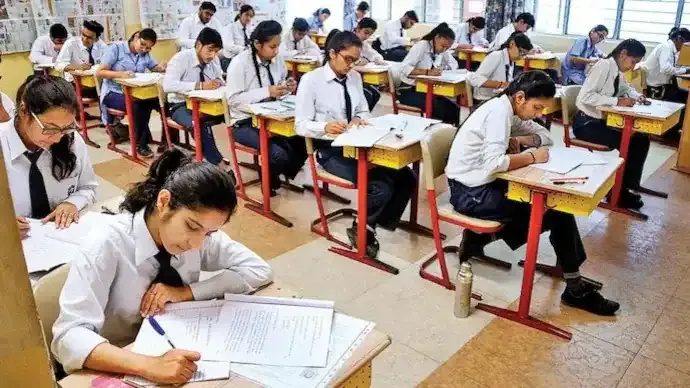

The Central Board of Secondary Education (CBSE) has announced a sweeping redesign of the Class 10 and Class 12 board exam pattern for 2026, signalling a decisive move away from memorisation-based learning toward analytical and application-driven evaluation. The updated framework, aligned with the National Education Policy (NEP) 2020, places greater emphasis on conceptual clarity, problem-solving and real-world understanding.
Starting with the 2026 examinations, 50% of every question paper will be competency-based, featuring formats such as case-based questions, real-life application questions, data-interpretation tasks, source-based items and MCQs designed to test interpretation and analytical skills.
Another 20% of the paper will consist exclusively of MCQs, while the remaining 30% will include short and long descriptive questions, ensuring a balanced assessment of comprehension, writing ability and conceptual depth.

CBSE stated that the revised model is intended to shift learning outcomes toward “understanding, analysis and application,” reinforcing long-term learning instead of rote recall.
Two Board Exams a Year for Class 10
The board has also confirmed that from 2026, Class 10 students will have the option to take two board exams in a single academic year, giving them multiple chances to improve performance without year-long pressure. This structural change, recommended under NEP 2020, is aimed at increasing flexibility and reducing exam stress.
2026 Board Exam Schedule Announced
CBSE has released the full examination timeline for 2026:
-
Exams begin: February 1, 2026
-
Class 10 first exam: Mathematics Standard and Mathematics Basic
-
Class 12 first exam: Biotechnology, Entrepreneurship, Shorthand (Hindi and English)
-
Class 10 exams end: March 10, 2026
-
Class 12 exams conclude: April 9, 2026
The board emphasised that these reforms mark one of the most significant shifts in assessment philosophy, designed to prepare students for higher education and competitive environments where analytical reasoning and problem-solving are critical.






Conversation
Be kind and stay on topic. Comments are moderated; abuse, spam and personal attacks are removed. Report a problem