

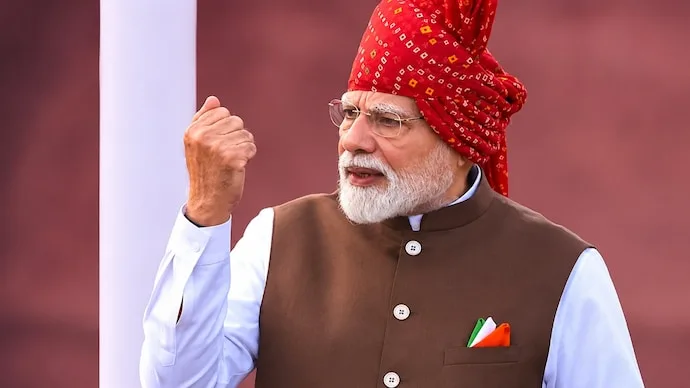

India has narrowed its power gap with China to its lowest level since 2018, while Prime Minister Narendra Modi has secured the second position in regional leadership assessments, behind Chinese President Xi Jinping, according to the Lowy Institute's 2026 Asia Power Index.
The Australian think tank released its latest assessment on November 22, highlighting India's growing regional influence despite economic challenges and a difficult year. India's overall power score increased by 0.5 points to 40.5, allowing it to retain its position as Asia's third-most powerful country, behind the United States and China.
However, China continues to maintain a substantial advantage, with its overall power assessed at around 80% higher than India's.

India Narrows Power Gap with China
In its report titled India Gains Influence, the Lowy Institute said India had consolidated its position as a major Asian power. The difference between the two countries' overall scores has narrowed to its smallest level since the index was introduced in 2018.
India's performance, however, varied across different categories. Its economic capability score declined to 26.4 points, although it retained third place in the category.
The report attributed the decline partly to a weakening rupee, changes in the International Monetary Fund's methodology for measuring economies and a nearly $20 billion reduction in India's outbound investment.
In contrast, India's future resources score improved to 56.2 points, reflecting a stronger economic outlook.
PM Modi Ranks Second in Regional Leadership
One of the key findings concerns the assessment of Narendra Modi's regional leadership.
According to the report, expert evaluations of the Prime Minister improved significantly, moving India up three places on the regional leadership indicator. Modi was ranked the second-most effective regional leader in Asia, behind Xi Jinping.
However, the institute noted that perceptions of Modi's global leadership and strategic ambition had weakened.
It linked this decline partly to India's relatively low diplomatic profile during the Middle East conflict, particularly its muted response to the sinking of an Iranian naval vessel by a US submarine. The vessel had been returning from a military exercise hosted by India.
Stability and Continuity Behind Modi's Improved Assessment
Speaking to Australia's ABC News, Lowy Institute analyst Jack Sato attributed the improvement in Modi's regional leadership assessment largely to political stability and continuity.
He noted that both Modi and External Affairs Minister S Jaishankar had established themselves in their respective roles, providing continuity in India's regional engagement.
The assessment suggests that India's consistent diplomatic presence has contributed to its improving regional leadership perception.
India's Defence Engagement in Southeast Asia Improves
The report also highlighted India's expanding defence relationships with Southeast Asian countries.
India's defence networks score increased to 18.6 points, helping the country climb two places to ninth in the category. The institute attributed the improvement partly to stronger regional defence cooperation and BrahMos missile sales to Southeast Asian countries.
Meanwhile, Pakistan moved up to 16th position in the 2026 Asia Power Index. Its diplomatic influence received a boost from its reported role in US-Iran ceasefire discussions, although the institute questioned whether this improvement could be sustained in future assessments.
Overall, the findings point to India's growing influence across Asia, even as China retains a considerable lead in overall power and regional influence.







Conversation
Be kind and stay on topic. Comments are moderated; abuse, spam and personal attacks are removed. Report a problem