

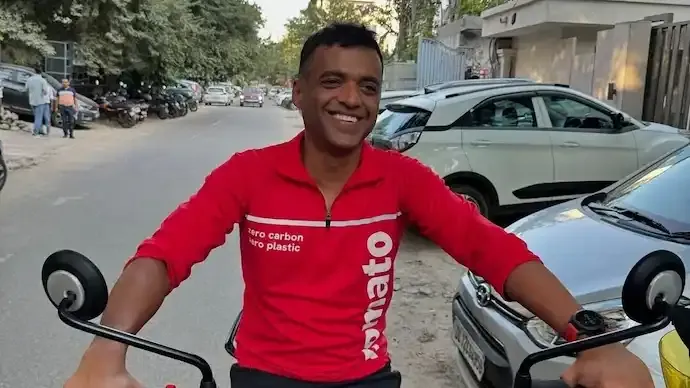

The debate around ultra-fast delivery models has resurfaced after gig worker unions raised safety concerns during strikes held on December 25 and December 31, questioning whether 10-minute delivery promises put undue pressure on delivery partners. While services on platforms such as Zomato and Blinkit continued largely uninterrupted during New Year’s Eve, the issue gained traction across social media and policy circles.
At the centre of the discussion is whether speed-centric delivery models encourage risky riding behaviour. Responding to the criticism, Zomato founder and CEO Deepinder Goyal issued a detailed clarification, arguing that the 10-minute delivery promise is driven by logistics design and infrastructure efficiency, not by forcing riders to rush.
Explaining the mechanics behind quick commerce deliveries, Goyal said that delivery speed is enabled by a dense network of nearby stores rather than high-speed riding. According to him, once an order is placed on Blinkit, picking and packing are completed in roughly 2.5 minutes. The delivery partner then travels an average distance of less than two kilometres, typically taking about eight minutes. This translates to an average riding speed of around 15 kilometres per hour, which he said does not require unsafe driving.

Goyal also addressed a common assumption that riders are under constant time pressure. He clarified that delivery partners do not see the promised delivery time shown to customers and do not have a countdown timer on their app. He added that there are no penalties imposed on riders if deliveries are delayed, as platforms recognise that real-world factors such as traffic, weather and order complexity can affect timelines.
On the question of worker safety and benefits, Goyal stated that all delivery partners on the platform are covered by medical and life insurance. This includes coverage for accidents and health-related emergencies while on duty. He said that safety mechanisms and insurance coverage are integral parts of the platform’s operations.
Addressing broader concerns around job security and career progression, Goyal acknowledged that gig delivery work is not designed as long-term employment. He pointed to an annual attrition rate of around 65%, indicating that most individuals work as delivery partners for limited periods before transitioning to other opportunities. According to him, the gig model offers flexibility rather than permanence, which appeals to many workers seeking short-term or supplemental income.
Goyal also pushed back against claims that gig workers are being systematically exploited. He argued that public perception is often shaped by incomplete information and encouraged customers and critics alike to engage directly with delivery partners to understand why many voluntarily choose platform-based work over traditional jobs.
At the same time, he admitted that no system is perfect and said the company remains open to improving working conditions and addressing legitimate concerns. His remarks come at a time when gig worker unions are demanding higher pay, expanded social security benefits and stronger safety norms across the platform economy.
Although the recent strikes had limited operational impact, the conversation around 10-minute deliveries has intensified. As ultra-fast commerce becomes more common in urban India, the balance between efficiency, worker welfare and public perception is likely to remain under scrutiny, keeping the spotlight firmly on platform accountability and gig worker safety.








Conversation
Be kind and stay on topic. Comments are moderated; abuse, spam and personal attacks are removed. Report a problem