

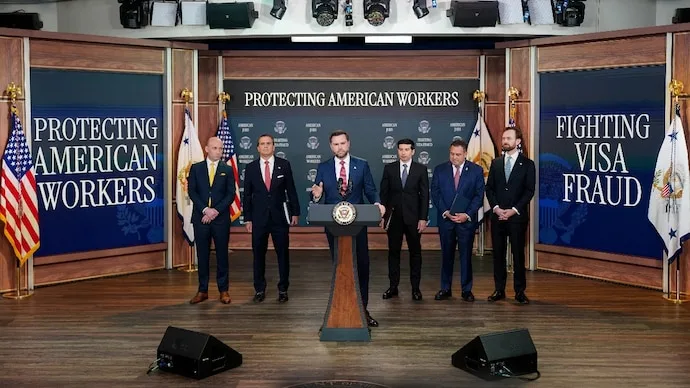

US Vice President JD Vance has intensified criticism of the H-1B visa programme, accusing major technology companies of using foreign recruitment to reduce labour costs and replace American workers. Describing some foreign employees brought in through outsourcing firms as “indentured servants”, Vance argued that the system was being exploited at the expense of US workers.
His remarks come after the Trump administration suspended Microsoft and several other technology companies from a programme connected to employment-based green cards, amid allegations of misuse.
Vance Alleges Wage Undercutting
Vance claimed that H-1B workers in the United States earn less than American citizens in comparable positions. According to his figures, H-1B employees earn around $20,000 less, while workers recruited through foreign outsourcing firms earn approximately $48,000 less than Americans in similar roles.

He alleged that some companies were laying off American employees while hiring foreign workers at lower wages.
The term “indentured servants” was used by Vance to describe what he considers restrictive employment arrangements. However, the modern H-1B visa programme is not legally equivalent to historical indentured servitude, and the allegations do not establish that every foreign worker recruited through the programme is exploited.
Microsoft Under Scrutiny
Vance singled out Microsoft, alleging that the company had made extensive use of the H-1B system while reducing its American workforce.
He cited the company’s reported layoffs of approximately 6,000 workers in 2025 and contrasted them with figures he said showed more than 6,000 H-1B visa approvals and 3,682 applications for permanent labour certification, known as PERM.
Nearly 1,000 of those applications were reportedly linked to positions matching jobs held by American workers who had been laid off, according to Vance’s account.
The allegations have renewed questions about how technology companies balance workforce reductions with recruitment from overseas. The claims should be distinguished from independently established findings of wrongdoing.
Other Technology Companies Face Action
US Labour Secretary Keith Sonderling said Microsoft was not the only company facing action. The administration also announced suspensions involving firms including Cognizant, Infosys, Tata, Wipro, HCO, Capgemini and Adobe from the programme described in the report.
The administration has also announced investigations into nine universities over allegations concerning international researchers and wages. Those inquiries are separate from the technology-company actions.
How H-1B Visas and Green Cards Work
The H-1B visa allows eligible skilled foreign workers to work temporarily in the United States. A green card, by contrast, provides permanent resident status.
For many employment-based green card applications, the process begins with PERM labour certification. Employers must demonstrate that qualified, willing and available American workers are not sufficient for the position and that hiring a foreign employee will not adversely affect the wages and working conditions of similarly employed US workers.
After certification, an employer may file an immigrant petition. Permanent residency depends on visa availability and other eligibility requirements; holding an H-1B visa does not automatically guarantee a green card.
The latest actions highlight the administration’s focus on employment-based immigration and the debate over protecting domestic workers while allowing US companies to recruit specialised international talent.






Conversation
Be kind and stay on topic. Comments are moderated; abuse, spam and personal attacks are removed. Report a problem